
Your Customers Wrote the Research. You Just Didn’t Read It.
The Internet Is Giving You Free Customer Research. Most Businesses Ignore It.
Most businesses pay to find out what their customers think.
They run surveys.
They conduct interviews.
They send NPS forms.
They organize focus groups.
They buy market research.
And then, somewhere on the internet, a customer writes:
“The product is great, but the support takes forever to respond.”
Another writes:
“Loved the experience. Wish they had more options.”
Someone else says:
“Good service, but the pricing isn't clear.”
And the business replies:
“Thank you for your valuable feedback.”
Then moves on.
That is the strange thing about modern customer research:
Customers are already doing it for you.
They're telling businesses what they love, what frustrates them, what almost made them leave, what competitors do better, and what they wish existed.
They're doing it publicly.
And most businesses are treating this intelligence as reputation management instead of market intelligence.
Your Customers Are Running the World's Largest Focus Group
A review isn't just a rating.
It's an unstructured customer interview.
The difference is that the customer isn't sitting across a table from a researcher. They're speaking in their own words, immediately after experiencing the product or service.
That makes the language unusually valuable.
A customer doesn't usually say:
“The post-purchase experience contains a response-time inefficiency.”
They say:
“Nobody replied to me for two days.”
That sentence tells a business far more than a 1–10 satisfaction score.
It tells you what happened.
And when hundreds or thousands of customers start saying similar things, those individual comments become something much more powerful:
a pattern.
The Feedback Problem Has Quietly Gotten Worse
Here's the uncomfortable part.
Businesses aren't necessarily getting more direct feedback from customers.
They're getting less.
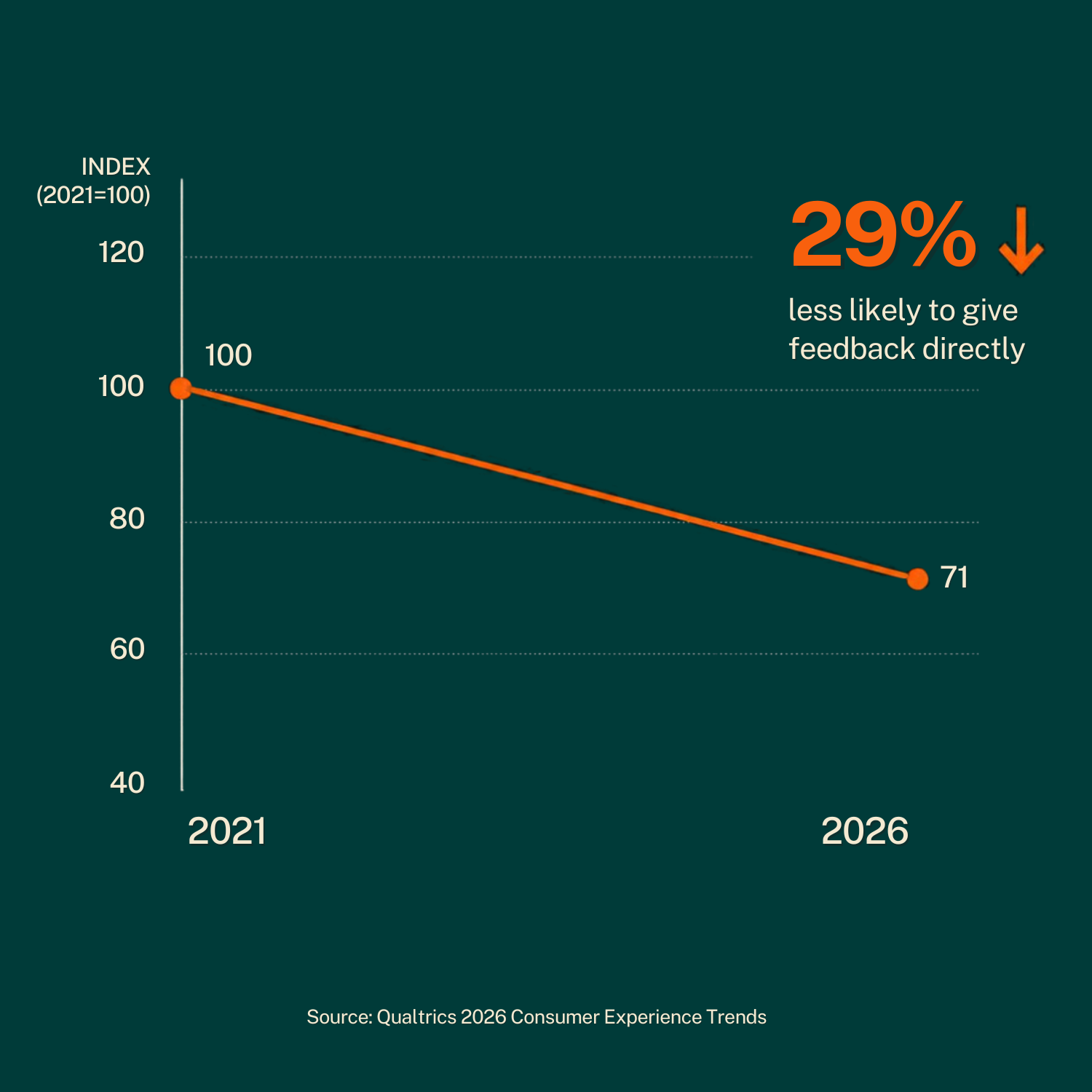
Qualtrics' 2026 Consumer Experience Trends research, based on more than 20,000 consumers across 14 countries and 18 industries, found that only around 3 in 10 customers are giving companies direct feedback.
Compared with 2021, 29% fewer consumers say they are likely to share feedback directly, while 30% say they don't tell anyone after a poor experience — they simply switch brands.
That creates a dangerous blind spot.
Because silence doesn't mean satisfaction.
Sometimes it means:
“I'm leaving.”
And you'll never know why.
This Is Why Unsolicited Feedback Matters
There is a fundamental difference between asking:
“How satisfied were you with your experience?”
and finding a customer spontaneously writing:
“The staff was helpful, but I waited 45 minutes even though I had an appointment.”
The first gives you a score.
The second gives you a problem to solve.
Qualtrics describes unsolicited feedback — including reviews, social comments, emails and other voluntary feedback — as particularly rich because customers provide it without being prompted. It can reveal issues that traditional feedback programs miss.
This is the part businesses often overlook:
The customer who complains publicly may be giving you better product research than the customer who completes your survey.
Because they're not answering your questions.
They're answering their own.
A Review Can Tell You More Than Your Rating Ever Will
Imagine a restaurant has:
4.6 ⭐ from 2,000 reviews.
Looks great.
But now imagine an AI analyzing those 2,000 reviews discovers:
183 customers mention slow service
91 mention parking difficulties
76 praise staff friendliness
64 mention portion sizes
42 complain about weekend waiting times
37 specifically mention one popular dish
complaints about service increased sharply over the last three months
The 4.6 rating hasn't changed much.
But the business has changed.
The rating is a snapshot.
The conversations are the movie.
And that's where the real intelligence lives.
The Most Valuable Insight May Be Hiding Inside a 3-Star Review
Businesses often divide reviews into:
Positive = good
Negative = bad
That's too simplistic.
A 3-star review can be incredibly valuable.
Consider:
“Food was excellent. Staff was lovely. But we waited 50 minutes for our order.”
That's not simply a negative review.
It's a diagnosis.
The customer is telling you:
Product → working.
People → working.
Operations → broken.
Another example:
“The product is great, but onboarding was confusing.”
Now you've learned something about the product.
Or:
“Love the service, but I couldn't figure out how to book online.”
That's not a marketing problem.
That's a conversion problem.
Or:
“Would have purchased, but nobody answered my WhatsApp.”
Now you're looking at lost revenue.
The words customers use can reveal problems across:
Product.
Operations.
Support.
Pricing.
Marketing.
Sales.
Experience.
Retention.
One review can touch several of them.
And Here's Where It Gets Interesting
One customer saying something is an anecdote.
Ten customers saying it is a pattern.
A hundred customers saying it is a business signal.
This is where review intelligence becomes fundamentally different from review management.
Review management asks:
“Did we respond?”
Review intelligence asks:
“What are customers repeatedly telling us?”
The first protects reputation.
The second can improve the business.
Your Customers May Be Building Your Product Roadmap for Free
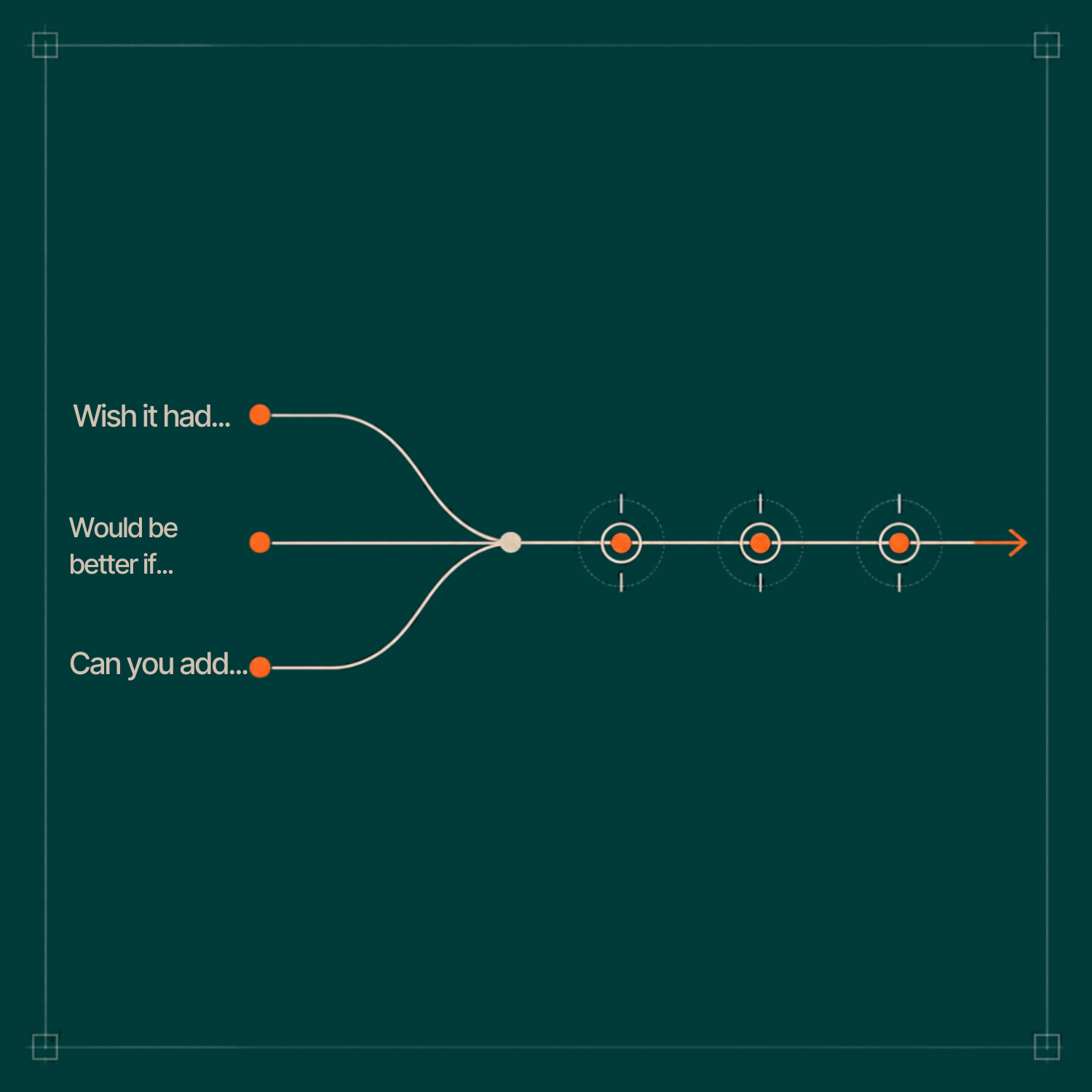
Consider a SaaS company receiving these comments over six months:
“Wish I could export this.”
“Would love WhatsApp integration.”
“The dashboard is confusing on mobile.”
“I need this report every Monday.”
“Why can't I assign this to another team member?”
Individually, they're just requests.
Collect them together and something changes.
You have a roadmap.
Not because someone inside the company brainstormed features.
Because customers repeatedly told you what they needed.
The same principle applies to physical businesses.
A salon may discover that customers repeatedly ask for:
earlier appointments
package pricing
online booking
specific services
reminders
A hotel may discover recurring complaints around:
check-in
breakfast
Wi-Fi
room maintenance
parking
A clinic may discover patterns around:
appointment availability
waiting times
communication
billing clarity
The review isn't the destination.
The pattern is.
The Internet Is Becoming a Giant, Messy Customer Database
The information already exists.
It's just scattered.
Google reviews.
Social comments.
Feedback forms.
Support conversations.
Emails.
Chat transcripts.
Marketplace reviews.
Survey responses.
For years, businesses have stored these conversations separately.
That's the problem.
A single review doesn't tell you much.
But thousands of conversations, analyzed together, can reveal:
What customers love.
What customers tolerate.
What customers repeatedly complain about.
What customers compare you against.
What makes them hesitate.
What makes them return.
What makes them leave.
That's not merely reputation data.
That's customer intelligence.
And AI Changes the Economics of Listening
Historically, analyzing thousands of customer comments required people.
Someone had to read them.
Tag them.
Categorize them.
Build spreadsheets.
Look for trends.
Create reports.
By the time the report reached management, the underlying problem might already be six months old.
AI changes that equation.
Modern language models can process large volumes of unstructured text and identify recurring themes, sentiment, topics and emerging patterns much faster than manual analysis.
That matters because customer feedback isn't valuable only when you understand it.
It's valuable when you understand it early enough to act.
A sudden increase in complaints about delivery times should not become a quarterly report.
It should become an alert.
A repeated request for a feature shouldn't disappear into individual review responses.
It should become a signal.
A cluster of complaints at one location shouldn't be buried inside the average rating of 50 locations.
It should become a management problem.
The Real Competitive Advantage Isn't Having More Feedback
It's knowing what to do with it.
Two businesses can receive 10,000 reviews.
One sees:
4.5 stars.
The other sees:
4.5 stars + declining sentiment around delivery + rising praise for staff + a recurring complaint about pricing clarity + one location consistently underperforming + a new complaint theme appearing this month.
They technically have the same reputation.
But they don't have the same intelligence.
And over time, that difference compounds.
Because the second business can act.
There Is Another Problem: Customers Don't Speak in Business Categories
Customers don't care whether a problem belongs to:
marketing
operations
product
customer success
sales
support
They simply describe what happened.
That's why traditional dashboards can miss the story.
A customer saying:
“I had to explain my issue three times before someone understood.”
could indicate:
training problem + support problem + process problem.
Another saying:
“The price was fine, but I couldn't understand what was included.”
could indicate:
pricing problem + communication problem + website problem.
The customer doesn't give you the category.
Your system has to find it.
From Reviews to Reputation Intelligence
This is the shift businesses need to make.
Don't just collect reviews.
Decode them.
Don't just monitor ratings.
Monitor patterns.
Don't just respond to complaints.
Identify the operational issue behind them.
Don't just look at what customers said yesterday.
Track how customer sentiment changes over time.
And don't treat every location, product or service as one average.
Find where the experience breaks.
Because reputation isn't created by a number.
It's created by thousands of individual experiences.
And every one of those experiences leaves a signal.
The Businesses That Listen Fastest Will Learn Fastest
The future of reputation management isn't simply about getting more five-star reviews.
It's about building a business that can continuously learn from the people experiencing it.
The smartest companies won't ask only:
“How many reviews did we get this month?”
They'll ask:
“What changed in what our customers are telling us?”
What are they suddenly mentioning?
What complaints are disappearing?
Which ones are increasing?
What do customers love that competitors don't?
What do they repeatedly wish were different?
Which locations are improving?
Which ones are falling behind?
What are customers asking for that nobody inside the company has put on a roadmap yet?
Those are much better questions.
Because the goal isn't simply to have a better reputation.
It's to build a better business using the intelligence your customers are already giving you.
The Internet Has Been Talking. Businesses Just Haven't Been Listening.
For years, companies have treated online feedback as something to manage after the customer experience.
That's backwards.
Customer feedback is one of the richest sources of information about the experience itself.
A review can tell you what happened.
A collection of reviews can tell you why it keeps happening.
And a system that can continuously identify those patterns can tell you what needs to change next.
The internet isn't just where your customers talk about your business.
It's one of the largest sources of customer research you'll ever get for free.
The question isn't whether your customers are telling you what they think.
They already are.
The question is whether your business is intelligent enough to hear the pattern.