
The Conversation Gap: Where Revenue Disappears Between Lead and Customer
The Conversation Gap: Where Revenue Disappears Between Lead and Customer
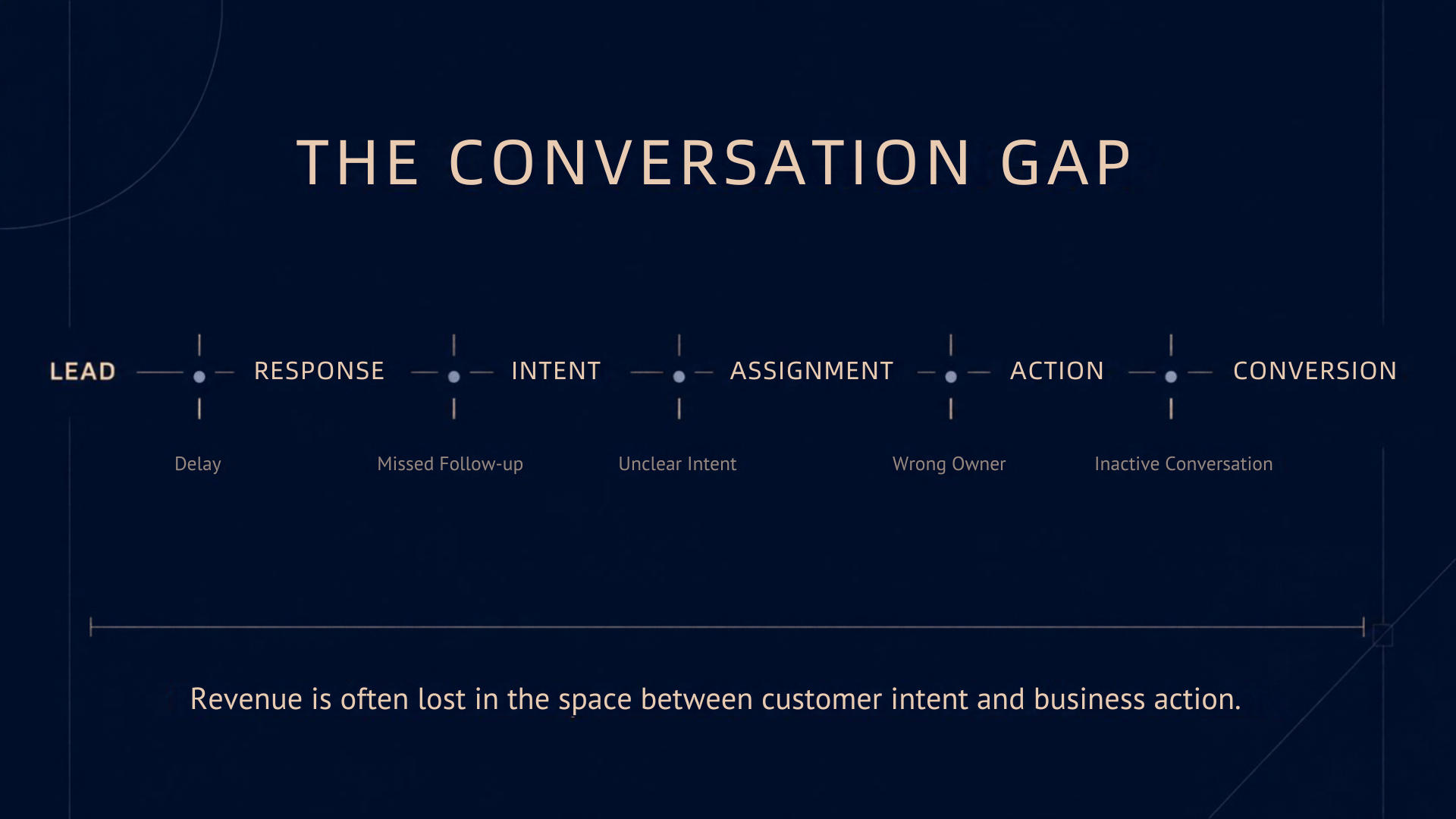
A customer sees an advertisement, clicks on it, and starts a WhatsApp conversation.
From the business's perspective, the lead has been generated.
The campaign has worked. The enquiry has arrived. The CRM has captured another contact. The sales team has one more opportunity to work with.
But from the customer's perspective, almost nothing has happened yet.
They have only opened a door.
What happens next determines whether that door leads to a purchase, another conversation, a follow-up next week, or complete silence.
This is where one of the most overlooked problems in modern customer engagement begins: the gap between customer interest and business action.
Businesses have become extremely good at generating attention. They run advertisements, collect enquiries, build landing pages, launch WhatsApp campaigns and invest in increasingly sophisticated CRM systems. But generating a conversation and progressing a conversation are two very different things.
A lead can arrive in seconds and remain untouched for hours.
A customer can ask for a demo and receive a brochure.
A prospect can show strong buying intent and still sit inside the same inbox as hundreds of routine enquiries.
A customer can say, “I'll get back to you,” and disappear—not because they rejected the product, but because nobody followed the conversation far enough to understand what happened next.
That space between interest and action is the Conversation Gap.
And as businesses move more of their customer journeys to messaging, the gap is becoming increasingly important.
The First Five Minutes Matter - But They Are Only the Beginning
Speed has always mattered in sales.
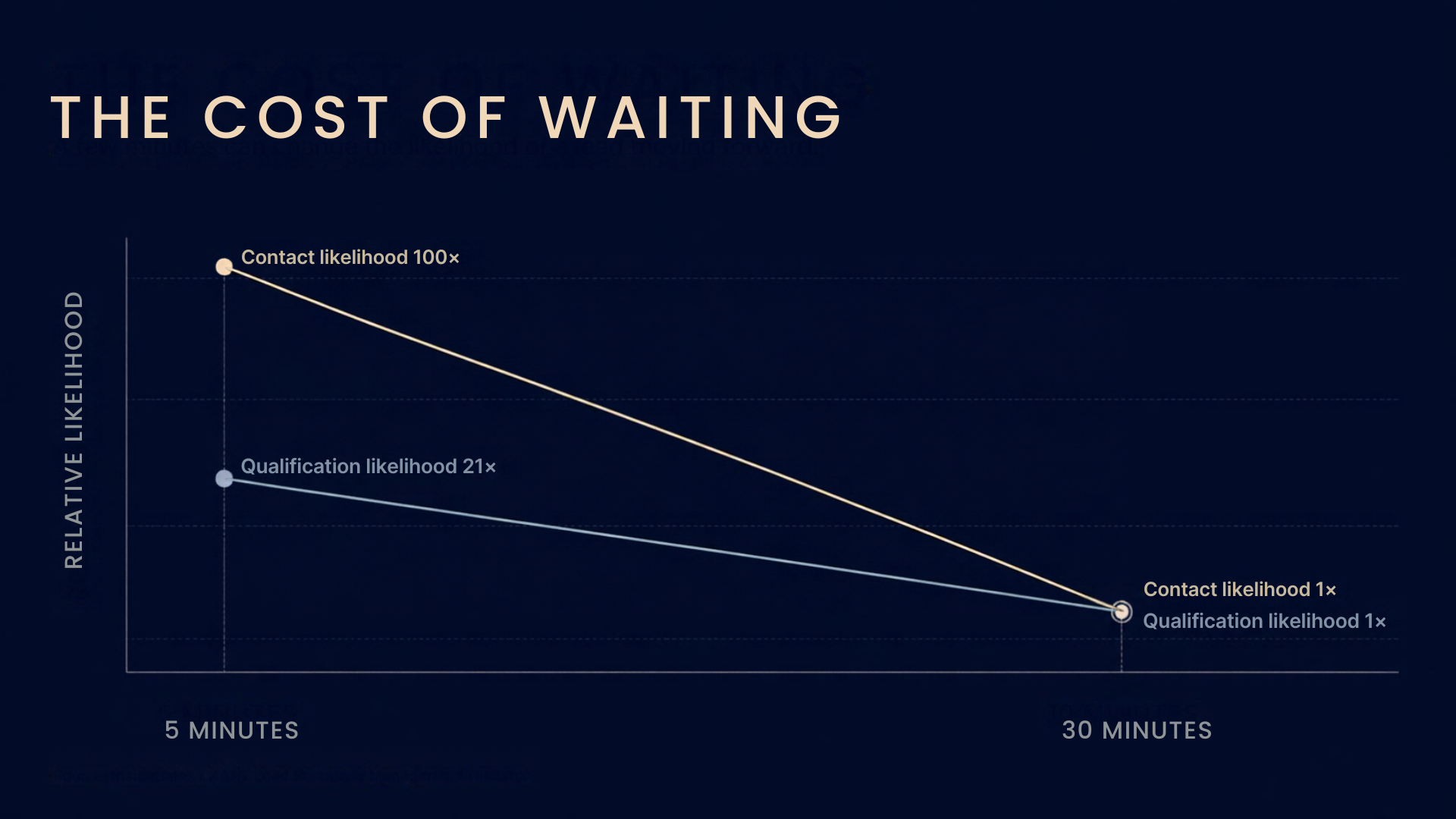
Research into lead response times has repeatedly demonstrated that the probability of making contact and qualifying a lead can fall dramatically as response time increases. The often-cited lead-response research associated with the MIT/InsideSales work found that contacting a lead within five minutes, compared with waiting 30 minutes, could make a business dramatically more likely to make contact and qualify that lead.
The lesson is obvious: when customer intent is fresh, delay is expensive.
But there is another lesson businesses often miss.
Fast response is not the same as effective engagement.
A customer who asks, “Can I see a demo tomorrow?” does not need the same response as someone asking, “What are your plans?”
A prospect saying, “We have 12 branches and need this for all of them,” is giving the business considerably more context than someone simply saying, “Hi.”
A generic automated reply may arrive within seconds and still fail to move either conversation forward.
That is why the real challenge isn't just response time.
It is response intelligence.
Businesses need to understand not only how quickly a conversation was answered, but also:
What was the customer trying to achieve?
What level of intent did they show?
What information did they already receive?
What should happen next?
Does the conversation require a salesperson?
Has the customer become inactive?
Should the conversation be recovered?
Is automation still appropriate?
The five-minute problem gets attention.
The much larger problem is everything that happens during the next five days.
The Customer Doesn't See Your Departments. They See One Business.
Inside a company, customer journeys are usually divided into functions.
Marketing generates the lead.
Sales handles the opportunity.
Support handles the problem.
Operations manages fulfilment.
Customer success handles retention.
Technology manages the systems connecting them.
That structure makes sense internally.
But customers don't experience a company that way.
They experience one continuous interaction.
This is supported by Salesforce's research into customer expectations. Its State of the Connected Customer research reports that 79% of customers expect consistent interactions across departments, while 80% say the experience a company provides is as important as its products and services.
That creates a significant operational challenge.
Imagine a customer who first speaks to marketing through an advertisement, then moves to WhatsApp, then talks to a salesperson, then needs support after purchase.
If each team sees only its own portion of the journey, the customer may have to repeat information, explain the same problem again, or wait while one department figures out what another department already knows.
From the company's perspective, these are separate interactions.
From the customer's perspective, it is one conversation with the same company.
And that difference is becoming increasingly important.
The Rise of Messaging Has Made This Problem Bigger
Messaging has changed the expectations around business communication.
A customer who contacts a business on WhatsApp isn't necessarily thinking:
“I have submitted a lead and entered a sales funnel.”
They are thinking:
“I have messaged the business.”
That sounds like a small distinction, but operationally it is enormous.
Meta reported in 2025, citing Kantar research, that 91% of online adults in India chat with businesses weekly. Meta has also positioned the WhatsApp Business Platform/API as a way for businesses handling larger volumes of customer messages to scale communication and automation.
That means messaging is no longer simply another channel sitting beside email and phone calls.
For many businesses, it is becoming one of the primary places where:
enquiries begin,
questions are answered,
products are evaluated,
demos are requested,
purchases are discussed,
support issues are raised,
and customers return.
The problem is that human attention does not scale as quickly as message volume.
A team that can comfortably manage 30 conversations can struggle with 300.
At 3,000 conversations, manually remembering who needs what becomes almost impossible.
This is where businesses don't just need messaging.
They need orchestration.
Not Every Conversation Has the Same Value
One of the biggest limitations of conventional inbox-based engagement is that it treats conversations too equally.
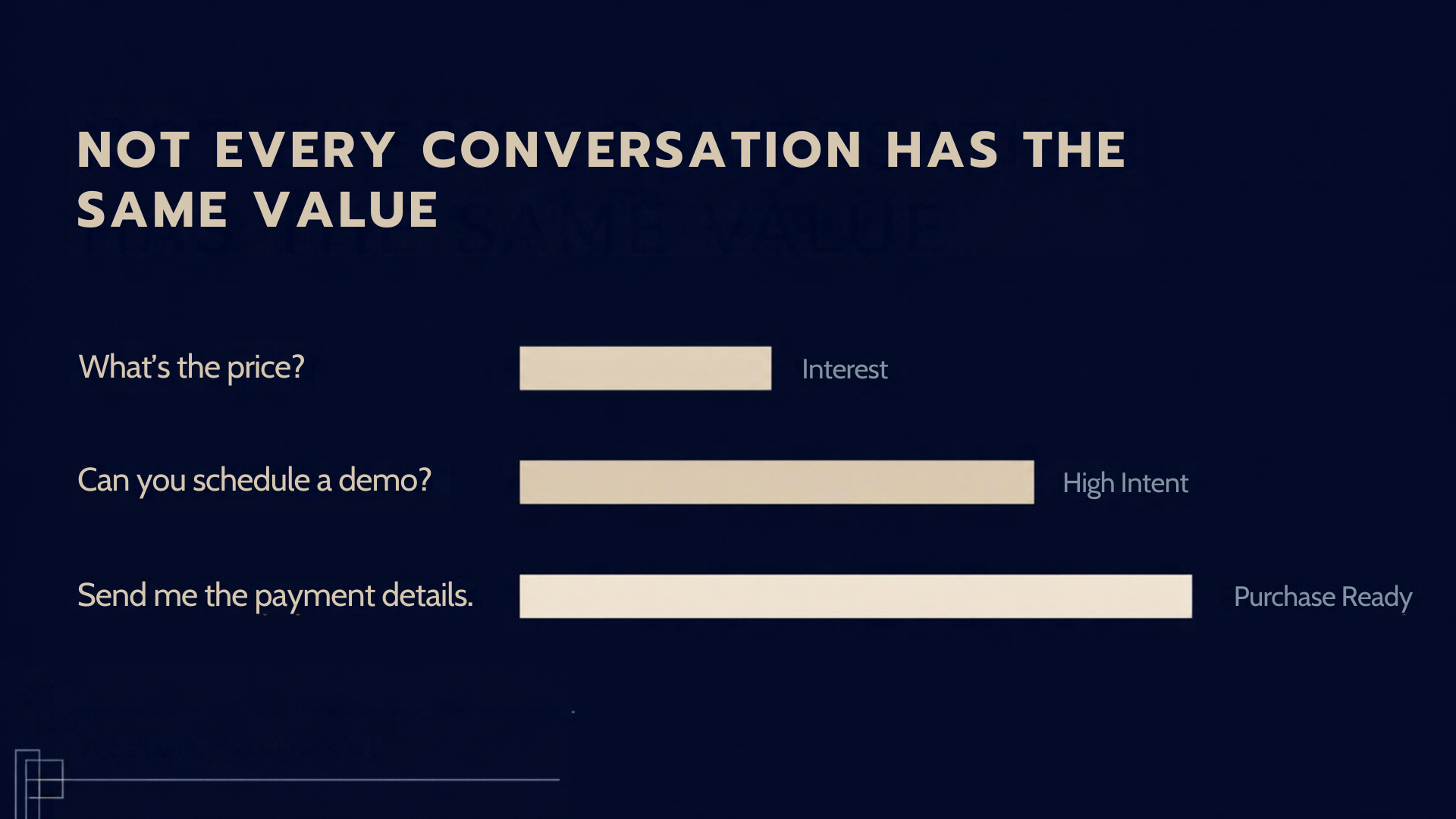
Consider these three messages:
“What's the price?”
“Can you schedule a demo for tomorrow?”
“Please send me the payment details.”
All three are incoming messages.
But they represent very different commercial situations.
The first may indicate initial interest.
The second may represent serious evaluation.
The third could indicate purchase readiness.
If all three simply appear as unread messages in the same inbox, the system is technically functioning—but commercially, it is not providing enough intelligence.
A modern engagement system needs to recognise the difference between activity and intent.
This is particularly important because customers increasingly expect businesses to understand context rather than repeatedly ask them to explain themselves.
Salesforce research has found that 81% of customers expect faster service as technology advances, while 73% expect better personalisation.
That combination is difficult to deliver manually at scale.
Customers want speed.
They also want relevance.
And those two things together require context.
A “Lost Lead” Is Often an Oversimplification
Consider a business with 5,000 leads.
At the end of the month, 600 haven't converted.
The conventional report may classify them as lost, inactive, or unconverted.
But those 600 people may represent very different situations.
Some genuinely rejected the product.
Some chose competitors.
Some were not qualified.
Some were only researching.
But others may have:
requested a quotation and never received a follow-up,
asked for a demo and gone inactive,
been interested but needed internal approval,
stopped responding temporarily,
asked a question that was never answered,
returned after several weeks,
or simply been buried under newer conversations.
Putting all of these people into one “lost” category hides useful information.
A better customer engagement system should be able to distinguish between rejection and inactivity.
Because a rejected customer needs a different strategy from a customer whose conversation simply stopped.
That distinction creates an entirely different opportunity:
Conversation recovery.
Recovery Is Not the Same as Follow-Up
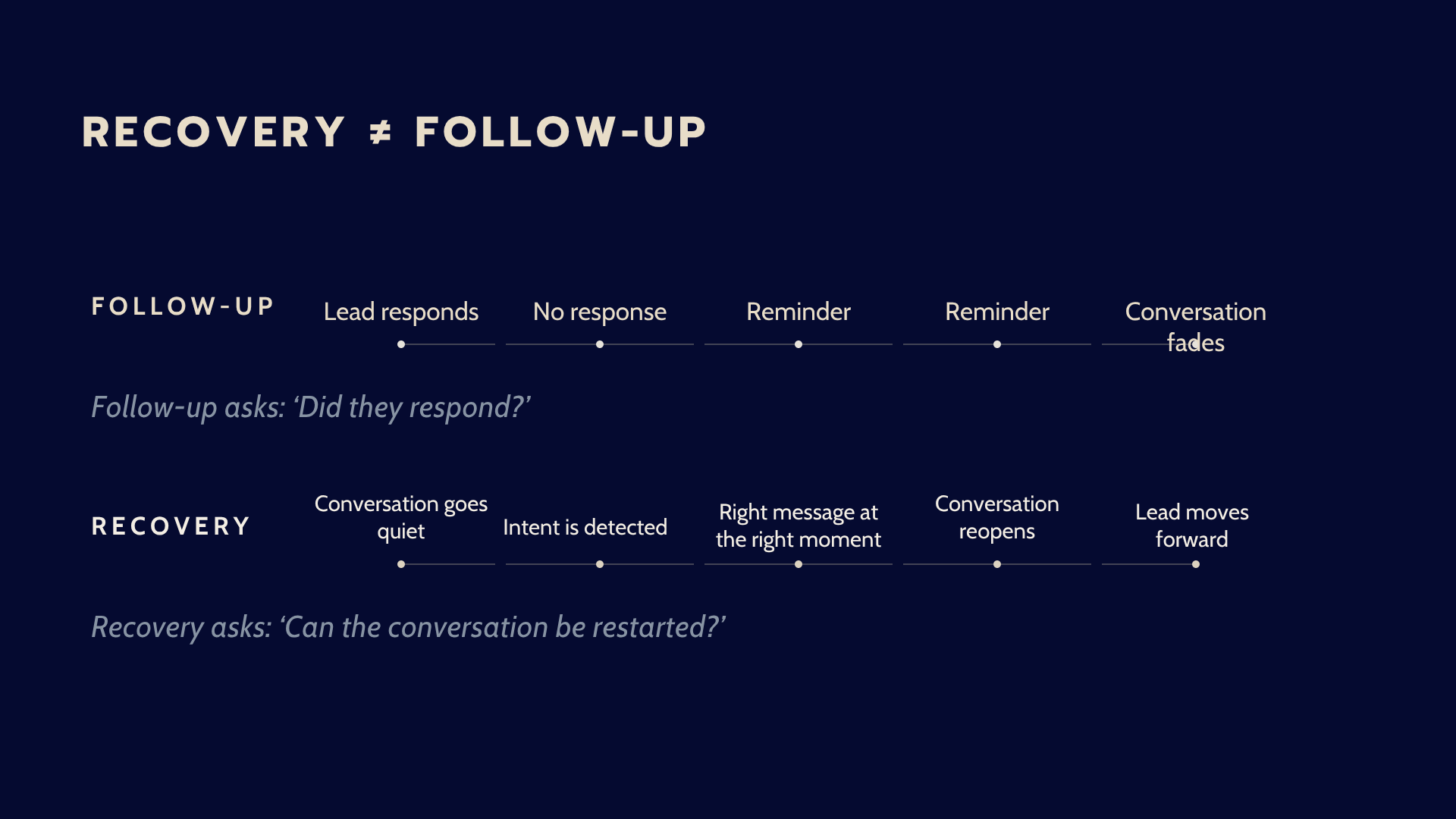
Traditional follow-up is usually calendar-driven.
“Call tomorrow.”
“Send another message in three days.”
“Follow up next week.”
But recovery can be context-driven.
If a customer asked for a demo and then disappeared, the reason for re-engagement is different from a customer who asked about pricing and never responded.
If a prospect previously showed strong intent, returned to the conversation, and asked another question, that behaviour may be more meaningful than simply counting how many days have passed.
This is where customer engagement starts moving from:
“When should we send the next message?”
to:
“Why should we send the next message?”
That is a much more sophisticated question.
The Real Funnel Isn't a Funnel Anymore
The traditional customer funnel is attractive because it is simple:
Awareness → Interest → Consideration → Conversion
But digital customer behaviour is increasingly non-linear.
A customer may discover a company through Instagram, ask a question on WhatsApp, compare competitors on Google, return to WhatsApp three days later, request pricing, disappear for a week, and then come back ready to buy.
The customer has not followed a straight line.
They have moved through moments.
And those moments carry different signals.
This is why modern engagement systems need to understand movement rather than simply stages.
The important questions become:
Where did the customer come from?
What did they ask?
What did they do next?
Did their intent increase?
Did the conversation become inactive?
Did they return?
Did someone take ownership?
What action should happen now?
The customer journey becomes less like a funnel and more like a living conversation.
The Experience Is Now Part of the Product
There was a time when companies could separate the product from the customer experience.
Today, that distinction is becoming harder to maintain.
A great product can still create frustration if purchasing it is difficult.
A strong advertisement can create disappointment if the response is slow.
A knowledgeable sales team can appear inefficient if customers have to repeat information.
A good support team can still disappoint if customers cannot reach them when needed.
Salesforce's research reports that 88% of customers say good customer service makes them more likely to purchase again. Its research also found that 48% of customers have switched brands to gain better service.
These numbers are important because they change the way customer engagement should be viewed.
Support isn't merely what happens after revenue has been generated.
Service, responsiveness and continuity can influence whether revenue happens again.
That means the conversation doesn't end when the customer buys.
In many cases, the conversation after the purchase determines the next purchase.
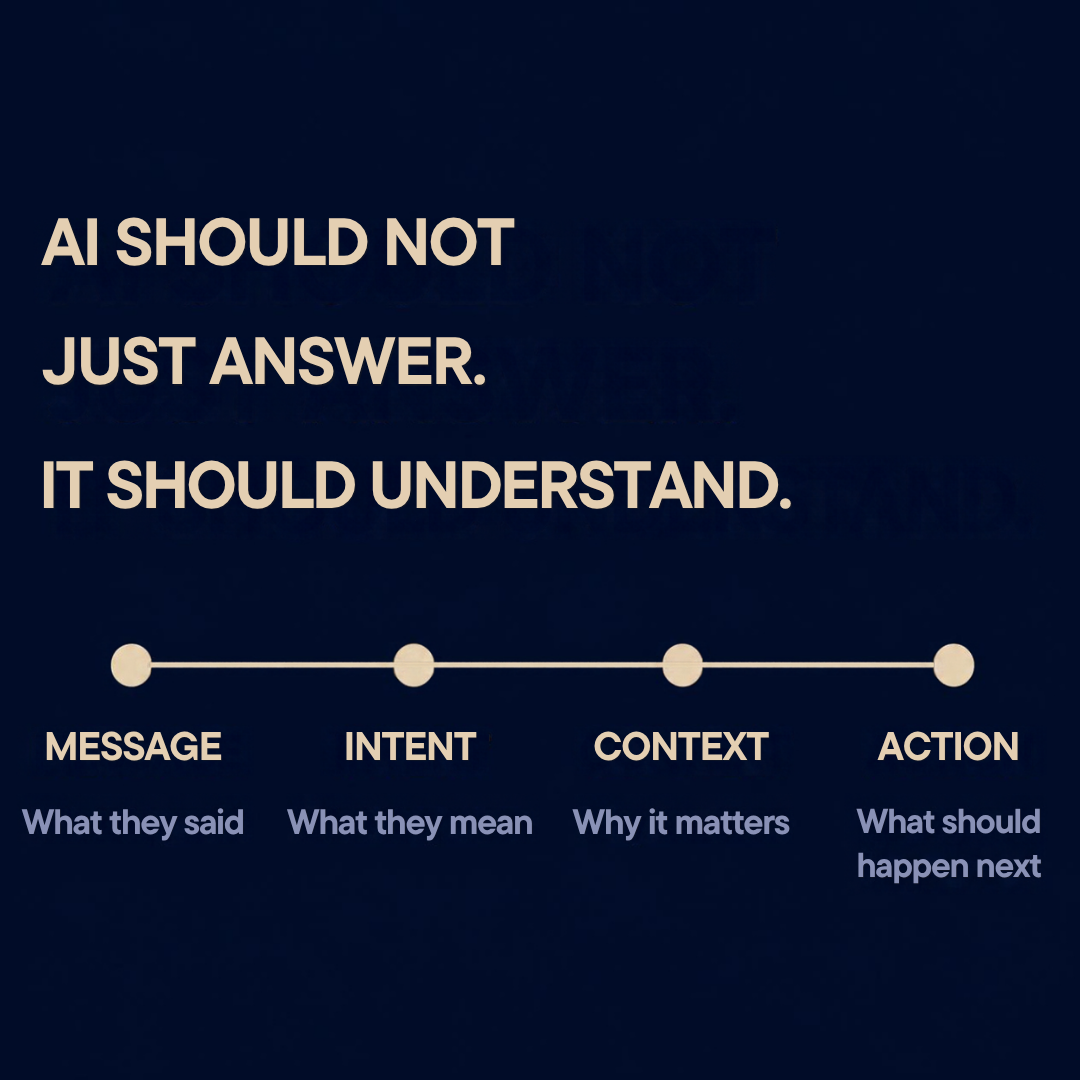
AI Should Not Just Answer. It Should Understand.
This is where the conversation around AI needs to mature.
The first generation of business AI focused heavily on answering questions.
“What are your working hours?”
“What is the price?”
“Where are you located?”
“Send me the brochure.”
Useful, certainly.
But increasingly, the bigger opportunity lies beyond the answer.
An intelligent engagement system should help determine:
What is this customer trying to accomplish?
How serious is their intent?
What information do they already have?
What should happen next?
Should automation continue?
Should the conversation be assigned to a human?
Should the customer be recovered later?
Has something changed in their behaviour?
This is a fundamental shift.
The goal is no longer to build AI that can simply talk.
The goal is to build systems that can understand where the conversation is going.
The Best Automation May Be the Automation You Don't Notice
Customers don't necessarily want to know how much automation a business uses.
They care about whether the experience feels easy.
Good automation can work quietly in the background:
identifying intent,
answering repetitive questions,
collecting relevant information,
routing conversations,
triggering appropriate follow-ups,
recovering inactive conversations,
and handing complex cases to people.
The customer simply experiences continuity.
This is particularly important because automation should not become an excuse to remove human judgment.
Some conversations should remain human.
Negotiation.
Complex objections.
Sensitive complaints.
High-value opportunities.
Unusual requirements.
Strategic decisions.
The goal isn't to automate every interaction.
The goal is to reserve human attention for the interactions where human attention creates the most value.
The New Sales Metric: Conversation Velocity
Businesses already track response time.
They track conversion rates.
They track lead volume.
They track acquisition costs.
But there is another metric worth thinking about:
Conversation Velocity.
How quickly does a meaningful customer conversation move from one useful stage to the next?
For example:
Interest → Question → Intent → Assignment → Demo → Decision
A high-velocity conversation keeps progressing.
A low-velocity conversation gets stuck.
And the reasons for that friction can be identified:
delayed response,
unclear ownership,
missing information,
poor qualification,
no follow-up,
low personalisation,
unresolved objections,
or lack of recovery.
This creates a much more useful operational question than simply:
“How many leads did we generate?”
The better question becomes:
“How many valuable conversations did we move forward?”
What a Modern Engagement System Should Actually Do
A modern customer engagement layer should connect the moments between acquisition and retention.
At minimum, it should help businesses:
1. Capture
Bring conversations from relevant channels into a structured environment.
2. Understand
Identify what customers are asking and what their behaviour indicates.
3. Qualify
Separate routine enquiries from meaningful opportunities.
4. Assign
Get the right conversation to the right person.
5. Engage
Provide timely, context-aware responses.
6. Recover
Identify conversations that have gone inactive but may still have potential.
7. Escalate
Recognise when automation should hand over to a human.
8. Support
Continue the relationship after conversion rather than treating the sale as the finish line.
9. Retain
Use the accumulated context to create better future interactions.
This is no longer simply a WhatsApp automation workflow.
It is an engagement infrastructure.
This Is Where Nextel Fits
Nextel is built around a simple idea: customer conversations should move, not merely exist.
The platform brings together the different actions that can determine whether a conversation progresses—AI-powered responses, intent understanding, lead qualification, assignment, follow-ups, recovery, support and human handoff.
The philosophy is straightforward.
A business should not have to manually inspect hundreds of conversations to discover which ones matter.
It should not have to treat every enquiry equally.
And it should not have to consider a customer “lost” simply because the conversation went quiet.
Instead, the system should help teams understand:
Who needs attention?
Why do they need it?
What happened previously?
What is the likely intent?
What should happen next?
That is the difference between managing an inbox and managing customer movement.
The Bigger Shift: From Lead Management to Conversation Management
For years, businesses have built systems around leads.
Capture the lead.
Store the lead.
Assign the lead.
Contact the lead.
Convert the lead.
But the customer does not experience themselves as a lead.
They experience themselves as a person having a conversation with a business.
That means the next evolution of customer engagement may not be about better lead management alone.
It may be about conversation management.
Lead management asks:
“Where is this lead?”
Conversation management asks:
“What is happening right now?”
Lead management asks:
“Was the lead contacted?”
Conversation management asks:
“Did the conversation progress?”
Lead management asks:
“Is the lead lost?”
Conversation management asks:
“Is there still a reason to continue?”
That difference sounds philosophical.
Operationally, it is enormous.
The Revenue Hidden Between Two Messages
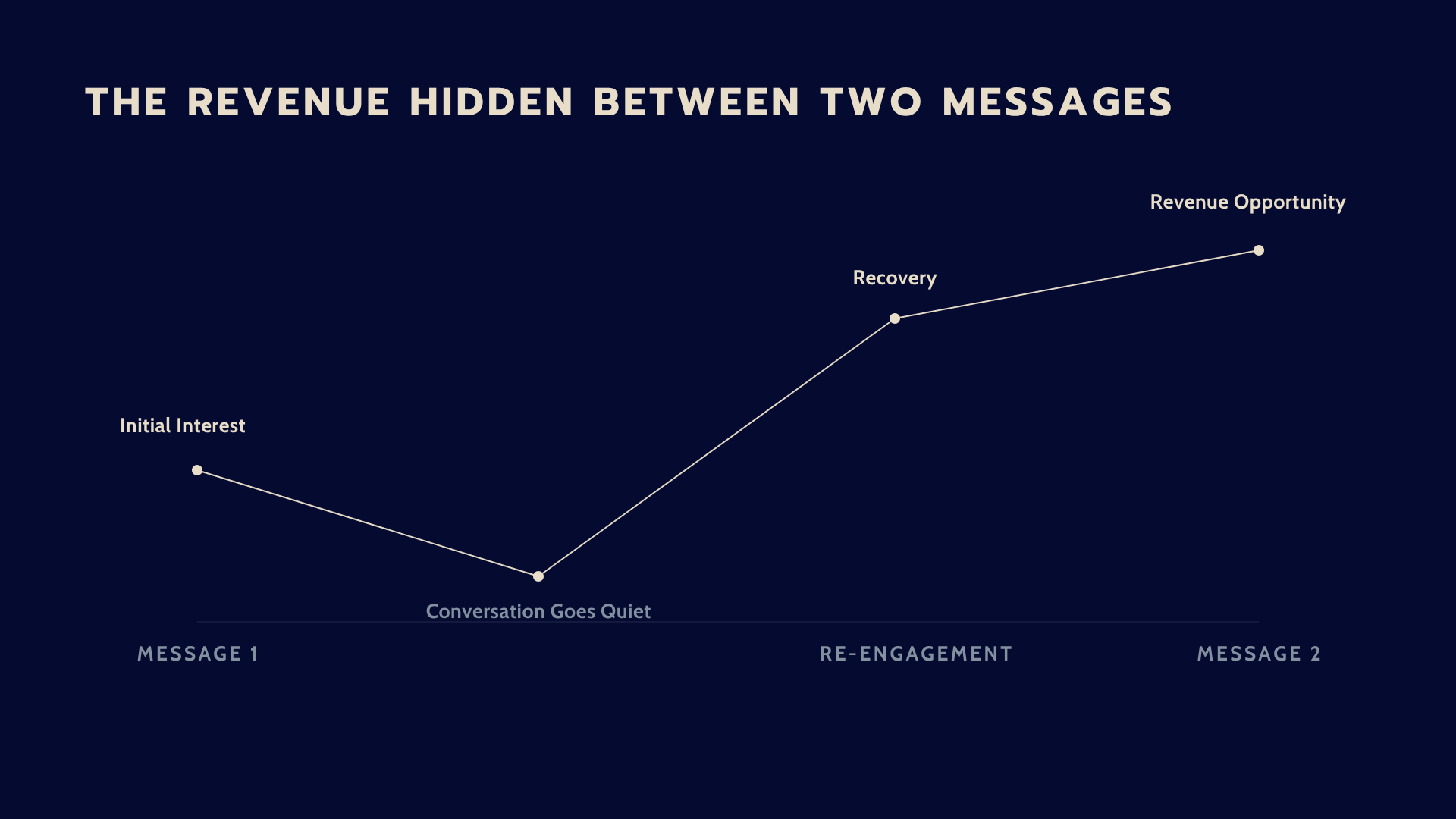
Imagine a business generating 1,000 conversations every month.
If even a small percentage of those conversations contain meaningful opportunities that never receive the right next step, the business isn't necessarily facing a marketing problem.
It may already have enough demand.
It may have a movement problem.
A missed follow-up here.
A delayed response there.
A high-intent lead assigned too late.
A customer waiting for a demo.
A conversation that becomes inactive.
A returning prospect nobody recognises.
Individually, each incident looks insignificant.
Across hundreds or thousands of conversations, they become a system.
And systems produce numbers.
That is why the Conversation Gap deserves to be treated as a business metric rather than merely a sales inconvenience.
The Future of Customer Engagement Is Not More Messages
Businesses don't need to become louder.
They need to become more aware.
More aware of intent.
More aware of context.
More aware of inactivity.
More aware of timing.
More aware of ownership.
More aware of when AI should act.
And more aware of when a human should step in.
The winners in the next phase of customer engagement may not be the companies sending the most messages.
They may be the companies that allow the fewest valuable conversations to disappear.
Because customers rarely disappear in one dramatic moment.
More often, the relationship weakens through a series of small operational gaps:
A delayed reply.
A missed follow-up.
An unanswered question.
An unclear handoff.
A forgotten conversation.
An unrecognised buying signal.
A customer who had to repeat themselves.
A salesperson who never knew the customer was ready.
Each gap looks small.
Together, they can become expensive.
Closing the Conversation Gap
The future of customer engagement will not be defined simply by better chatbots, bigger CRMs or more sophisticated campaigns.
It will be defined by how intelligently businesses connect the moments between those systems.
From the first advertisement to the first message.
From the first message to intent.
From intent to assignment.
From assignment to conversion.
From conversion to support.
From inactivity to recovery.
From support to retention.
That is where customer relationships actually move.
And perhaps that is the shift businesses need to make:
Stop measuring only how many conversations they create.
Start measuring how many meaningful conversations they move forward.
Because the conversation was never the problem.
The gap was.
And closing that gap is no longer just an operational improvement.
It is a growth strategy.
Nextel
Not where leads wait.
Where leads move.