
The Customer Journey Is Not a Funnel Anymore. It’s a Conversation.
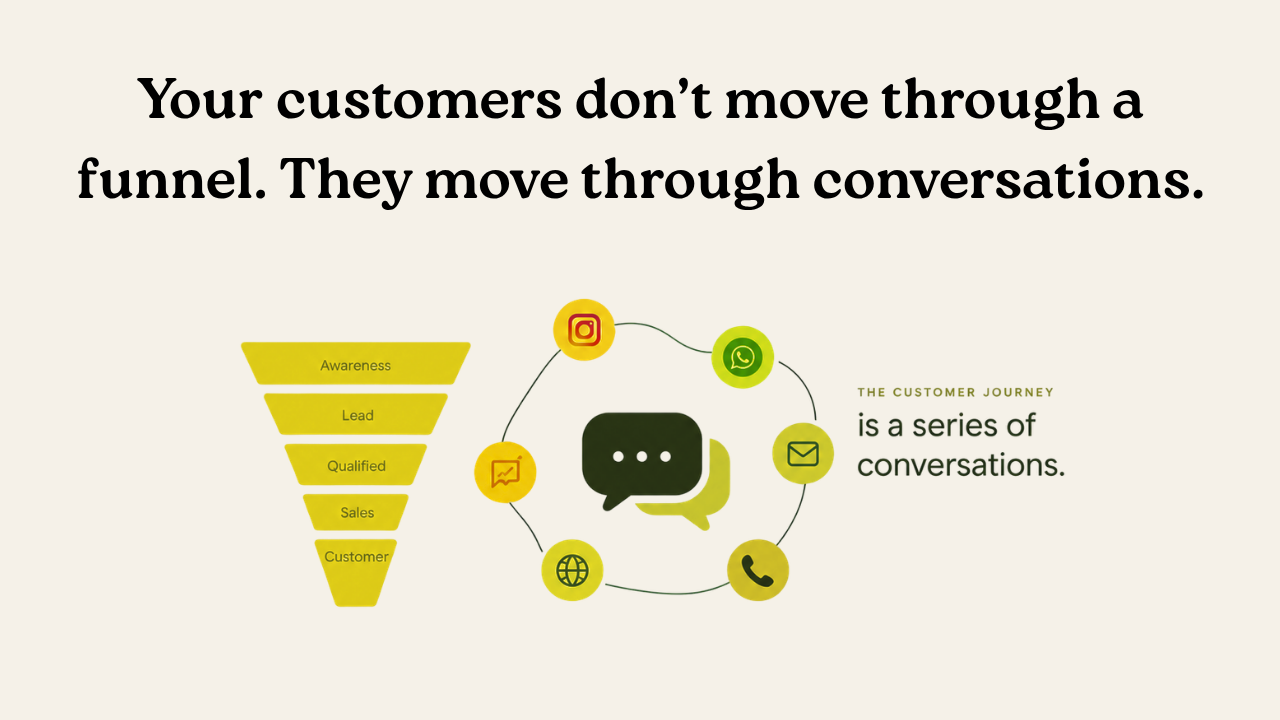
For years, businesses have been taught to think about customers as a funnel.
Someone sees an advertisement. They become a lead. The lead is qualified. Sales follows up. The customer converts. Support takes over. Marketing tries to bring them back.
It is a neat model.
It is also increasingly disconnected from how customers actually behave.
A customer does not experience your business as a funnel.
They experience it as a series of conversations.
They discover you on Instagram. They click an ad. They open WhatsApp. They ask a question. They disappear for two days. They return with another question. They compare you with someone else. They ask for a price. They need approval from someone internally. They come back a week later. They buy. They need support. They eventually want something else.
There is no clean line from awareness to conversion.
There is movement, hesitation, interruption, intent, interaction and return.
And somewhere inside all of that is the most valuable asset a business has:
the conversation with the customer.
The Problem Was Never Just Getting More Leads
Businesses spend enormous amounts of money trying to generate demand.
Meta Ads. Google Ads. Content. Influencers. Landing pages. Lead forms. Campaigns. Partnerships.
And then the lead arrives.
This is where something interesting happens.
The entire organisation suddenly starts treating the person as a number.
New lead.
Hot lead.
Unqualified lead.
Follow-up pending.
Converted.
Lost.
But the customer doesn't think of themselves that way.
They are simply trying to get something done.
Maybe they want to know whether a product is right for them. Maybe they want a quotation. Maybe they want to understand pricing. Maybe they want to book an appointment. Maybe they are comparing options. Maybe they are interested but not ready yet.
The business sees a lead.
The customer sees a conversation.
That difference matters.
Because when you optimise only for lead generation, you can end up measuring how many people entered the funnel without understanding what happened to them once they arrived.
A hundred new leads sound impressive.
But what happened inside those hundred conversations?
How many were answered immediately?
How many received the information they needed?
How many showed buying intent?
How many asked for a demo?
How many stopped responding?
How many needed human assistance?
How many could have converted with one more relevant interaction?
And how many simply disappeared because the business stopped engaging?
The number of leads tells you what entered the system. The conversation tells you what happened next.
Customers Don't Move Through Departments. They Move Through Moments.
Inside a business, the customer journey is usually divided into departments.
Marketing generates demand.
Sales handles prospects.
Support handles customers.
Operations handles fulfilment.
Retention handles existing customers.
Each team has its own tools, processes, dashboards and objectives.
But the customer doesn't care where one department ends and another begins.
They simply message the business.
Consider a customer who sees an advertisement for a service and sends a WhatsApp message asking for more information.
At that moment, it is a marketing-generated conversation.
Then they ask about pricing.
It becomes a sales conversation.
They ask how the service works.
It becomes an educational conversation.
They book a demo.
It becomes a conversion conversation.
After purchasing, they have a question.
Now it is a support conversation.
A few months later, they enquire about another service.
The cycle begins again.
Was that five different customers?
Of course not.
It was one customer having different kinds of conversations with the same business.
Yet most business systems treat those interactions as separate events.
That fragmentation is one of the biggest reasons customer experience becomes inconsistent.
What If Engagement Was the Layer Connecting All of It?
This is where the idea of an engagement engine becomes interesting.
Engagement should not simply mean sending messages.
It should mean understanding where the customer is, recognising what they need and helping them move forward.
That could mean answering a question.
It could mean qualifying an enquiry.
It could mean recommending the next step.
It could mean booking a demo.
It could mean handing the conversation to a human.
It could mean following up after silence.
It could mean recovering an abandoned conversation.
It could mean helping an existing customer.
Or it could simply mean staying relevant after the transaction is over.
The common thread is not the function.
The common thread is the customer.
That is the philosophy behind Nextel.
Nextel Is Not Just Another Tool Sitting Beside Your Sales and Support Stack
Nextel is designed as an engagement layer that sits across the customer journey.
Instead of asking businesses to think about separate systems for every interaction, it brings different engagement capabilities into one connected environment.
A conversation can begin with a lead generated through advertising.
The customer can then be engaged through WhatsApp.
AI can help understand what they are asking.
A predefined chatflow can guide them toward the relevant action.
A sales team member can take over when human intervention is needed.
If the conversation becomes inactive, recovery workflows can bring it back into focus.
After conversion, the same engagement layer can continue supporting the customer.
And when the business wants to proactively communicate with its audience, broadcasts can extend that relationship beyond individual conversations.
This is important because engagement does not stop when a lead converts.
In many cases, that is when the more valuable relationship begins.
One Conversation Can Carry More Business Value Than a Lead Form Ever Will
A lead form can tell you that someone is interested.
A conversation can tell you why.
That difference is enormous.
Imagine two customers submitting the exact same form.
Customer A says:
“Can I get the price?”
Customer B says:
“I have three branches and I'm looking for a system that my support team can use across all of them. Can I see a demo?”
On a spreadsheet, both might appear as leads.
Inside a conversation, they are completely different opportunities.
One needs pricing information.
The other has already revealed use case, scale, intent and a potential next action.
This is why conversational engagement can be so much more powerful than simply collecting contact information.
The conversation contains context.
And context is what allows businesses to respond intelligently.
AI Shouldn't Replace the Conversation. It Should Make the Conversation Better.
There is a tendency to describe AI in customer engagement as if the objective is simply to replace human agents.
That misses the bigger opportunity.
The real value of AI is not that it can talk.
The real value is that it can help businesses understand and manage conversations at scale.
Thousands of customers can ask thousands of questions.
Some will be repetitive.
Some will require context.
Some will indicate strong purchase intent.
Some will be support requests.
Some will be completely unrelated.
A human team cannot manually interpret every interaction with the same speed.
AI can help handle the volume, identify intent, answer routine questions and guide customers through relevant journeys.
And when the conversation reaches a point where human judgement is valuable, the human can step in.
That creates a much more practical model:
AI for scale. Humans for judgement.
The objective isn't to remove people from customer engagement.
It is to make sure people spend their time where they add the most value.
Sales Doesn't Begin When a Salesperson Calls
One of the biggest misconceptions about sales is that the sales process begins when a salesperson starts speaking to a prospect.
In reality, it may have started much earlier.
It starts when someone sees an advertisement.
It continues when they click.
It develops when they ask their first question.
It becomes clearer when they reveal their requirements.
By the time a salesperson enters the conversation, the customer may already have provided valuable information about their intent.
An engagement engine can help capture that context.
That means sales teams don't necessarily have to begin every interaction from zero.
They can enter a conversation that already has history.
The customer has already explained something.
The system has already captured something.
The next step can therefore be more relevant.
Good sales is not about saying more. It is about understanding more.
And Not Every Conversation Needs a Salesperson
This is equally important.
If every customer interaction immediately becomes a sales task, businesses create unnecessary pressure on their teams and unnecessary friction for customers.
Someone asking a simple question may not want a sales call.
Someone looking for an appointment may not need a human at all.
Someone asking about a product feature may simply need an answer.
Automation can take care of these moments.
The sales team can then focus on conversations where human involvement can genuinely influence the outcome.
This is where intelligent engagement creates operational value, not just communication value.
It helps businesses decide where humans are needed — instead of making humans responsible for everything.
Support Shouldn't Be the Department That Receives the Customer After Everyone Else Is Done
Support is often treated as something that begins after a transaction.
But customers ask questions throughout the journey.
They ask before buying.
They ask while deciding.
They ask while onboarding.
They ask after purchasing.
They ask months later.
That means support and sales are not always opposite functions.
Sometimes the difference is simply the customer's intent at that particular moment.
A question about a product can become a buying conversation.
A question after purchase can become a retention opportunity.
A frustrated customer can become a relationship that needs immediate human attention.
The important thing is recognising the context.
With a connected engagement layer, customer conversations don't have to become isolated tickets that disappear into another system.
The business can maintain continuity.
The Most Undervalued Part of Customer Engagement Is Recovery
There is a strange thing businesses do.
They spend money to acquire a customer.
They get the customer to start a conversation.
Then the customer stops responding.
And the business often treats the opportunity as finished.
But silence is not always rejection.
People get busy.
Priorities change.
Budgets get delayed.
Approvals take time.
Customers forget.
Sometimes they simply need more information.
This is why recovery deserves to be treated as its own part of engagement.
A recovery system can identify conversations that have gone inactive and create appropriate opportunities to reconnect.
The objective is not to endlessly chase people.
It is to recognise that an unfinished conversation is not necessarily a lost relationship.
That distinction can change how businesses think about follow-ups.
The Real Opportunity Is Not Automation. It Is Continuity.
Automation is useful.
But automation by itself is not the breakthrough.
Businesses have been automating individual tasks for years.
Send this message.
Create this lead.
Update this field.
Trigger this notification.
Send this reminder.
The bigger opportunity is connecting those actions around the customer.
Imagine a journey where:
A lead enters through an advertisement.
The customer is immediately engaged.
AI understands the initial intent.
A relevant chatflow guides the conversation.
A qualified opportunity reaches the sales team.
A demo or appointment is scheduled.
Unanswered conversations are followed up appropriately.
Abandoned conversations enter recovery.
Customers receive support after conversion.
Existing customers can be re-engaged through broadcasts.
Human teams can intervene whenever the conversation requires them.
None of these are isolated features.
They are different moments in one customer relationship.
That is continuity.
From Lead Generation to Customer Retention — The Same Conversation Keeps Moving
This changes the way a business can think about its technology stack.
Instead of asking:
“Which tool handles leads?”
you can ask:
“Which system helps us engage the person who became a lead?”
Instead of:
“Which tool handles support?”
ask:
“Which system can continue the customer relationship after conversion?”
Instead of:
“Which tool sends broadcasts?”
ask:
“How do we keep existing customers meaningfully engaged?”
Instead of:
“Which tool recovers abandoned chats?”
ask:
“How do we make sure valuable conversations don't simply disappear?”
The questions become bigger because the problem is bigger.
This Is What an Engagement Engine Should Actually Do
A modern engagement engine should be capable of participating across the entire customer lifecycle.
Attract
Turn incoming interest into conversations rather than letting leads sit untouched.
Understand
Use conversation context and AI-powered intent detection to understand what customers are trying to achieve.
Engage
Respond quickly and guide customers through relevant conversations and journeys.
Convert
Move high-intent conversations toward demos, appointments, enquiries, bookings or purchases.
Support
Handle routine customer questions while allowing human teams to step in when required.
Recover
Identify conversations that went inactive and create opportunities to reconnect.
Retain
Continue communicating with customers after the transaction through relevant updates, campaigns and ongoing engagement.
The individual capabilities matter.
But their real value comes from being connected.
The Future of Customer Engagement May Not Be Another Channel
Businesses already have enough channels.
WhatsApp.
Instagram.
Email.
Websites.
Calls.
CRM.
Ads.
The problem is rarely that customers don't have enough ways to contact a business.
The problem is that the business struggles to maintain continuity across those interactions.
A customer doesn't want to understand your technology stack.
They don't care which department owns the conversation.
They don't care whether the message came from marketing automation or a support workflow.
They care about one thing:
Did the business understand me, and did it help me move forward?
That is the standard customer engagement should be built around.
The Business of the Future Will Not Just Manage Customers. It Will Manage Conversations.
The most valuable customer data isn't always a field in a CRM.
Sometimes it is a sentence.
A question.
A hesitation.
A request.
A complaint.
A buying signal.
A reason for not converting.
A reason for returning.
These signals live inside conversations.
The businesses that can understand those signals, respond to them and maintain continuity around them will have a fundamentally different relationship with their customers.
And that is the space Nextel is built for.
Not merely generating leads.
Not merely sending messages.
Not merely answering support queries.
Not merely automating follow-ups.
But creating an intelligent engagement layer that can participate across the journey — from the first interaction to conversion, from support to recovery, and from one transaction to the next.
Because the Customer Journey Was Never a Funnel.
We simply drew it that way because funnels are easier to measure.
Real customers don't move downward in a straight line.
They move sideways.
They pause.
They return.
They change their minds.
They ask questions.
They need help.
They disappear.
They come back.
And every one of those moments creates another opportunity for a business to engage intelligently.
So perhaps the next evolution of customer engagement isn't about finding another way to acquire customers.
Perhaps it is about becoming better at staying with them.
From the first “Hi” to the next “I need help.”
From “Tell me more” to “Let's do it.”
From “Not right now” to “I'm back.”
Nextel is built to keep that conversation moving.
One engagement engine.
Every customer conversation.
Every stage of the journey.