
Why AI Pilots Fail to Scale: The Missing Link Between Experimentation and Execution
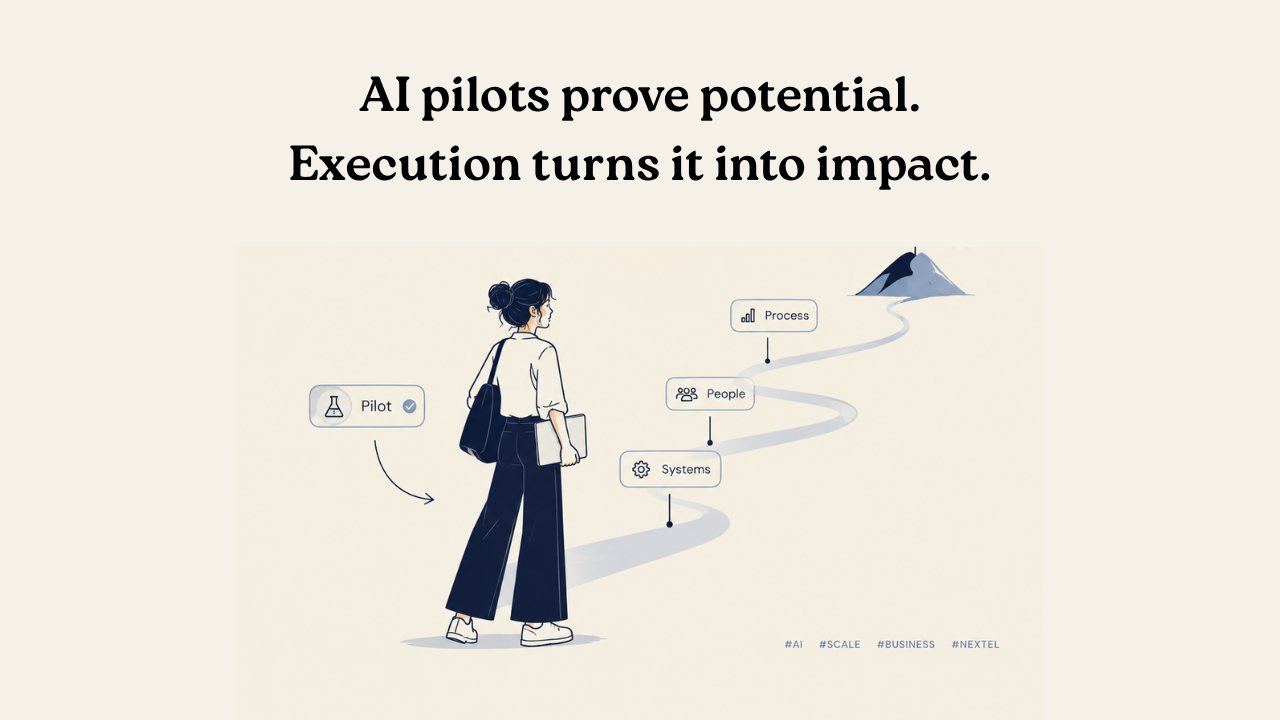
AI Is No Longer the Experiment. Execution Is the Competitive Advantage.
Artificial intelligence has moved from boardroom conversations to real business environments. Organizations are experimenting with AI agents, automated customer interactions, predictive analytics, intelligent workflows, and generative AI tools to improve efficiency and accelerate growth.
Yet a critical gap remains between demonstrating what AI can do and making it work consistently across an organization.
A pilot can produce impressive results in a controlled environment. An AI agent can answer customer questions, qualify incoming leads, automate repetitive tasks, or recover abandoned opportunities. A proof of concept can demonstrate measurable improvements within a small team or a narrowly defined workflow.
But what happens when the same solution must handle thousands of interactions, integrate with existing systems, accommodate unpredictable customer behaviour, and deliver consistent outcomes across multiple teams?
This is where experimentation meets its greatest challenge: execution.
According to McKinsey’s State of AI in 2025 survey, nearly two-thirds of respondents said their organizations had not yet begun scaling AI across the enterprise. Deloitte’s 2026 State of AI in the Enterprise research also identifies the transition from pilot projects to scaled deployment as a critical challenge for organizations pursuing AI value.
These findings point to a broader business problem. The ability to experiment with AI is becoming widespread, but the ability to operationalize it remains a differentiator.
The issue is not always the quality of the underlying technology. Often, it is the absence of the operational infrastructure, workflow design, accountability, and measurement required to turn a successful experiment into a repeatable business capability.
The real challenge is no longer proving that AI works. It is building an organization in which AI can work reliably, repeatedly, and at scale.
1. The Pilot Trap: Why Early Success Can Be Misleading
AI pilots are designed to answer a specific question: Can this technology solve a particular problem?
To answer that question quickly, organizations usually narrow the scope. They select a limited dataset, define a small group of users, choose a manageable workflow, and evaluate performance under relatively controlled conditions.
This approach is useful. It reduces risk, limits initial investment, and helps teams understand the technology before committing to a larger deployment.
However, the conditions that make a pilot successful can also conceal the problems that emerge during implementation.
Consider a company testing an AI agent to handle customer enquiries.
During the pilot, the agent answers frequently asked questions, retrieves information from a curated knowledge base, and responds accurately to common requests. The team observes faster response times and reduced manual effort. The project is declared successful.
The organization then decides to extend the agent across additional products, customer segments, communication channels, and support teams.
Suddenly, the environment changes.
Product information differs between departments. Customer records are incomplete. Some enquiries require exceptions that were never included in the original test. Conversations need to be transferred to human agents. Different teams follow different escalation procedures. The system must now operate within real business hours, service expectations, and performance constraints.
The technology that performed well in the pilot has entered a much more complex environment.
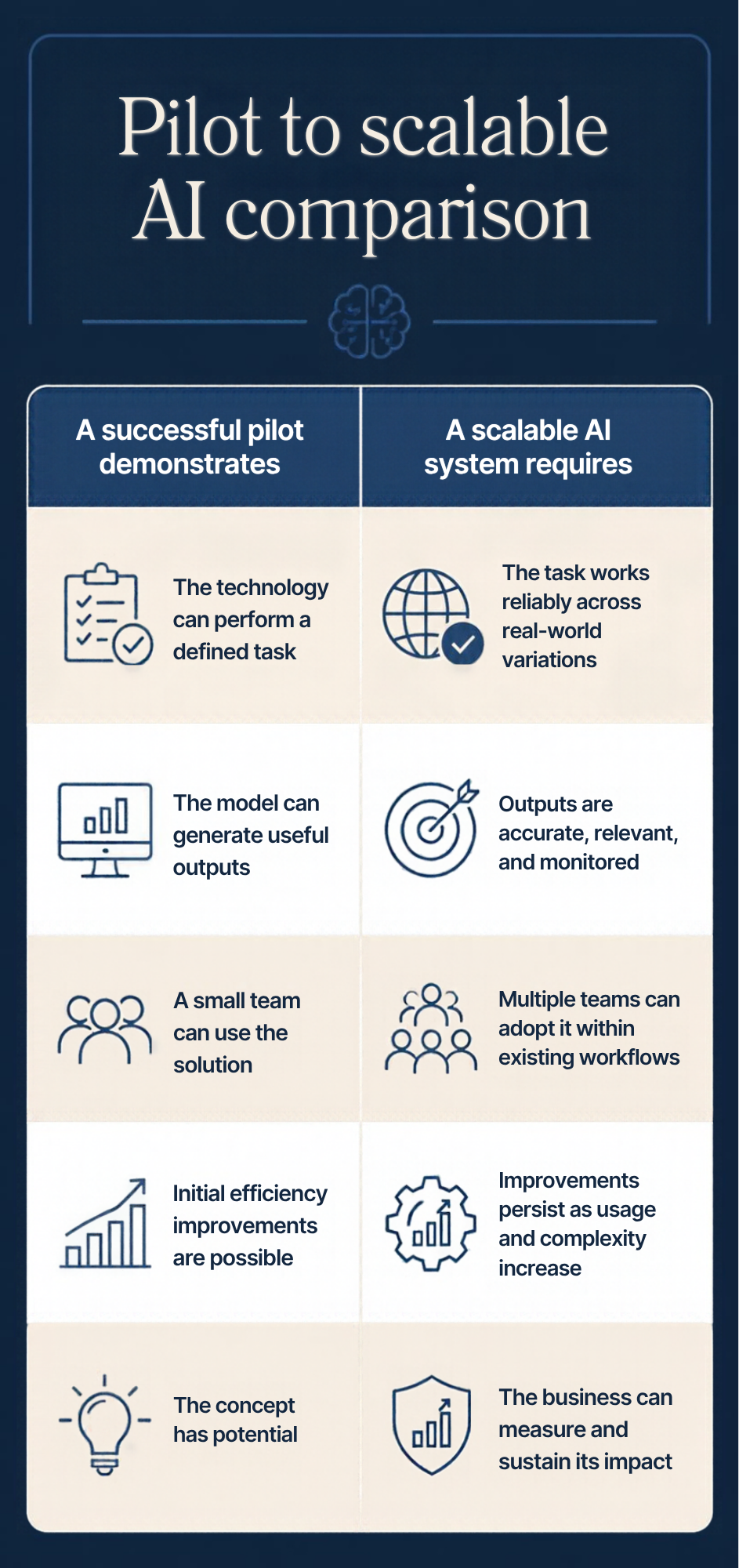
The pilot demonstrated technical feasibility. It did not necessarily demonstrate operational readiness.
2. The Missing Link Is Operational Design, Not Just Better AI
When an AI initiative fails to progress beyond experimentation, the immediate response is often to reconsider the model, test another tool, or invest in a more advanced solution.
Sometimes that is necessary. But technical improvements cannot independently solve problems caused by fragmented processes, unclear ownership, disconnected systems, or poorly defined business objectives.
An AI system operates within the environment an organization gives it.
If customer information is inconsistent, the system may produce inconsistent answers. If escalation rules are unclear, it may struggle to determine when a human should intervene. If no one owns the workflow after deployment, performance issues may remain unresolved. If the business measures activity instead of outcomes, the system may appear successful without creating meaningful value.
In other words, AI inherits many of the strengths and weaknesses of the processes surrounding it.
This is why scaling AI requires a shift from thinking about isolated tools to designing complete operating workflows.
A practical AI workflow must answer five questions:
What initiates the workflow? A customer enquiry, a new lead, a support request, an abandoned transaction, or a change in business data.
What should the AI do? Retrieve information, answer questions, classify intent, qualify an opportunity, recommend an action, or complete an approved task.
What information does it need? Accurate product details, customer history, business policies, current availability, or relevant system records.
What happens when it cannot proceed? The workflow must define escalation, human intervention, error handling, and recovery.
How will the business evaluate success? Through resolution rates, conversion, time saved, cost per outcome, customer satisfaction, or another meaningful business measure.
These questions turn an AI capability into an operational system.
Without this layer, organizations risk building impressive demonstrations that remain disconnected from the work they were intended to improve.
3. Five Reasons AI Pilots Fail to Scale
3.1 They Start With Technology Instead of a Business Problem
The excitement around AI can encourage organizations to begin with a tool rather than a clearly defined operational need.
Teams ask what an AI agent can do, which model to use, or which process could be automated. They may launch several experiments without establishing which business problem deserves priority.
This creates a mismatch between technological capability and business value.
An organization might deploy AI to generate customer responses because the capability is readily available. However, the actual problem may be that incoming enquiries are not routed correctly, customer information is incomplete, or sales representatives cannot identify which opportunities need immediate attention.
Automating responses alone will not resolve those underlying issues.
A stronger approach starts by identifying a measurable business problem and then evaluating whether AI is the right way to address it.
For example, instead of defining the objective as “implement an AI customer support agent,” define it as “reduce repetitive enquiry-handling time while maintaining resolution quality and ensuring complex issues reach the right person.”
The second objective establishes a business outcome, a quality constraint, and an operational requirement.
It also creates a meaningful basis for deciding whether the project should progress beyond the pilot stage.
The principle is simple: select AI use cases based on the value they can create, not merely on what the technology can demonstrate.
3.2 The Pilot Operates Outside the Real Business Workflow
Many AI experiments succeed because they are tested separately from the systems and processes that determine how work actually gets done.
A team may test an AI agent through a demonstration interface or a limited dataset. However, the production environment may require connections to a CRM, support platform, product catalogue, booking system, order management tool, or internal knowledge base.
The AI must also interact with existing teams and business rules.
Consider an incoming sales enquiry.
An AI system might successfully identify the customer's requirements and classify the enquiry as high intent. But if that information does not reach the sales team, the qualification has little practical value.
The lead still waits. The sales representative still needs to gather the same information. The customer may still receive a delayed response.
The intelligence exists, but the workflow remains incomplete.
For AI to create operational value, its output must trigger the appropriate next step.
That might mean updating a customer record, assigning a conversation, initiating a follow-up, escalating a request, or notifying the responsible team. These actions should be connected to the organization's existing processes rather than left as isolated recommendations.
Integration is therefore not simply a technical consideration. It determines whether AI can participate in the actual execution of work.
3.3 Organizations Underestimate Real-World Complexity
A pilot typically focuses on the most common scenarios. Production systems must also handle the less predictable ones.
Customers ask incomplete questions. Business policies change. Product information becomes outdated. Users switch topics midway through a conversation. Requests fall outside predefined categories. External systems become unavailable.
A system that performs well on standard inputs may struggle when these conditions occur together.
Scaling AI requires organizations to plan for exceptions rather than treating them as unusual inconveniences.
This includes defining what the system is allowed to do, which information it can access, how it should handle uncertainty, and when it must stop and involve a human.
For customer-facing AI, this is particularly important. A confident but incorrect answer can damage trust more quickly than a delayed answer that is handled transparently.
A robust implementation should therefore include:
Reliable, maintained sources of business information.
Clear limits on the AI's authority and actions.
Testing across common, uncommon, and high-risk scenarios.
Escalation rules for uncertainty, repeated failures, and sensitive requests.
Logging and monitoring to identify recurring errors.
A defined process for correcting information and improving performance.
The objective is not to eliminate every possible failure before deployment. That would make experimentation unnecessarily slow.
The objective is to ensure that the system can detect, contain, and recover from failures without allowing them to undermine the wider operation.
3.4 No One Owns the Outcome After Deployment
AI initiatives frequently involve multiple stakeholders: business leaders, product teams, developers, IT, operations, compliance, and the employees who use the system.
Each group may have a legitimate responsibility, but shared involvement does not automatically create clear accountability.
A development team might consider the project complete once the system is deployed. Operations might assume that technical teams will resolve performance issues. Business teams might expect the AI to improve results without changing existing processes.
When ownership is unclear, small problems accumulate.
Knowledge bases become outdated. Exceptions are handled inconsistently. Employees develop workarounds. Performance deteriorates without triggering corrective action.
The organization has technically deployed AI, but no one is responsible for ensuring that it continues to deliver the intended result.
Scaling requires an explicit operating model.
Every production AI workflow should have an accountable owner responsible for its business performance, supported by clear responsibilities for technical maintenance, risk management, employee adoption, and continuous improvement.
Ownership should also extend beyond launch.
Teams need defined review cycles, escalation paths, performance thresholds, and procedures for modifying or pausing a system when necessary.
This approach is consistent with the NIST AI Risk Management Framework, which emphasizes governance, measurement, management, and ongoing consideration of AI risks throughout the system lifecycle.
AI deployment should be treated as the beginning of operational responsibility, not the end of a project.
3.5 Success Is Measured by Activity Instead of Business Impact
An AI pilot can generate impressive activity metrics.
The system may handle thousands of conversations, automate hundreds of tasks, or respond to customers within seconds. These figures can demonstrate usage and technical capability, but they do not necessarily demonstrate business value.
A support agent that answers quickly but fails to resolve issues may increase the volume of interactions without reducing the workload.
A sales agent that qualifies leads but fails to route them correctly may improve classification while leaving conversion unchanged.
An AI recovery workflow may send reminders to abandoned customers without producing meaningful recoveries.
In each case, the system is active. The intended business outcome remains uncertain.
To avoid this problem, organizations must distinguish between activity metrics, operational performance, and business outcomes.
For example:
Activity: Number of enquiries handled by AI.
Operational performance: Percentage of enquiries resolved without unnecessary human intervention.
Business outcome: Reduction in support cost per resolved enquiry while maintaining customer satisfaction.
Or consider sales engagement:
Activity: Number of leads contacted.
Operational performance: Percentage of leads receiving timely, relevant follow-up.
Business outcome: Improvement in qualified opportunities progressing to conversion.
The most useful metrics depend on the workflow, but the principle remains consistent: AI performance must be evaluated in the context of the business objective it was introduced to achieve.
Without this connection, organizations may scale automation while failing to scale value.
4. The Hidden Bottleneck: The Gap Between AI Output and Business Action
Across these challenges, one recurring problem stands out.
AI can produce an answer, recommendation, classification, or prediction. But a business outcome usually requires additional steps.
Information must reach the right person. A decision must lead to an action. An action must occur at the right time. The result must be recorded and evaluated.
The distance between an AI output and the next meaningful business action is where operational value is frequently lost.
Consider a customer who submits an enquiry through a company's website or messaging channel.
A conventional workflow might look like this:
The enquiry arrives.
The customer waits for a response.
A team member reviews the message.
The team member identifies the customer's requirement.
The enquiry is assigned to the appropriate person.
Follow-up depends on availability and manual processes.
The business eventually determines whether the enquiry converted.
An AI system can improve several stages of this journey. It can answer initial questions, identify customer intent, gather relevant information, and classify the opportunity.
But if the workflow stops at classification, the business has automated only one part of the process.
An execution-oriented system connects the stages.
The AI engages the customer, uses approved business information to respond, identifies intent, and routes qualified opportunities to the appropriate team. If the customer needs human assistance, the system transfers the conversation with relevant context. If a follow-up is required, the next step is defined rather than left entirely to memory.
The result is not simply a faster response. It is a more coherent operational process.
This distinction applies beyond customer engagement. In finance, operations, support, and internal productivity, the value of AI depends on whether its outputs reliably trigger the actions needed to complete the work.
The most important question is not whether AI can perform a task. It is whether the organization can turn that capability into a complete, dependable workflow.
5. From Experimentation to Execution: A Practical Framework for Scaling AI
Moving beyond pilots does not mean deploying AI everywhere at once. It means creating a disciplined path from a promising use case to a reliable production capability.
A practical approach involves six stages.
Stage 1: Identify a High-Value, Clearly Defined Use Case
Start with a specific operational problem rather than a broad ambition to adopt AI.
Look for workflows that involve substantial repetitive effort, measurable delays, inconsistent execution, missed opportunities, or avoidable manual intervention.
Evaluate each use case against four considerations:
Business value: What cost, revenue, service, or productivity outcome could improve?
Feasibility: Are the required data, integrations, and technical capabilities available?
Risk: What happens if the system produces an incorrect answer or action?
Measurability: Can the organization establish a baseline and evaluate the result?
Choose a use case with a clear owner and a realistic path to implementation.
A narrow but valuable workflow with measurable outcomes is often a better starting point than an ambitious initiative spanning several departments.
Stage 2: Establish a Baseline Before Introducing AI
Organizations cannot reliably demonstrate improvement if they have not measured the existing process.
Before deployment, document how the workflow currently performs.
Depending on the use case, the baseline might include average response time, resolution rate, manual handling time, conversion rate, error frequency, cost per transaction, or customer satisfaction.
Define the intended improvement and any conditions that must remain stable.
For example, reducing response time should not come at the expense of answer accuracy. Increasing automation should not create a disproportionate increase in escalations or customer complaints.
These baselines make the pilot more informative and provide a defensible basis for deciding whether to expand it.
Stage 3: Design the Entire Workflow, Including Exceptions
Map the process from beginning to end.
Identify the event that initiates it, the information required, the decisions the AI can make, the actions it can execute, and the conditions that require human involvement.
Pay particular attention to transitions between systems and teams.
For each important step, ask what happens when the expected information is missing, the customer changes their request, an integration fails, or the AI cannot confidently complete the task.
Document these scenarios before scaling.
A workflow is not production-ready merely because its standard path works. It must also behave predictably when reality differs from the original assumptions.
Stage 4: Integrate AI Into Existing Systems and Responsibilities
AI should operate within the organization's real working environment.
Connect it to approved sources of information and relevant systems. Establish how outputs are recorded, how actions are triggered, and how employees receive the context they need.
Equally important, define who owns each stage of the workflow.
Employees should understand what the AI handles, what they remain responsible for, and how to intervene when necessary. Managers should know where to review performance and how to address recurring issues.
Integration must include people and processes, not just software.
Stage 5: Scale in Controlled Stages
Once the pilot meets its predefined success criteria, expand its scope gradually.
This might mean increasing the number of users, introducing additional enquiry types, extending coverage to another department, or handling a larger volume of transactions.
At each stage, evaluate whether performance remains consistent under the new conditions.
Monitor accuracy, reliability, cost, latency, adoption, exception frequency, and the business outcome that matters most.
Use the results to refine the workflow before expanding further.
A staged rollout helps organizations discover operational weaknesses early without exposing the entire business to untested assumptions.
Stage 6: Build Continuous Improvement Into Operations
AI systems operate in environments that change.
Customer expectations evolve. Product information is updated. Business policies change. New use cases emerge. Patterns of system failure become visible only after sustained usage.
A one-time deployment cannot account for every future condition.
Organizations should establish a regular cycle of monitoring, reviewing, correcting, and improving the system.
This includes analyzing failed interactions, identifying recurring exceptions, updating knowledge sources, reviewing human escalations, and comparing current performance against the original baseline.
The aim is to make improvement part of normal operations rather than a separate project that begins only when something breaks.
A pilot proves potential. A production system must continue earning its place in the business.
6. Human Oversight Is What Makes Scaled AI Sustainable
Scaling AI does not require removing humans from every workflow.
In many business environments, the most effective approach combines AI's speed and consistency with human judgment, contextual understanding, and accountability.
The objective is to allocate responsibility intelligently.
AI can handle routine enquiries, retrieve approved information, classify requests, summarize interactions, and execute predefined actions. Human employees can focus on exceptions, complex decisions, sensitive situations, and relationships that require personal attention.
However, this division of responsibility must be designed deliberately.
A human handoff should not simply transfer a conversation without context. It should provide the information needed to continue the interaction, including the customer's request, relevant history, actions already taken, and the reason for escalation.
Similarly, human oversight should be supported by practical controls rather than informal expectations.
Organizations should define:
Which actions the AI can perform independently.
Which decisions require human approval.
What conditions trigger an escalation.
How employees can correct or override an AI decision.
How errors are documented and prevented from recurring.
The degree of oversight should reflect the risk and consequences of the task. A low-risk informational response does not require the same controls as a consequential financial, legal, or operational decision.
The goal is not maximum automation. It is reliable execution with appropriate accountability.
7. Why AI Scaling Requires Organizational Change, Not Just Technology Adoption
Even a technically sound AI system can fail if the organization continues working exactly as it did before deployment.
Employees may distrust the system, ignore its recommendations, duplicate its work, or create informal processes around its limitations. Managers may continue measuring the same activities without recognizing that responsibilities have changed.
These are not necessarily technology failures. They are implementation failures.
Successful AI adoption requires employees to understand how the system changes their work and why the new workflow is better.
Training should focus on actual responsibilities: reviewing outputs, handling exceptions, interpreting performance indicators, correcting errors, and knowing when to intervene.
Leadership must also establish realistic expectations. AI should not be treated as an infallible decision-maker, nor should every imperfect output be interpreted as proof that the technology is unusable.
Instead, organizations need a clear process for evaluating performance, identifying limitations, and improving the system responsibly.
This also means aligning incentives with outcomes.
If employees are evaluated solely on the number of tasks they personally complete, they may have little reason to adopt automation that changes how those tasks are performed. If teams are rewarded for resolution quality, customer outcomes, and operational efficiency, the benefits of a well-designed AI workflow become easier to recognize.
Scaling AI is therefore as much a question of organizational design as it is of technical capability.
8. The Economics of Scaling: Prove the Value Before Expanding the Cost
A pilot often operates at a small scale, where infrastructure costs, human supervision, and integration work appear manageable.
Production introduces a different economic reality.
Higher usage may increase model, infrastructure, integration, and monitoring costs. More complex tasks may require additional human review. Poorly designed workflows may generate repeated interactions, unnecessary escalations, or expensive errors.
For this reason, organizations should evaluate the total cost of delivering the intended business outcome, not merely the cost of running the AI model.
A useful framework is:
Net business value = measurable benefits − total operating and implementation costs
Benefits might include reduced manual effort, faster resolution, fewer missed opportunities, improved conversion, or greater service capacity. Costs may include software, integration, maintenance, human oversight, training, and error recovery.
The calculation should reflect the specific workflow rather than assume that every automated interaction creates equivalent value.
For example, an AI agent that handles 1,000 enquiries is not necessarily more valuable than one that handles 600. If the first generates a large number of unresolved conversations while the second resolves more requests accurately and at a lower cost, the second system may produce better business results.
Organizations should also distinguish between time saved and actual financial benefit. Time savings become economic value when they reduce costs, increase productive capacity, improve service levels, or allow employees to focus on higher-value work.
The goal is sustainable value, not automation for its own sake.
9. Applying the Framework to Customer Engagement
Customer engagement offers a particularly clear illustration of the difference between AI experimentation and operational execution.
Businesses receive enquiries across websites, messaging channels, advertising campaigns, and other customer touchpoints. Yet an enquiry arriving does not guarantee that the customer will receive a timely answer, obtain the information needed to make a decision, or receive an appropriate follow-up.
The gap between initial interest and meaningful action creates operational friction.
A basic automation might send an acknowledgement when a customer submits an enquiry. A more capable AI system might answer frequently asked questions. Both can improve individual steps.
But an end-to-end engagement workflow addresses the broader customer journey.
Consider a hypothetical business receiving a high volume of enquiries through messaging.
A well-designed workflow could operate as follows:
1. Engage: The AI responds to incoming enquiries using approved business information, helping customers obtain relevant answers without waiting for manual intervention.
2. Understand: The system identifies customer intent, gathers necessary details, and distinguishes routine information requests from genuine buying interest.
3. Qualify: Relevant enquiries are classified according to predefined business criteria, helping the team prioritize the opportunities that need attention.
4. Route: Qualified conversations are transferred to the appropriate sales representative or support team with the context needed to continue the interaction.
5. Follow through: Where appropriate, the workflow initiates approved follow-ups or recovery processes, subject to customer preferences, consent, and applicable communication rules.
6. Learn: The business reviews conversation outcomes, unresolved questions, escalation patterns, and conversion performance to identify what needs improvement.
Each stage has a defined purpose. More importantly, each stage connects to the next.
This is the difference between automating isolated customer interactions and building an engagement system designed to move customers toward a meaningful outcome.
It is also where the operational principles discussed throughout this article become tangible: clearly defined objectives, connected workflows, reliable information, human oversight, and outcome-based measurement.
For Nextel, this distinction is central to how AI-driven engagement should be understood. The objective is not simply to automate conversations or increase the number of messages sent. It is to help businesses respond, understand intent, prioritize opportunities, and coordinate the next action across the customer journey.
AI becomes more valuable when it helps work move forward.
10. What Businesses Should Ask Before Scaling an AI Pilot
Before moving an AI initiative into wider production, decision-makers should evaluate its readiness across six dimensions.
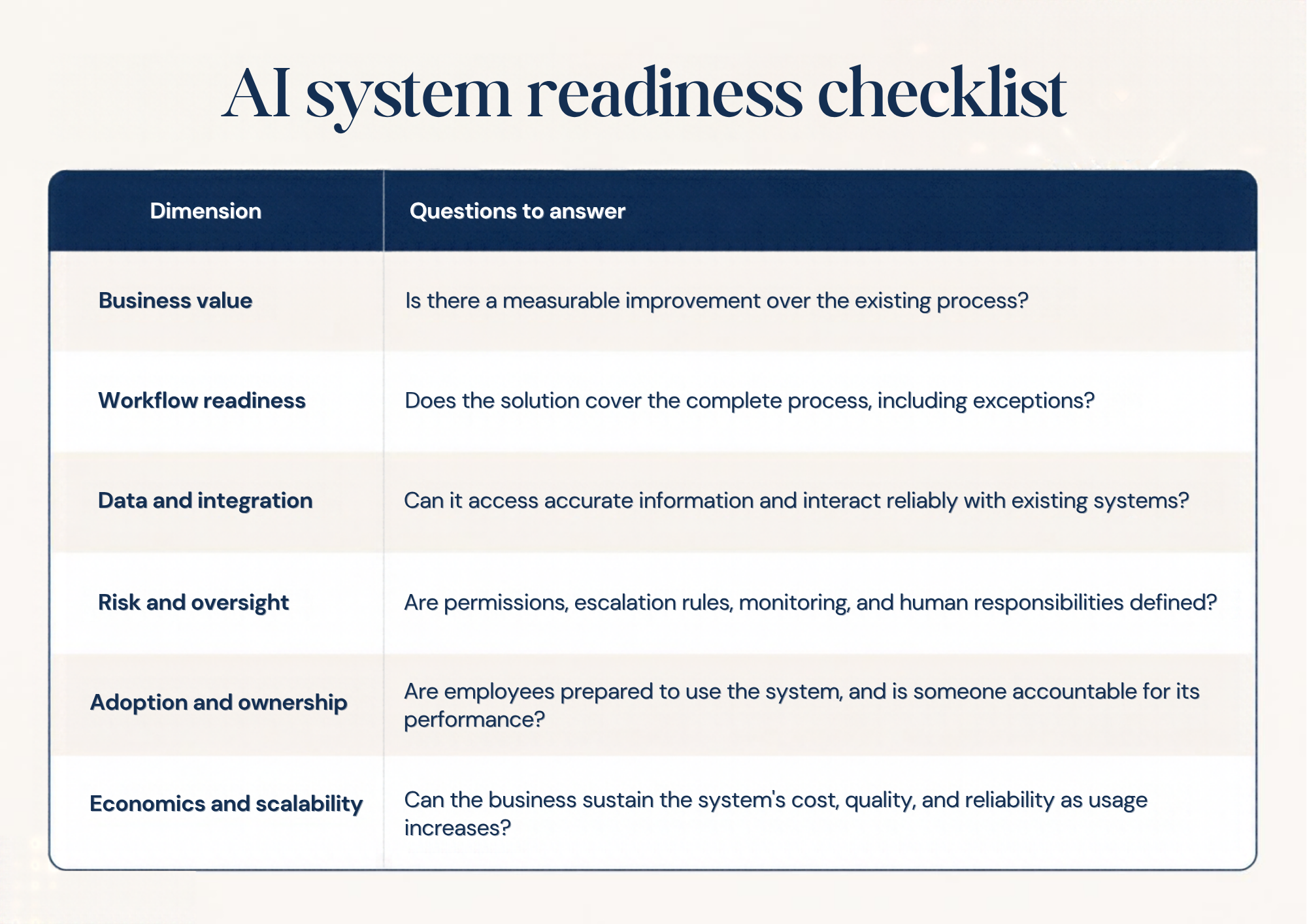
A pilot does not need to be perfect in every dimension before it can progress. However, the organization should understand its limitations, know which risks remain, and have a plan for addressing them.
The decision to scale should be based on evidence, not enthusiasm.
If the system has demonstrated value but lacks reliable integrations, the next step may be to strengthen the underlying workflow. If the technology performs well but employees are not adopting it, the priority may be training and process redesign. If outcomes remain unclear, the business may need better baseline data before expanding.
The right next step depends on what the pilot has actually revealed.
This approach avoids two equally costly mistakes: scaling a system before it is ready and abandoning a valuable use case because the first implementation was incomplete.
Conclusion: The Future Belongs to Organizations That Can Execute With AI
The AI landscape is moving beyond the question of what artificial intelligence can do.
Organizations have already demonstrated that AI can generate content, answer questions, analyze information, classify requests, and automate portions of complex workflows. The next challenge is to make these capabilities dependable parts of everyday business operations.
That requires more than choosing the right model or launching another proof of concept.
It requires clear business objectives, reliable data, connected systems, carefully designed workflows, accountable ownership, appropriate human oversight, and continuous measurement.
Most importantly, it requires a change in how organizations define success.
A successful AI pilot demonstrates that something is possible. A successful AI implementation demonstrates that it can be done reliably, at an acceptable cost, within real business conditions. A successful AI operating model ensures that the value continues as the organization grows and changes.
The distinction is significant.
Businesses that focus only on experimentation may accumulate tools and prototypes without fundamentally improving how work gets done. Businesses that invest in execution can turn individual AI capabilities into repeatable operational advantages.
For customer-facing businesses, this means moving beyond automated replies toward systems that connect engagement, qualification, conversion, support, and retention. For other functions, it means ensuring that AI outputs lead to appropriate actions, that exceptions are handled responsibly, and that results are measured against real business objectives.
The opportunity is not simply to introduce more AI into the organization.
It is to build an organization that knows how to operate with AI.
Because the real competitive advantage is not having an AI pilot that works. It is having an operating system that turns AI capability into consistent business outcomes.
At Nextel, this is the principle behind execution-oriented AI engagement: helping businesses move beyond isolated interactions and build connected workflows that turn customer intent into meaningful next steps.
The next phase of AI adoption will not be defined by how many experiments businesses launch. It will be defined by how effectively they turn those experiments into execution.