
The API Is Becoming a Commodity. What Will Make Messaging Companies Valuable Next?

Imagine two businesses using different messaging platforms.
Both can connect to WhatsApp. Both can send broadcasts, automate responses, integrate with a CRM and manage customer conversations. Both offer dashboards, templates and automation workflows.
On paper, their capabilities look remarkably similar.
Now imagine that one business still spends hours manually qualifying leads, chasing unanswered enquiries and figuring out which customers need attention. The other uses intelligent workflows to identify customer intent, prioritise promising enquiries, automate appropriate interactions and route complex conversations to the right employee.
Both businesses have access to messaging infrastructure. But they are not getting the same value from it.
That difference raises a question the messaging industry needs to take seriously:
If access to the API is no longer enough to differentiate a platform, what will make businesses choose one messaging company over another?
For years, messaging platforms created value by making customer communication more accessible. They helped businesses move beyond individual phones, manual conversations and disconnected communication processes.
That value has not disappeared. Reliable infrastructure, compliance, deliverability and integrations remain fundamental.
But the expectations surrounding messaging are expanding.
Businesses increasingly want technology that does more than deliver communications. They want systems that understand customer intent, coordinate workflows, reduce repetitive work and help teams make better decisions.
The opportunity, therefore, is not to replace messaging infrastructure. It is to build more valuable capabilities on top of it.
And that could fundamentally change how messaging companies compete.
1. The API Was the Beginning of the Opportunity, Not the End
To understand where the industry is heading, it helps to understand what made messaging APIs valuable in the first place.
A business communicating with customers manually faces obvious limitations. Conversations become difficult to manage at scale, customer histories get scattered, follow-ups depend on employees remembering to send them, and important enquiries can disappear into crowded inboxes.
Messaging APIs helped businesses integrate communication into their existing operations.
They enabled developers and platforms to build capabilities such as:
Automated customer notifications and transactional messages.
Broadcast campaigns and customer re-engagement.
CRM and e-commerce integrations.
Shared inboxes for sales and support teams.
Automated responses and structured conversational workflows.
Reporting and visibility into messaging activity.
These capabilities solved real problems. For many businesses, they represented a meaningful improvement over manual communication.
However, as more providers offer similar foundational capabilities, the presence of an API connection becomes less distinctive.
The same principle applies across much of the software industry. When a capability becomes widely accessible, businesses begin evaluating what a provider can do beyond making that capability available.
A database is valuable, but businesses also need applications that use the data. Cloud infrastructure is essential, but companies still need software that turns computing resources into useful products. Payment processing enables transactions, but merchants also care about fraud prevention, reconciliation and customer retention.
Messaging is following a similar pattern.
The infrastructure creates the possibility. The product experience and operational outcomes determine much of the value.
For messaging companies, this means competing on connectivity alone can become increasingly difficult. The next opportunity lies in helping businesses accomplish more with the connections they already have.
2. The Problem With Treating Every Messaging Platform as a Feature Checklist
When businesses evaluate messaging software, comparisons often begin with feature lists.
Does the platform support broadcasts? Can it integrate with a CRM? Does it offer automation? Is there a shared inbox? Can it connect to an e-commerce store?
These are legitimate questions. A business needs to know whether a platform meets its requirements.
But a feature checklist has a limitation: it describes what a platform can do, not necessarily how effectively a business can use it.
Consider two platforms that both offer automated follow-ups.
Platform A allows a business to create a sequence of predefined messages at fixed intervals.
Platform B supports a workflow that can use customer activity, relevant conversation context and defined qualification criteria to determine an appropriate next step, while escalating cases that require human intervention.
Both may advertise automated follow-ups. Yet the underlying workflows can be very different.
The distinction becomes clearer when we examine what businesses actually need.
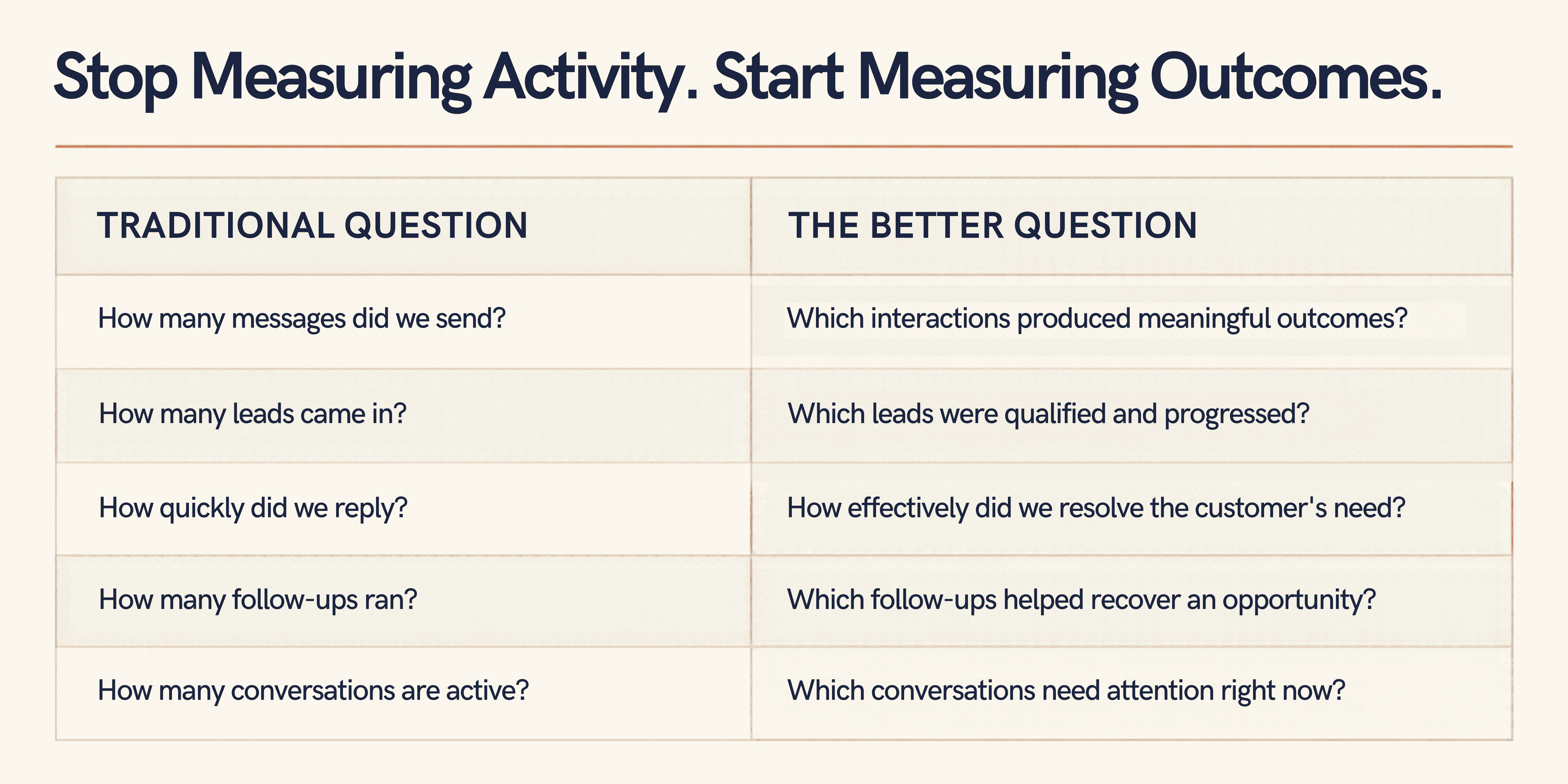
The right-hand column does not make features irrelevant. It changes how their value is evaluated.
A shared inbox matters because it helps teams coordinate conversations. Lead scoring matters because it can help prioritise attention. Integrations matter because they can connect customer interactions to the work that follows.
The strongest platforms will not simply accumulate features. They will make those features work together around a business objective.
3. AI Is Making Basic Automation Easier. That Changes the Competitive Equation.
The introduction of AI into business messaging creates another shift.
Traditional automation generally relies on predefined rules. When a trigger occurs, the system executes a configured action. This is effective for predictable tasks such as sending order confirmations, appointment reminders or scheduled follow-ups.
AI introduces the possibility of handling more varied interactions by interpreting natural language, identifying intent and generating contextually relevant responses.
For example, a customer might ask about pricing, explain a specific requirement and then raise an objection. A rigid workflow may struggle when the conversation does not follow its expected sequence. An AI-assisted workflow may be able to interpret the request, retrieve relevant information and determine whether it can continue independently.
But there is a competitive implication that messaging companies should not overlook.
If more platforms can offer AI-generated responses, simply adding AI will not necessarily create lasting differentiation.
The harder problem is making AI useful inside real business operations.
A capable system needs to work with appropriate business information, follow defined rules, recognise uncertainty, maintain relevant context and escalate situations it cannot safely or accurately handle.
It also needs to connect its response to the next action.
Imagine a customer who contacts a business through WhatsApp to enquire about a service.
An elementary workflow might send a welcome message, collect a few details and notify the sales team.
A more developed workflow could:
Understand the enquiry: Identify the service the customer needs and any important requirements.
Gather missing information: Ask relevant questions rather than forcing the customer through an unnecessarily rigid form.
Assess qualification: Apply the business's actual criteria to determine whether the enquiry is a suitable opportunity.
Provide relevant information: Answer supported questions using approved business information.
Prioritise the conversation: Direct promising or time-sensitive enquiries to the appropriate employee.
Preserve context: Give the employee the information already collected so the customer does not have to start again.
Track the next step: Record whether the conversation requires a follow-up, a demonstration, a booking or another action.
Not every business needs every step, and not every step should be automated. The important point is that the workflow is designed around the process rather than the individual message.
The competitive advantage increasingly lies in how well AI, business rules, integrations and human decisions work together.
4. The Next Battle Will Be About Workflow Execution
One of the most overlooked distinctions in business software is the difference between connecting systems and coordinating work.
Businesses often operate across multiple tools. An advertising platform generates enquiries, a messaging platform receives them, a CRM stores customer information, a team inbox supports employees and another system manages orders or appointments.
Connecting these tools is useful. But an integration does not automatically create a well-designed process.
Consider a service business receiving enquiries from advertisements.
The process might look like this:
A potential customer clicks an advertisement and starts a WhatsApp conversation.
The business needs to understand the customer's requirement.
The enquiry needs to be qualified.
A suitable lead should reach the sales team.
A demonstration or appointment may need to be scheduled.
If the customer does not proceed immediately, an appropriate follow-up may be required.
The eventual outcome should be recorded.
If these stages are disconnected, employees end up performing the coordination manually.
They copy information between tools, check whether someone has replied, remind colleagues to follow up and search through old conversations to understand what happened.
The software may be integrated, but the workflow still depends on human effort to keep it moving.
This creates a useful distinction:
Integration moves information between systems. Workflow execution turns information into the next appropriate action.
For messaging platforms, the opportunity is to make the second capability as important as the first.
That could involve:
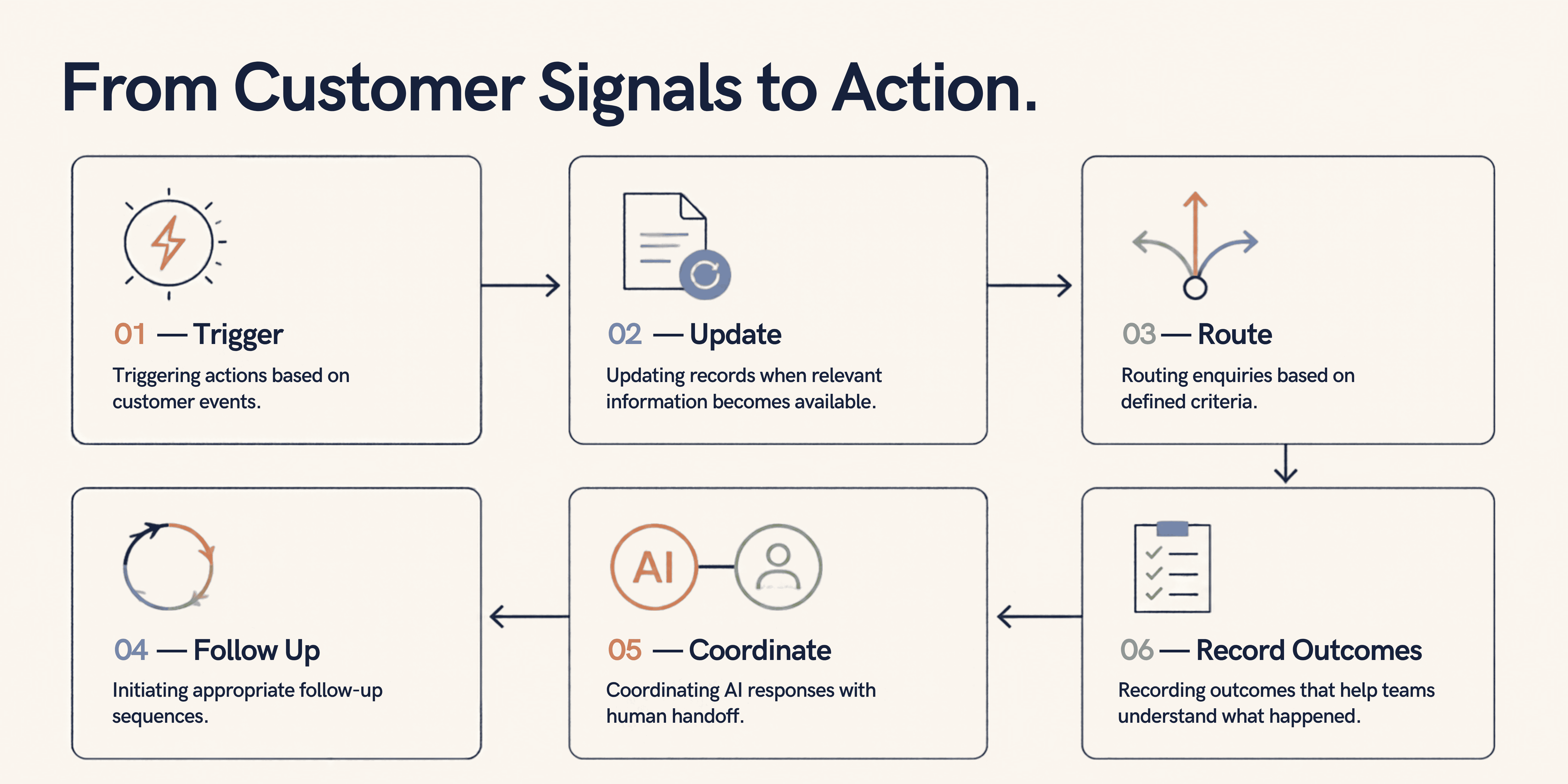
Triggering actions based on customer events.
Updating records when relevant information becomes available.
Routing enquiries based on defined criteria.
Initiating appropriate follow-up sequences.
Coordinating AI responses with human handoff.
Recording outcomes that help teams understand what happened.
The goal is not to automate every possible step. It is to remove unnecessary coordination while preserving control over important decisions.
A platform that helps businesses manage an entire process can become more deeply embedded in their operations than one used primarily to send messages.
5. Customer Conversations Could Become a Source of Business Intelligence
Every customer interaction contains information.
A pricing question may reveal confusion about the product's value. A repeated delivery complaint may expose an operational problem. A sales call may reveal an objection that the marketing team has never addressed. A customer who repeatedly asks about a particular feature may be signalling an unmet need.
Yet many businesses treat these interactions as isolated events.
A message gets answered, a call gets completed and a ticket gets closed. The information rarely makes its way back into the decisions that shape the business.
This is a missed opportunity.
Messaging and conversational systems can help businesses organise and interpret recurring customer signals — provided the information is captured appropriately, analysed reliably and used with suitable privacy safeguards.
Consider what different teams could learn from customer interactions.
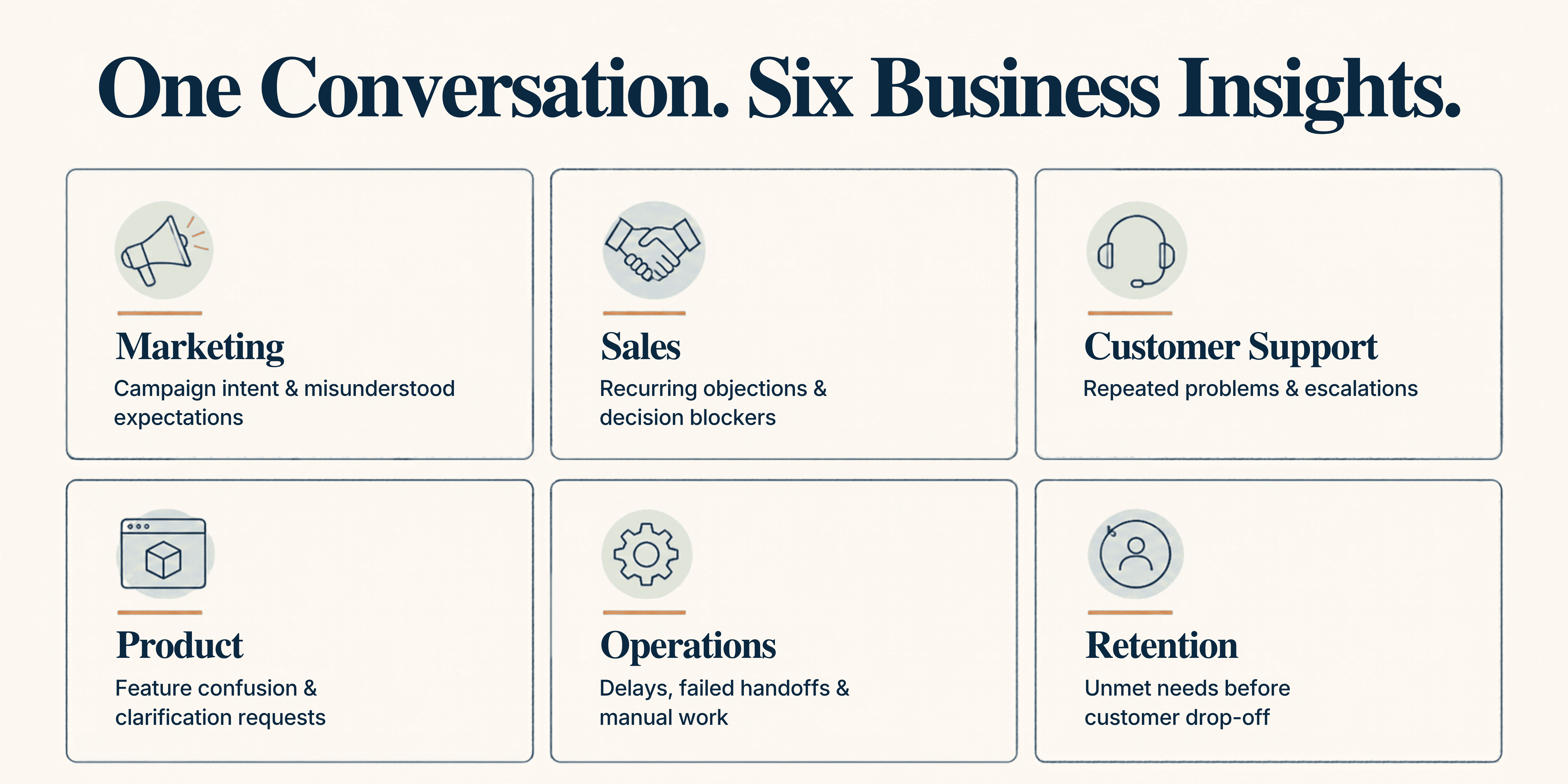
The value is not in collecting the largest possible volume of conversations. It is in identifying reliable patterns that can inform better decisions.
For example, if several customers repeatedly ask the same question before booking a demonstration, the business might improve its website, refine its sales material or add clearer information to an approved AI knowledge base.
If call analysis repeatedly identifies the same objection, sales managers can investigate whether the issue comes from pricing, product fit, communication or an operational constraint.
This creates a feedback loop: customer interactions inform business decisions, and those decisions improve future customer interactions.
The opportunity is to make conversations useful beyond the moment in which they occur.
For messaging companies, that represents a broader role than communication management alone.
6. More Automation Does Not Automatically Mean Better Business Performance
As automation capabilities expand, businesses may be tempted to measure success by the number of tasks they automate.
How many replies were generated? How many follow-ups were sent? How many conversations were handled without an employee?
These metrics can be useful, but they are incomplete.
A system can automate thousands of interactions and still create poor outcomes if its responses are inaccurate, its follow-ups are irrelevant or its escalation rules are ineffective.
In some situations, excessive automation can introduce additional work instead of reducing it.
Consider an automated follow-up sequence that continues sending messages even after a customer has expressed disinterest. Or an AI agent that repeatedly attempts to answer a question it does not understand rather than escalating to a person.
The automation is running. The experience is deteriorating.
This is why businesses need to distinguish between automation activity and automation effectiveness.
What should businesses measure instead?
The appropriate metrics depend on the workflow, but several categories deserve attention.
For sales and lead qualification:
Percentage of enquiries meeting defined qualification criteria.
Time from enquiry to appropriate human contact.
Progression from qualified enquiry to demonstration or purchase.
Conversion rates across relevant stages, with attribution limitations understood.
For customer support:
Resolution rate, defined consistently.
Time to resolution.
Repeated contacts for the same issue.
Escalation frequency and quality.
Customer satisfaction where it is measured reliably.
For engagement and recovery:
Meaningful responses to follow-ups.
Recovered opportunities or customers.
Repeat purchases within an appropriate measurement window.
Unsubscribes, opt-outs and negative engagement signals.
For operational efficiency:
Manual steps eliminated.
Employee time spent on repetitive tasks.
Errors and unnecessary handoffs.
Cost per successfully completed workflow.
These metrics should not be interpreted in isolation. A higher automation rate is not necessarily better if resolution quality falls. A faster response is not necessarily better if the customer receives incorrect information.
Likewise, a recovered sale should not automatically be attributed to a particular automation sequence without considering other factors.
The objective is to measure whether technology improves the process it was introduced to support.
For messaging companies, helping customers establish that relationship between activity and outcomes could become a meaningful differentiator.
7. The Human Handoff Problem: Knowing When AI Should Stop
Much of the conversation around AI focuses on what systems can automate.
An equally important question is what they should not attempt to handle independently.
Business interactions vary considerably. Some involve routine information requests. Others involve complex purchasing decisions, unusual customer requirements, sensitive complaints or exceptions to established policies.
A system that treats every interaction as an opportunity for another automated response can create unnecessary friction.
A better approach is to design clear boundaries between automated handling and human responsibility.
For example, an AI agent may be appropriate for answering routine product questions using verified information. But if the customer asks for an exception to a pricing policy, disputes a transaction or raises a complex complaint, the workflow may need to escalate the interaction.
Effective human handoff requires more than notifying an employee that a conversation exists.
The employee needs enough context to continue effectively.
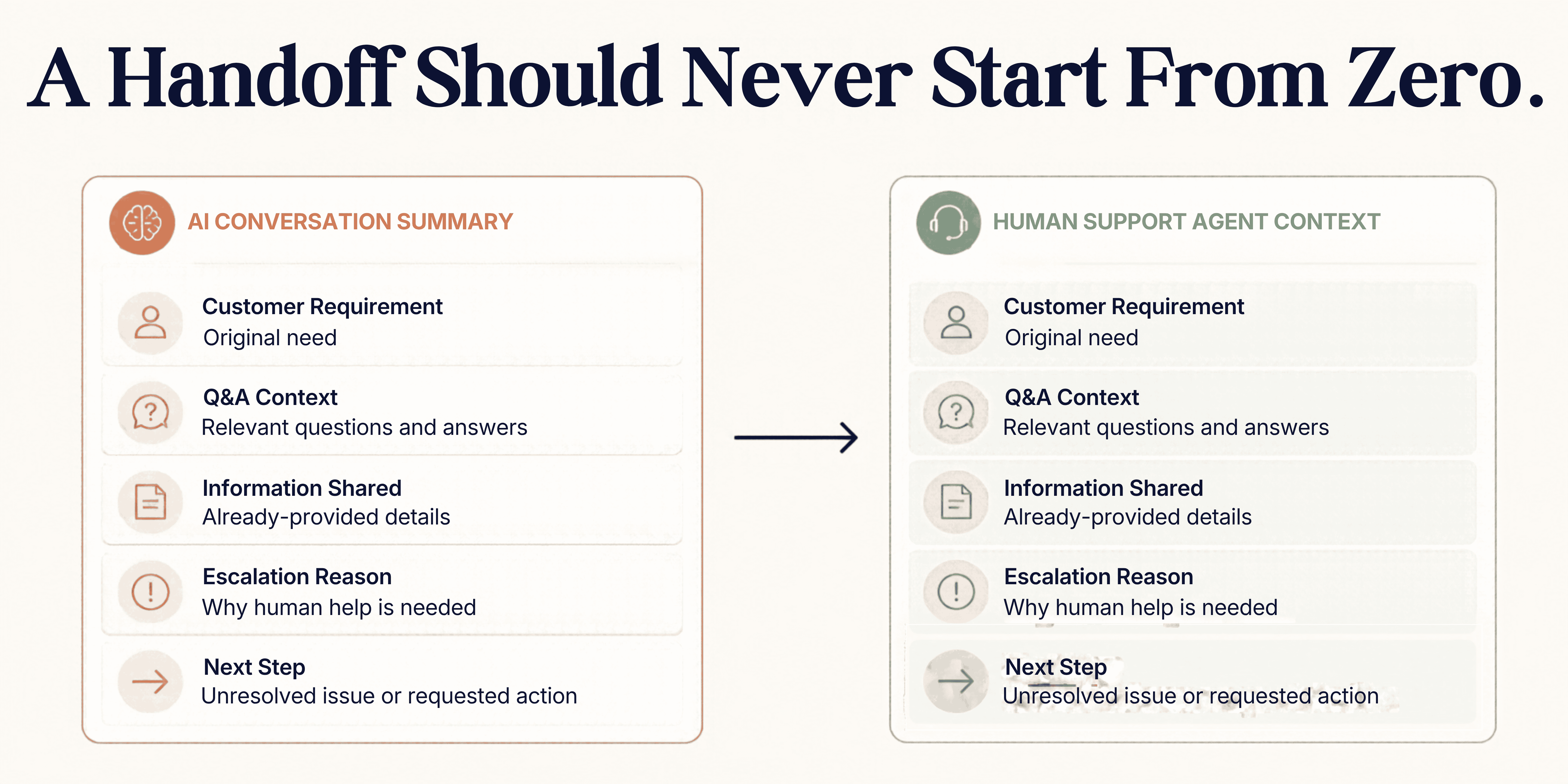
Without that context, the customer may need to repeat the entire interaction, defeating part of the purpose of automation.
A well-designed workflow should therefore account for both the automated stage and the human stage.
It should define when escalation occurs, who receives the conversation, what information is transferred and who owns the next action.
The goal of intelligent automation is not to eliminate human involvement. It is to make human involvement more purposeful.
This distinction matters because trust depends not only on how often AI gets things right, but also on how it behaves when it cannot.
8. The Hidden Risk of Building a Business Around Message Volume
Messaging platforms can be evaluated through several commercial models, including subscriptions, usage-based pricing and outcome-oriented pricing arrangements.
Each model has trade-offs, but the underlying question is important: what exactly is the customer paying for?
If a business pays primarily for messaging activity, it needs to understand whether that activity creates sufficient value.
A campaign that sends more messages is not necessarily a better campaign. A workflow that generates more automated replies is not necessarily more effective. A high volume of interactions can even increase costs without improving the outcome the business cares about.
This does not mean usage-based pricing is inherently wrong. Message volume, infrastructure consumption and support requirements can represent genuine costs.
The problem arises when the commercial model and the customer's objectives become disconnected.
For example, a business focused on generating qualified enquiries may care more about the cost per qualified lead than the number of messages sent. A customer support operation may care more about the cost and quality of resolving an issue than the total number of responses generated.
This creates an opportunity for messaging companies to help customers evaluate the economics of their workflows.
Useful questions include:
What does each successfully completed workflow cost?
How much manual effort does the automation eliminate?
What proportion of automated interactions require additional human work?
Does the process improve conversion, resolution or retention?
Are the benefits sustainable when volume increases?
The answers will differ across industries and use cases. There is no universal pricing model that guarantees better outcomes.
But platforms that help customers understand the relationship between cost, activity and business value can support a more meaningful commercial conversation than those that focus exclusively on message volume.
9. Trust, Control and Reliability Will Matter More as AI Takes Action
As messaging platforms evolve from sending communications to executing workflows, the consequences of errors can become more significant.
An incorrect automated message may cause confusion. An incorrectly routed enquiry may delay a sale. An AI agent that provides unsupported information may damage customer trust. A poorly designed workflow may send messages when it should stop.
The more responsibility a system receives, the more important its safeguards become.
Businesses evaluating intelligent messaging platforms should consider several areas.
Accuracy and information quality
AI systems should use appropriate, up-to-date business information and have a clear way to handle questions they cannot answer confidently.
Permissions and boundaries
Automated systems should operate within defined permissions. Not every agent needs access to every record or authority to perform every action.
Escalation and accountability
Businesses need to know when a person will be involved, how exceptions are handled and who remains accountable for the customer experience.
Customer consent and platform compliance
Messaging workflows must respect applicable consent requirements, opt-outs, privacy obligations and platform policies. Automation should not become a mechanism for sending irrelevant or unwanted communications at scale.
Monitoring and improvement
Businesses should be able to review workflow performance, identify recurring failures and make controlled improvements when something goes wrong.
These considerations are not obstacles to innovation. They are part of making automation dependable enough to use in real business operations.
A platform that can demonstrate appropriate control and reliability may be more valuable than one that simply promises to automate more tasks.
10. What Will Actually Differentiate Messaging Companies Next?
The future is unlikely to be defined by one feature or one technological breakthrough.
Instead, competitive differentiation may increasingly depend on how well several capabilities work together.
1. Infrastructure that businesses can depend on
Reliable messaging, appropriate compliance controls and stable integrations remain the foundation. New capabilities cannot compensate for failures in the basics.
2. Intelligence grounded in business context
Understanding customer intent requires more than generating fluent responses. Systems need relevant context, clear instructions and appropriate limits.
3. Workflows that connect decisions to actions
Platforms need to help businesses move from identifying a need to completing the next appropriate step, whether that involves an automated action or a human employee.
4. Useful visibility into performance
Businesses need insight into what their workflows accomplish, where they fail and what should improve.
5. Adaptability across business use cases
A clinic, an e-commerce business, a property agency and a multi-location service brand do not have identical workflows. The ability to configure suitable processes without creating unnecessary complexity can be valuable.
6. A clear relationship between cost and value
Customers should be able to understand what they are paying for and how the platform contributes to their operational objectives.
These capabilities reinforce one another.
Infrastructure makes communication possible. Context helps systems interpret it. Workflow execution turns decisions into actions. Monitoring helps businesses understand the results. Commercial clarity helps them decide whether the system is worth continuing to use.
That is a more demanding proposition than simply adding another feature to a messaging platform.
It also creates more opportunities to deliver differentiated value.
11. What This Shift Means for Nextel
For Nextel, this industry shift creates an opportunity to position business messaging around a broader operational purpose.
The underlying communication infrastructure remains important. But the wider product opportunity is to help businesses manage what happens throughout the customer interaction lifecycle.
Consider how different capabilities contribute to that objective.
AI agents and lead qualification
AI agents can support customer enquiries, identify relevant intent and help qualify opportunities using defined business criteria. The objective is to help teams focus their attention, not to assume every enquiry will become a sale.
Engagement and recovery workflows
Automated engagement can help businesses follow up with customers who have gone silent or revisit suitable opportunities. The quality of the workflow depends on relevance, timing, context and respect for customer preferences.
Team inbox and human handoff
Shared conversation management can help teams coordinate responsibility, while appropriate escalation ensures that complex interactions reach a person who can handle them.
Integrations and operational workflows
Connections with other business systems can make it easier to coordinate customer communication with activities such as lead management, orders and other relevant processes.
Call tracking and conversation analysis
Call tracking and analysis can provide additional visibility into customer interactions. Over time, useful analysis can help teams investigate recurring questions, identify friction and improve the way they handle enquiries.
These capabilities are not interchangeable, and their impact depends on how they are configured and used.
However, they share a common direction: moving beyond communication as an isolated activity and towards communication as part of a coordinated business process.
That is the larger opportunity for Nextel.
Rather than defining the platform solely by the infrastructure it connects to, the more ambitious positioning is to focus on the work it helps businesses accomplish through those connections.
The distinction matters.
A platform can offer an API, automation, integrations and AI agents without necessarily delivering a coherent experience across them. Bringing these capabilities together around customer context, workflow execution and meaningful outcomes is a different challenge.
It is also a more valuable direction in which to build.
Conclusion: The API Gets You Connected. Execution Sets You Apart.
The messaging industry is not moving away from APIs. It is moving beyond the idea that API access alone is enough to define a compelling product.
Businesses will continue to need reliable infrastructure, compliant communication, integrations and tools that help teams manage conversations.
But as these capabilities become more accessible, the questions businesses ask will become more demanding.
Can the platform understand what a customer needs? Can it coordinate the right workflow? Can it recognise when a human should take over? Can it help the business understand what worked and what needs to improve?
These are questions about the role technology plays in running a business, not simply about sending messages.
The next generation of messaging companies will need to combine reliable infrastructure with useful intelligence, thoughtful workflow design, human accountability and meaningful performance measurement.
Not every platform will need to build every capability itself. Partnerships and integrations will continue to matter. And no amount of automation can guarantee a particular commercial outcome.
But the direction is clear: the value of a messaging platform increasingly depends on what businesses can accomplish through it.
The API gets you connected. Intelligence helps you understand. Workflow execution moves things forward. And measurable outcomes show whether it was worth doing.
For messaging companies, that is the opportunity beyond the API.