
From Call Recordings to Actionable Insights: Rethinking How Businesses Analyse Conversations
Every day, businesses have conversations that influence their sales, customer relationships, and operations. Prospects discuss their requirements, customers raise concerns, sales teams handle objections, and support representatives work towards resolving issues.
These interactions contain valuable information. They reveal what customers are looking for, what prevents them from making decisions, which problems arise repeatedly, and where businesses have opportunities to improve.
Yet, much of this information remains difficult to access after a call ends.
Recordings are stored, conversations are completed, and teams move on to the next interaction. Extracting meaningful insights from those calls often requires someone to revisit the recording, listen carefully, take notes, and identify the details worth retaining.
When a business handles a handful of calls, this process may be manageable. When it handles hundreds or thousands, analysing every conversation becomes an entirely different challenge.
The next evolution of call tracking isn't just about recording conversations. It's about making the information inside them easier to understand, access, and act upon.
The Growing Challenge of Manual Call Analysis
Call recordings provide businesses with a record of customer interactions, but recordings alone don't necessarily make conversations easier to analyse.
A manager who wants to review the performance of a sales team may need to listen to multiple calls. A salesperson preparing to follow up with a prospect may need to revisit an earlier conversation to recall specific requirements. A support team investigating a recurring complaint may need to search through several recordings to understand what happened.
Each task involves a similar sequence: locate the recording, listen to the conversation, identify the relevant information, and make sense of it.
The time required adds up quickly.
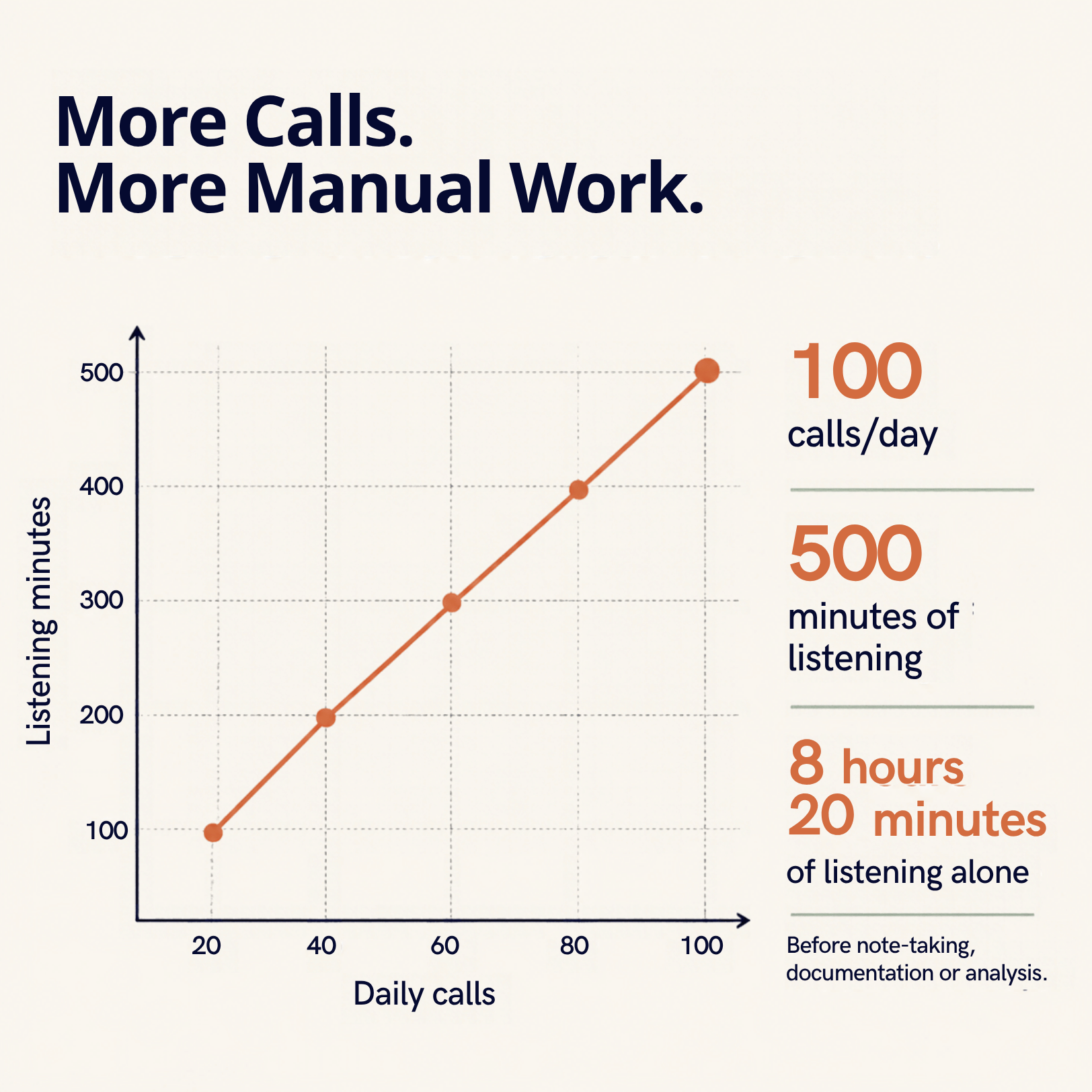
Consider a business handling 100 calls a day, with each call lasting an average of five minutes. Listening to every recording would require approximately 500 minutes — more than eight hours of listening alone, before accounting for note-taking, documentation, or analysis.
As call volumes grow, the effort required to review conversations grows with them.
Consequently, businesses may end up reviewing only selected calls instead of examining the full volume of interactions. Important details can be overlooked, and useful information may remain inaccessible simply because extracting it requires too much manual work.
The challenge, therefore, is not the availability of call data. It is the gap between collecting conversations and understanding them efficiently.
Introducing AI-Powered Call Tracking by Nextel
Nextel is bringing AI-powered call tracking to help businesses bridge this gap.
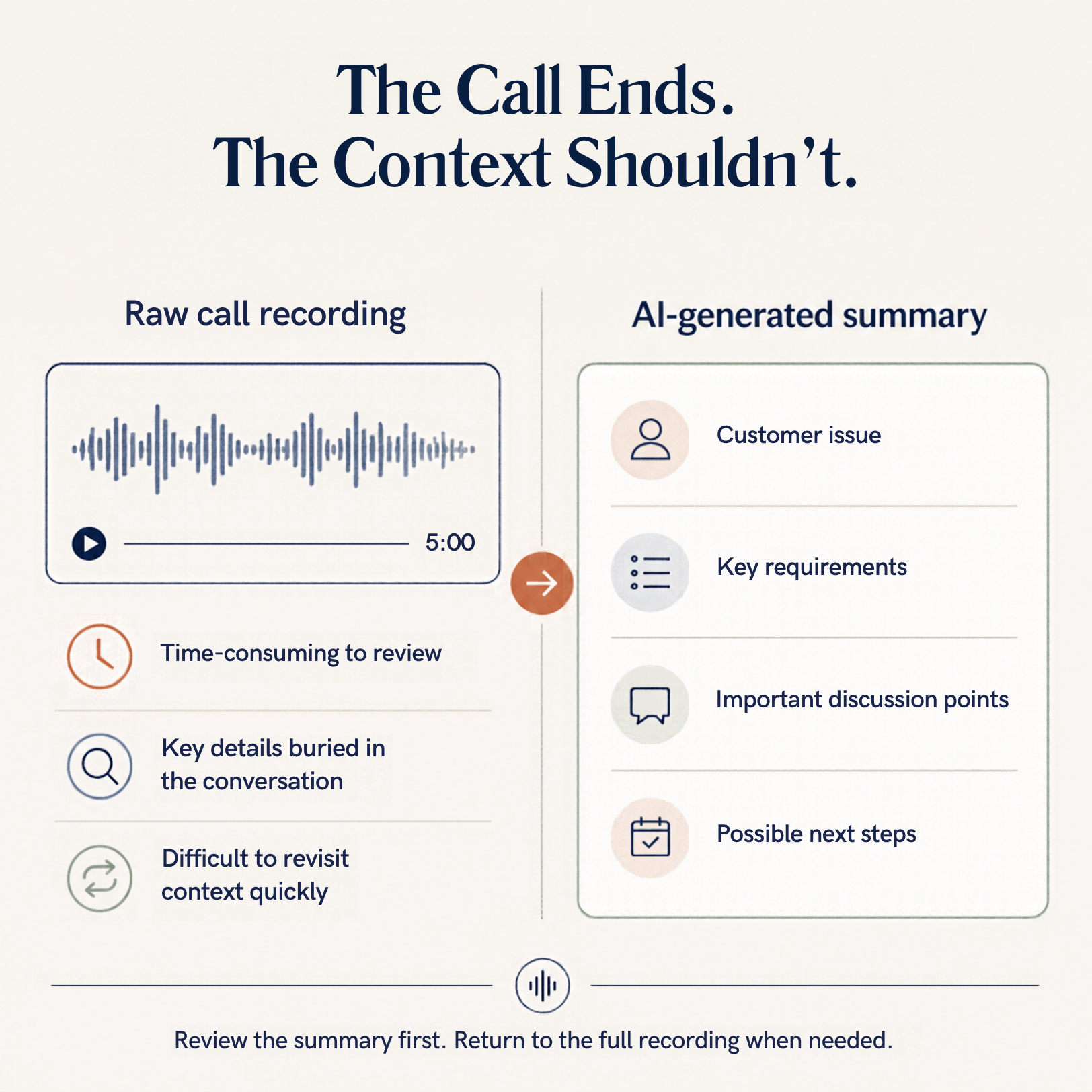
The solution uses AI to fetch call recordings and generate an individual summary for each conversation. Rather than requiring teams to listen to every call in its entirety just to understand what was discussed, it provides a concise overview that makes the conversation easier to review.
The objective is to simplify the work that happens after a call ends.
Recordings contain the original conversations. AI-generated summaries provide a more accessible way to revisit their context, helping teams spend less time on repetitive listening and more time on the information that matters.
Whether a business wants to review customer interactions, understand a prospect's requirements, or revisit a conversation before a follow-up, summaries create a more convenient starting point.
Instead of beginning every review with a recording, teams can begin with an overview and return to the full conversation whenever additional detail is needed.
How AI Makes Call Analysis More Efficient
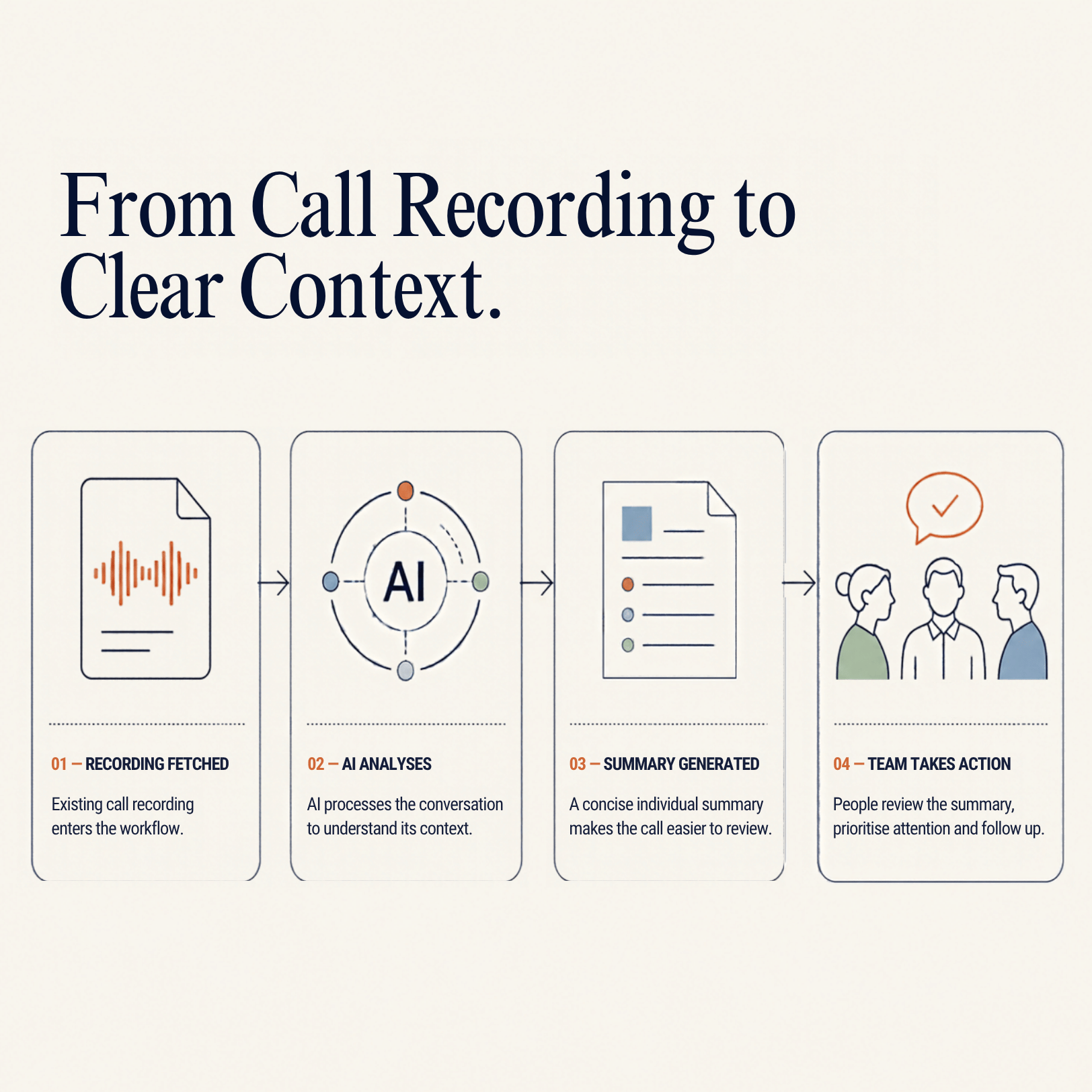
The process brings together call recordings and AI-generated summaries in a straightforward workflow.
1. Call recordings are fetched
Once calls have been recorded and are available to the system, Nextel's AI fetches those recordings for analysis. This makes the recorded conversation the starting point for extracting useful information.
2. AI processes the conversation
The recording is analysed to understand the conversation and identify its relevant context. This reduces the need for someone to manually listen to the entire call simply to establish what took place.
3. An individual summary is generated
AI creates a summary for each call, giving teams a concise overview of the conversation. Instead of having to replay the recording to recall its general context, they can review the summary first.
4. Teams review information and decide what to do next
With the summary available, employees can review conversations more efficiently, identify calls that need further attention, and return to the original recording when a detailed review is necessary.
This creates a more practical approach to call analysis: AI assists with the initial review, while people retain control over interpretation, decisions, and follow-up actions.
The benefit is not simply a shorter version of a conversation. It is a more efficient way to access the information that conversation contains.
What This Means for Sales Teams
Sales conversations rarely follow a predictable pattern. One prospect may be ready for a demonstration, another may need more information, and a third may be interested but concerned about pricing, timing, or implementation.
Understanding these differences is essential to effective follow-ups.
However, when sales representatives handle multiple calls throughout the day, remembering every detail becomes difficult. Revisiting recordings can help, but doing so for every prospect adds another task to an already demanding schedule.
AI-generated call summaries can make it easier to revisit the context of earlier conversations.
Before following up, a representative can review the available summary to refresh their understanding of what was discussed. Teams can also use summaries as a starting point for reviewing customer objections, identifying common questions, and understanding the conversations that precede successful or unsuccessful outcomes.
Over time, this can support more informed sales reviews and help teams identify areas where their conversations may need improvement.
The goal is not to replace the salesperson's judgement. It is to make the information needed for that judgement easier to access.
Better Visibility for Managers Without Listening to Every Call
For managers overseeing sales or support teams, maintaining visibility across customer interactions can be challenging.
Listening to individual recordings provides detailed context, but reviewing every conversation personally is rarely practical at scale. As a result, managers must decide which calls to examine and which to leave unreviewed.
AI-generated summaries offer a more efficient first layer of review.
Managers can use summaries to understand the general context of conversations and determine where a closer look may be necessary. This can make it easier to review a wider range of interactions without dedicating the same amount of time to every recording.
Summaries can also support team discussions, training, and the review of recurring customer concerns. When a particular interaction requires deeper investigation, the original recording remains the reference point.
This approach helps make call reviews more manageable while preserving the importance of detailed human evaluation where it is needed.
A More Accessible Way to Understand Customer Support Conversations
Customer support calls often contain information that extends beyond the immediate issue being resolved.
Customers may describe recurring problems, explain where they experienced difficulty, or highlight gaps between their expectations and the actual experience. When similar concerns arise across multiple conversations, identifying the pattern can be valuable for support and operations teams.
However, recognising these patterns becomes harder when the information is spread across a large collection of recordings.
By making individual conversations easier to review, AI-generated summaries can help teams revisit customer concerns and identify calls that may warrant further attention.
This can support a more informed understanding of customer interactions and provide useful context for internal discussions about service quality, recurring issues, and process improvements.
While summaries do not replace a full investigation or guarantee that every underlying pattern will be identified automatically, they reduce the effort required to begin reviewing the information.
Beyond Efficiency: The Long-Term Value of Call Intelligence
The immediate benefit of AI-powered call analysis is straightforward: less manual effort spent reviewing recordings.
But the broader opportunity lies in how businesses can use conversation data to improve their operations.
When call information becomes easier to access, teams have a better foundation for examining recurring objections, understanding customer expectations, reviewing sales conversations, and identifying areas for improvement.
Businesses can begin asking more meaningful questions:
What concerns do prospects frequently raise before making a decision?
Which questions repeatedly require clarification?
What information should sales representatives have before a follow-up?
Which customer issues deserve further investigation?
Where could team training or process improvements make a difference?
Answering these questions may still require additional analysis, context, and human judgement. However, AI-generated summaries make it easier to begin that work without first spending hours listening to recordings individually.
This is an important distinction. Call recordings are a source of information; the ability to work with that information efficiently is what creates the opportunity for better decisions.
As AI capabilities evolve, call tracking can become a more meaningful part of how businesses understand customer interactions and improve everyday operations.
Making Every Conversation Easier to Work With
Businesses don't need more recordings simply for the sake of having them. They need a practical way to understand the conversations they are already having.
That means reducing the distance between a completed call and the information someone needs from it.
With AI-powered Call Tracking, Nextel is taking a step towards making this process simpler by fetching call recordings and generating individual summaries that help teams review conversations more efficiently.
The approach brings a practical advantage to everyday workflows: less dependence on manual listening, easier access to conversation context, and more time available for the work that follows.
The original recording remains important. Complex interactions may still require detailed review, and meaningful business decisions will continue to depend on human judgement. AI makes the initial process of understanding a call more accessible, allowing teams to direct their attention where it matters most.
Because a recorded conversation should be more than a file saved for future reference.
It should be information a business can actually use.
Nextel - turning conversations into clarity.