
Your Customers Are Telling You How to Grow. Are You Listening?
What Google Reviews Reveal About Your Business Beyond the Star Rating
A 4.6-star rating looks good.
A 4.8-star rating looks even better.
But neither number tells you why customers feel that way.
And that's the problem.
Most businesses look at their Google reviews and see a number, a few comments, and a task to reply to.
But hidden inside those reviews is something far more valuable:
Your customers are telling you what to fix, what to protect, what to promote, and what they expect from you next.
Your reviews aren't just reputation.
They're customer intelligence.
Your Google Rating Is the Result. Your Reviews Are the Explanation.
Imagine two businesses with the exact same 4.5-star rating.
One is getting praised for:
Friendly staff
Fast service
Great product quality
But customers keep complaining about:
Long waiting times
Difficult booking
The other has almost the opposite pattern.
Same rating.
Completely different business problems.
That's why a star rating alone can never tell the full story.
The number tells you what happened.
The review tells you why.
And when you start looking at hundreds of reviews together, the "why" becomes incredibly useful.
1. Your Customers Are Already Doing Your Research for You
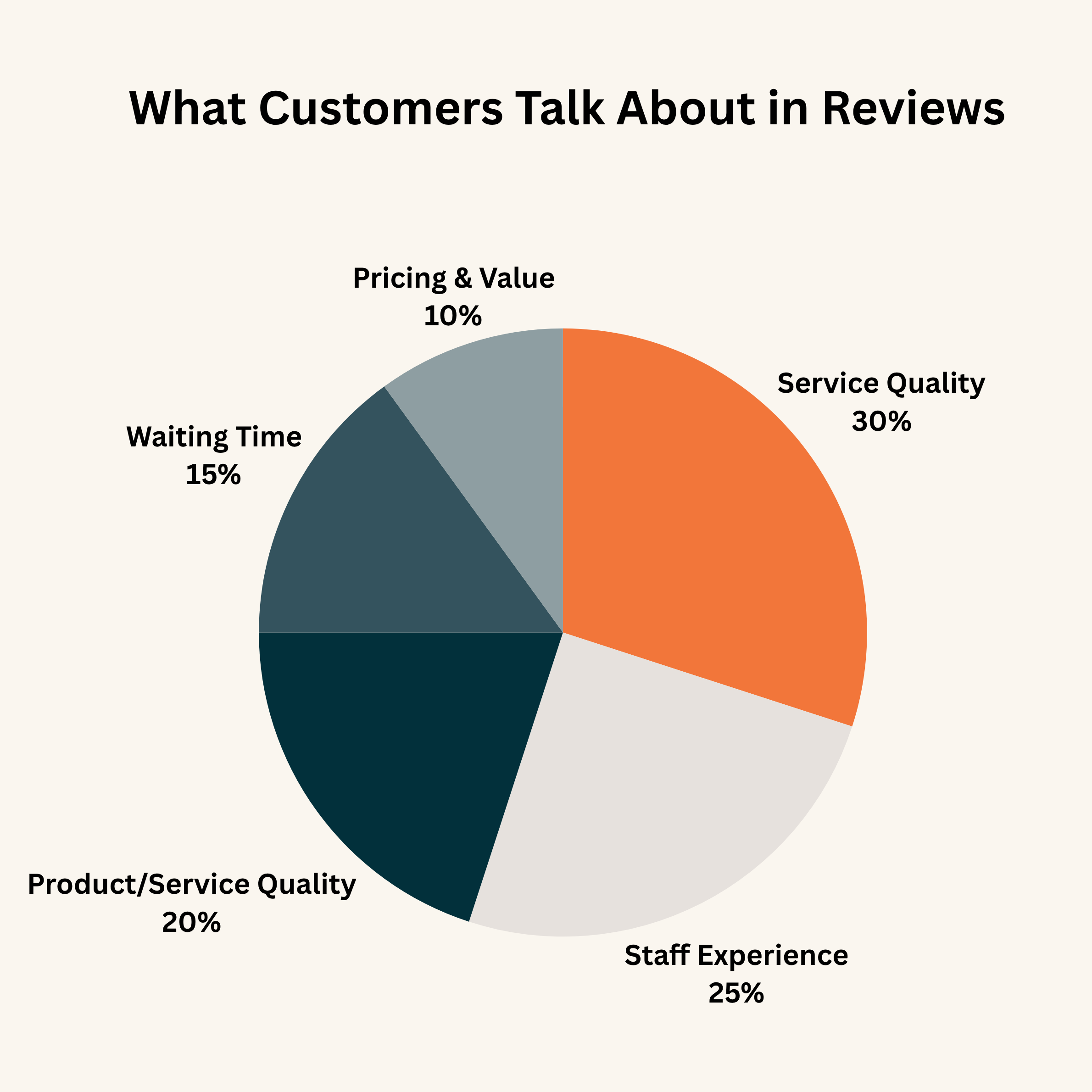
Think about what people mention in reviews.
"Staff was incredibly helpful."
"Food was amazing."
"Had to wait 40 minutes."
"Booking was super easy."
"Delivery was late."
"Packaging could be better."
These aren't random comments.
They're real customer observations, written after experiencing your business.
And unlike a survey, customers often mention things you didn't think to ask about.
That's what makes reviews so powerful.
Your customers are naturally documenting:
What worked.
What didn't.
What surprised them.
What they expected.
What they remembered.
The challenge is that businesses often read these comments individually.
The real value appears when you look at them collectively.
2. One Complaint Is Feedback. A Pattern Is Intelligence.
One customer complaining about slow service could simply be a bad day.
But what if 30 customers mention waiting?
Now you have a pattern.
And what if those reviews mostly come from Friday evenings?
Now you have a possible operational insight.
And what if customers at one location complain about it while customers at another don't?
Now you've found something even more interesting.
You can start asking:
What is different between these locations?
This is where reviews stop being just reputation management.
They become a way to identify business problems hiding in plain sight.
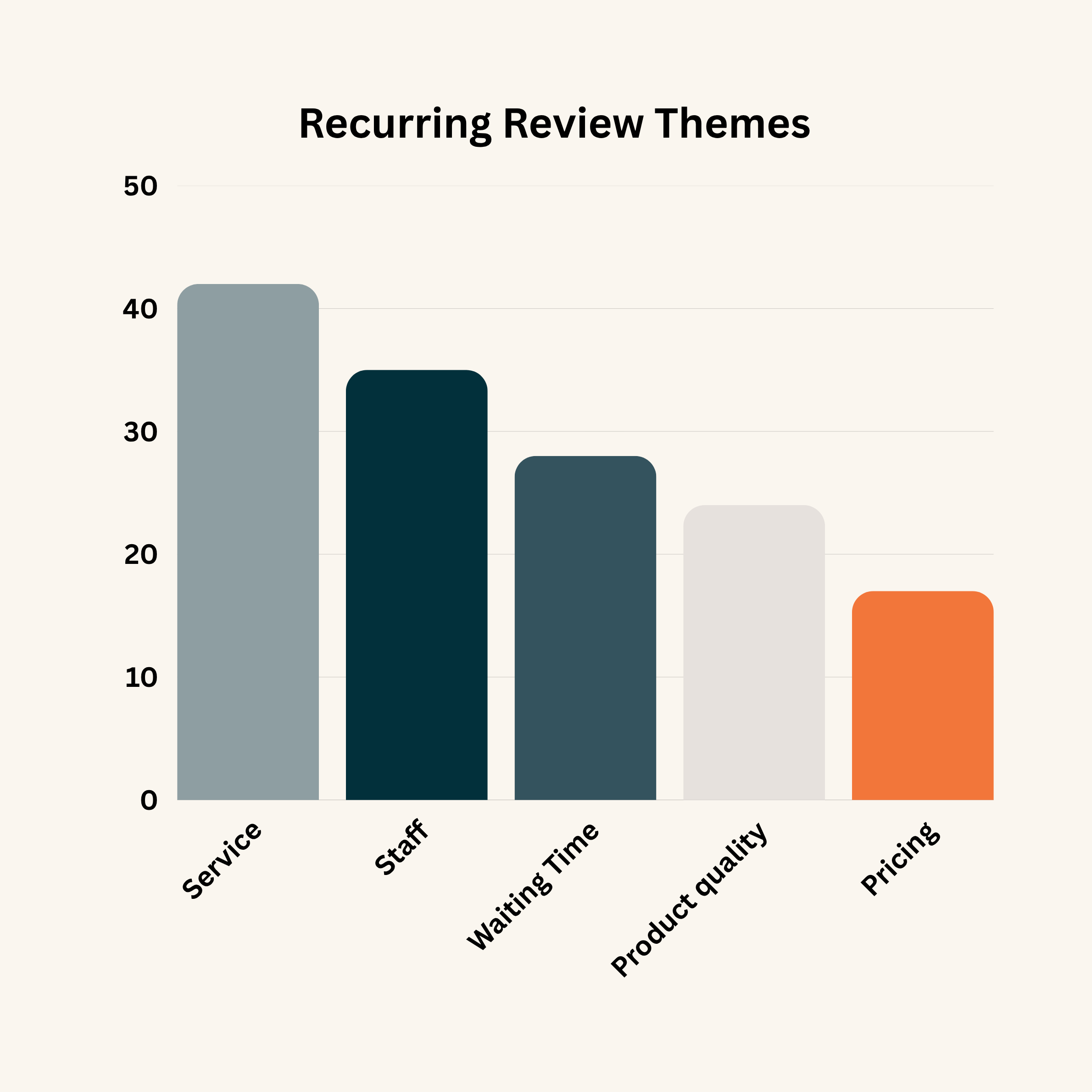
Illustrative example of how recurring themes can reveal business signals.
3. Your Best Reviews Can Tell You What to Double Down On
Businesses usually look at negative reviews and ask:
"What are we doing wrong?"
But there's another question worth asking:
"What are we doing right?"
Suppose customers repeatedly say:
"The staff made us feel welcome."
That's not just a nice compliment.
It could be one of your strongest differentiators.
If customers constantly mention:
"Fast service"
that's something your marketing can confidently highlight.
If they repeatedly mention:
"Easy booking"
protect that experience as you scale.
If customers keep talking about:
"Personal attention"
that's probably something worth preserving.
Your happiest customers are often telling you what makes your business worth choosing.
So don't just use reviews to find weaknesses.
Use them to discover your competitive strengths.
4. The Most Valuable Review Isn't Always the Most Negative One
Here's something businesses often miss.
A review can be overwhelmingly positive and still contain a valuable warning.
For example:
"Loved the food and the staff was amazing. Just had to wait too long for our order."
Overall sentiment?
Positive.
Business insight?
Very specific.
The customer loved the experience — but one part of the journey created friction.
That's why simply sorting reviews into:
Positive / Negative
isn't enough.
You need to understand:
What did they feel?
What were they talking about?
Where in the customer journey did it happen?
Because a review isn't just an emotion.
It's context.
5. Reviews Can Expose Customer Expectations
Sometimes customers aren't really complaining about what you delivered.
They're telling you that what you delivered wasn't what they expected.
A customer saying:
"Great product, but I expected delivery sooner."
isn't necessarily saying your product failed.
They're revealing an expectation gap.
And expectation gaps matter.
Because customers don't judge an experience in isolation.
They compare it with what they thought would happen.
Your reviews can therefore reveal:
What customers expect before buying
What they value most
Where communication is unclear
Which promises create friction
Where your actual experience falls short
That insight can influence everything from marketing copy to service processes.
Sometimes the solution isn't:
"Improve the product."
It might simply be:
"Set a better expectation."
6. Your Competitors' Reviews Are Talking Too
Here's where things get even more interesting.
Your competitors' reviews contain customer intelligence too.
Imagine customers repeatedly praising a competitor for:
"Quick responses."
"Easy booking."
"No waiting."
"Great after-sales support."
That tells you something important.
It tells you what customers in your market have started to expect.
You don't need to copy your competitor.
You need to understand why customers are choosing them.
Your reviews tell you where you stand.
Competitor reviews can tell you where the market is moving.
Together, they give you a much clearer picture of your reputation.
7. The Bigger You Grow, the Harder This Becomes
Reading 20 reviews manually?
Easy.
Reading 200?
Manageable.
Reading 2,000 reviews across 10 locations?
Now you're dealing with a completely different problem.
The information is there.
But humans can't efficiently spot every pattern.
This is where AI-powered reputation analysis becomes valuable.
Instead of simply asking:
"What's our average rating?"
businesses can start asking:
What are customers talking about most?
Which complaints are increasing?
What do customers consistently praise?
Which location has the strongest sentiment?
Where are experience gaps appearing?
What issues keep coming back?
How is customer sentiment changing over time?
Suddenly, hundreds of individual reviews become a much clearer picture.
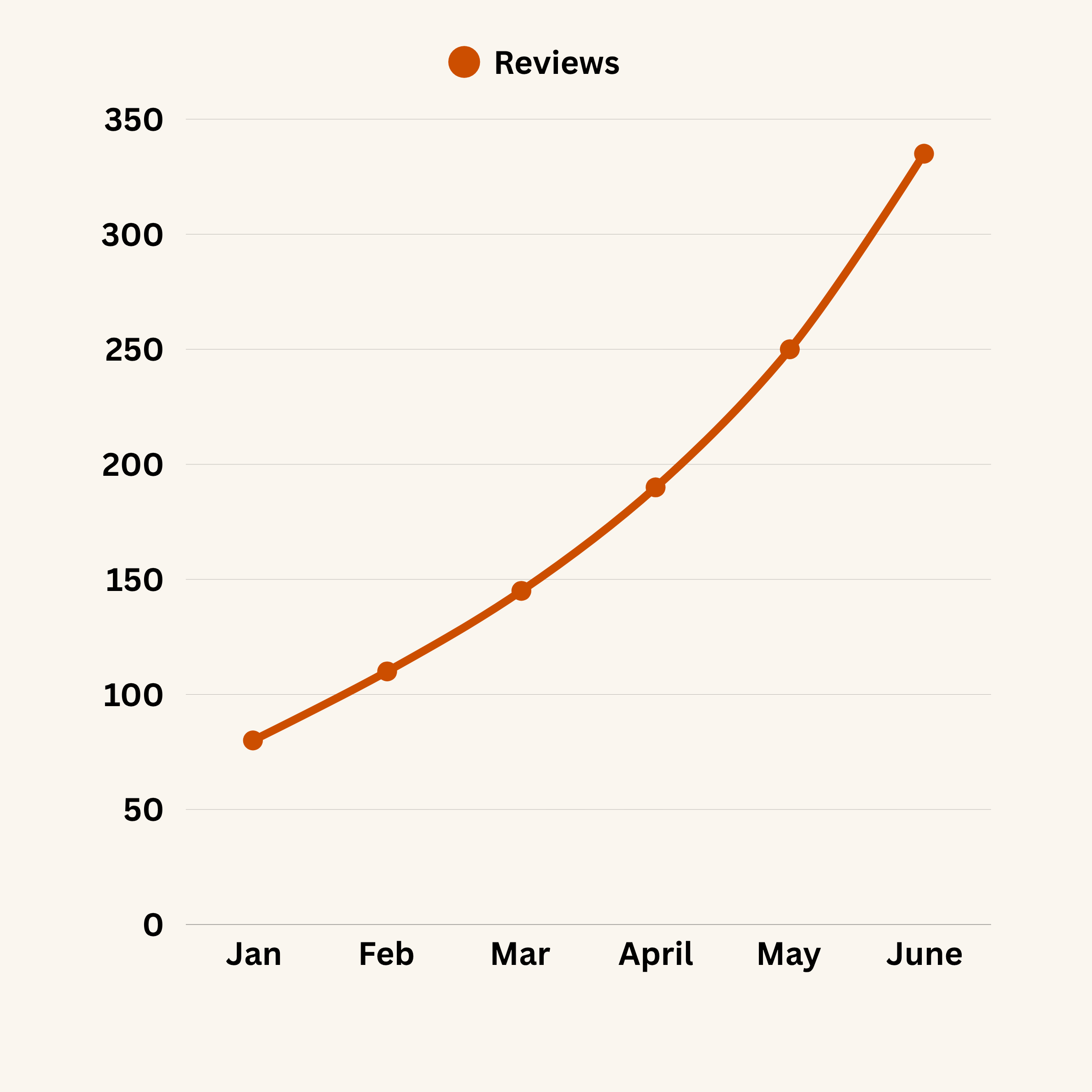
Illustrative growth in review volume.
8. This Is the Shift From Reputation Management to Reputation Intelligence
For years, reputation management meant:
Get reviews.
Respond to reviews.
Maintain your rating.
That's still important.
But businesses now have the opportunity to go further.
Collect → Understand → Act → Improve
Your reviews can become a feedback loop.
A customer mentions long waiting times.
↓
The business identifies a pattern.
↓
The process gets improved.
↓
Future customers have a better experience.
↓
New reviews reflect that improvement.
That's reputation working as a business improvement system, not just a marketing activity.
9. And This Is Where StarOwl Fits In
StarOwl helps businesses look at their reputation as more than a Google rating.
Because the real question isn't:
"How many stars do we have?"
It's:
"What are our customers telling us?"
StarOwl brings the focus closer to the signals behind your reputation — helping businesses understand customer sentiment, identify patterns, monitor reputation, and turn customer feedback into something they can actually act on.
Instead of:
Read → Reply → Forget
businesses can move toward:
Read → Understand → Act → Improve
And that's a much more powerful way to think about customer feedback.
Your Reviews Are a Conversation With Your Business
Your customers are already giving you feedback.
Every day.
Through every review.
The problem isn't a lack of information.
It's that most businesses aren't looking at that information as intelligence.
A star rating can tell you whether you're winning.
A review can tell you why.
A pattern can tell you what to do next.
And when you consistently turn those patterns into action, your reputation becomes more than something you manage.
It becomes something you can learn from.
So the next time you open your Google reviews, don't just ask:
"What's our rating?"
Ask:
"What are our customers trying to tell us?"
Because somewhere inside those reviews is a better version of your business.
You just have to listen.
Turn Customer Feedback Into Business Intelligence
Don't just monitor your reputation. Understand it.
Discover what your customers are really saying with StarOwl and turn review data into insights that help your business make better decisions.
Your customers are already talking.
It's time to start listening.