
A Customer Can Love Your Business and Still Choose Someone Else.
A customer can have a great experience with your business.
They can love your product.
They can recommend you to their friends.
They can leave your store thinking, “I'll definitely come back.”
And yet, the next person searching for exactly what you offer can still choose your competitor.
Not because your business is worse.
Not because your service isn't good enough.
Sometimes, it's simply because the other business looked like the safer choice online.
That is the uncomfortable reality of local business today.
The customer doesn't experience your business first.
They experience your online presence first.
And increasingly, that means Search, Maps, reviews, photos, social content, and everything else that helps them decide whether you're worth their time.
The First Experience Happens Before the First Visit
Think about the last time you searched for a restaurant, salon, clinic, hotel, coaching institute, repair service, or store.
You probably didn't start by calling every business in the area.
You searched.
You opened a few listings.
You looked at ratings.
You checked reviews.
You looked at photos.
You checked whether the information seemed current.
Maybe you compared two or three businesses.
Then you chose one.
The interesting part?
The businesses you didn't choose may have been perfectly good too.
You simply didn't have enough reason to choose them.
Google itself describes Business Profiles as a way for customers to find businesses on Search and Maps and for businesses to control how their information appears there.
And current consumer research shows just how much happens during that research stage.
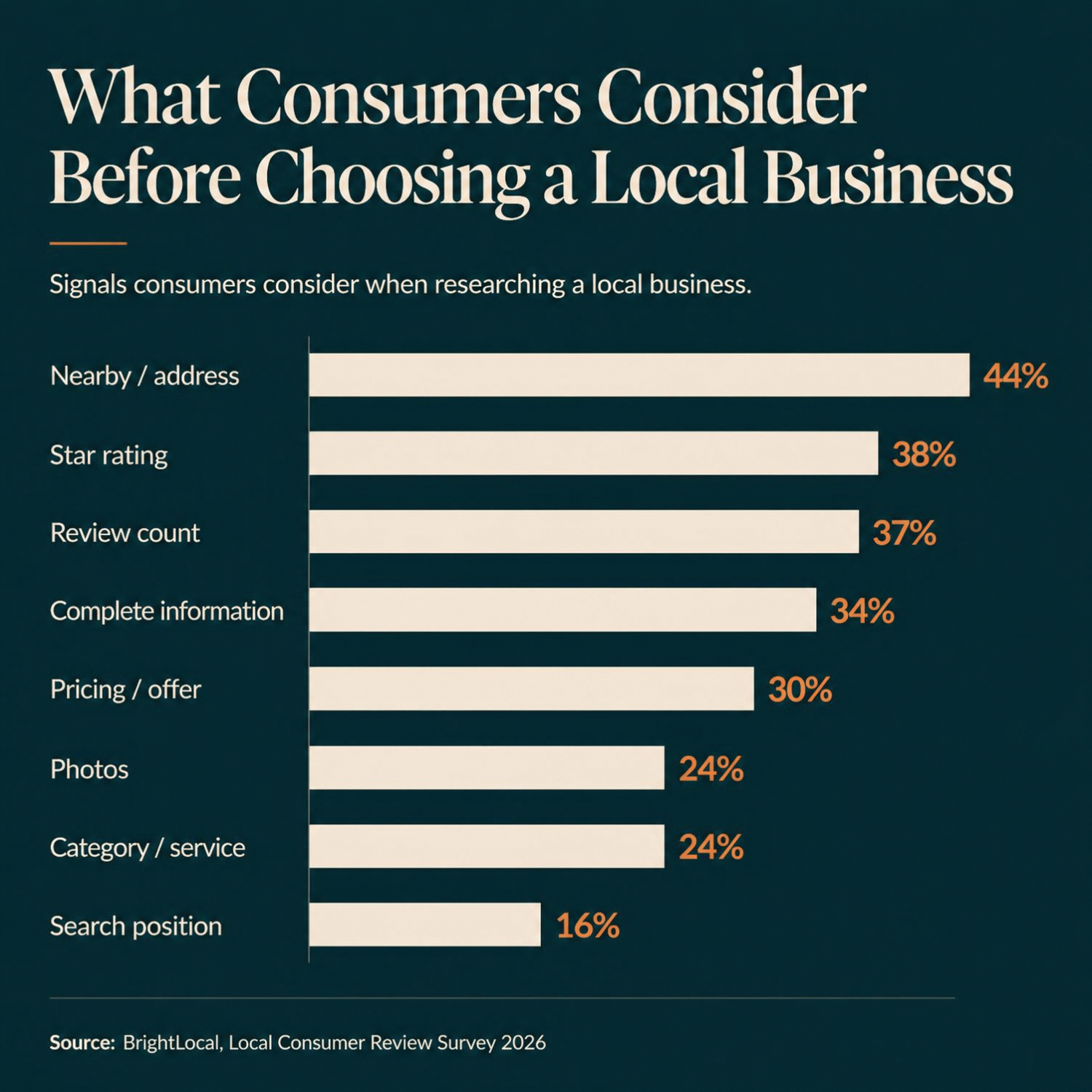
BrightLocal's 2026 research found that when consumers research a local business, the factors they most commonly consider include proximity, star rating, review count, complete information, pricing or offers, photos, category, and position in search results. Only 6% said they simply clicked the top result.
So the question isn't simply:
“Are you visible?”
It's:
“What does your visibility tell people?”
Your Reputation Is Part of Your Sales Process
For years, businesses have treated reviews as something that happens after the sale.
Customer buys.
Customer uses the service.
Customer leaves a review.
Done.
But that is only one side of the equation.
That same review can influence the next sale.
The customer who leaves a review today may be helping convince another customer tomorrow.
That's why reputation isn't just a customer-service activity.
It is part of the acquisition journey.
Consider the chain:
Great Experience
↓
Happy Customer
↓
Review / Recommendation
↓
Stronger Online Reputation
↓
More Trust During Search
↓
Higher Chance of Being Considered
The experience happens offline.
But the business can continue benefiting from it online.
And Customers Are Looking at More Than Your Star Rating
A 4.8-star rating looks great.
But a customer doesn't necessarily stop there.
They may read the actual reviews.
They may look at photos.
They may check whether the information is complete.
They may look at recent activity.
They may compare you with another business.
They may even leave Google and check your website or social media.
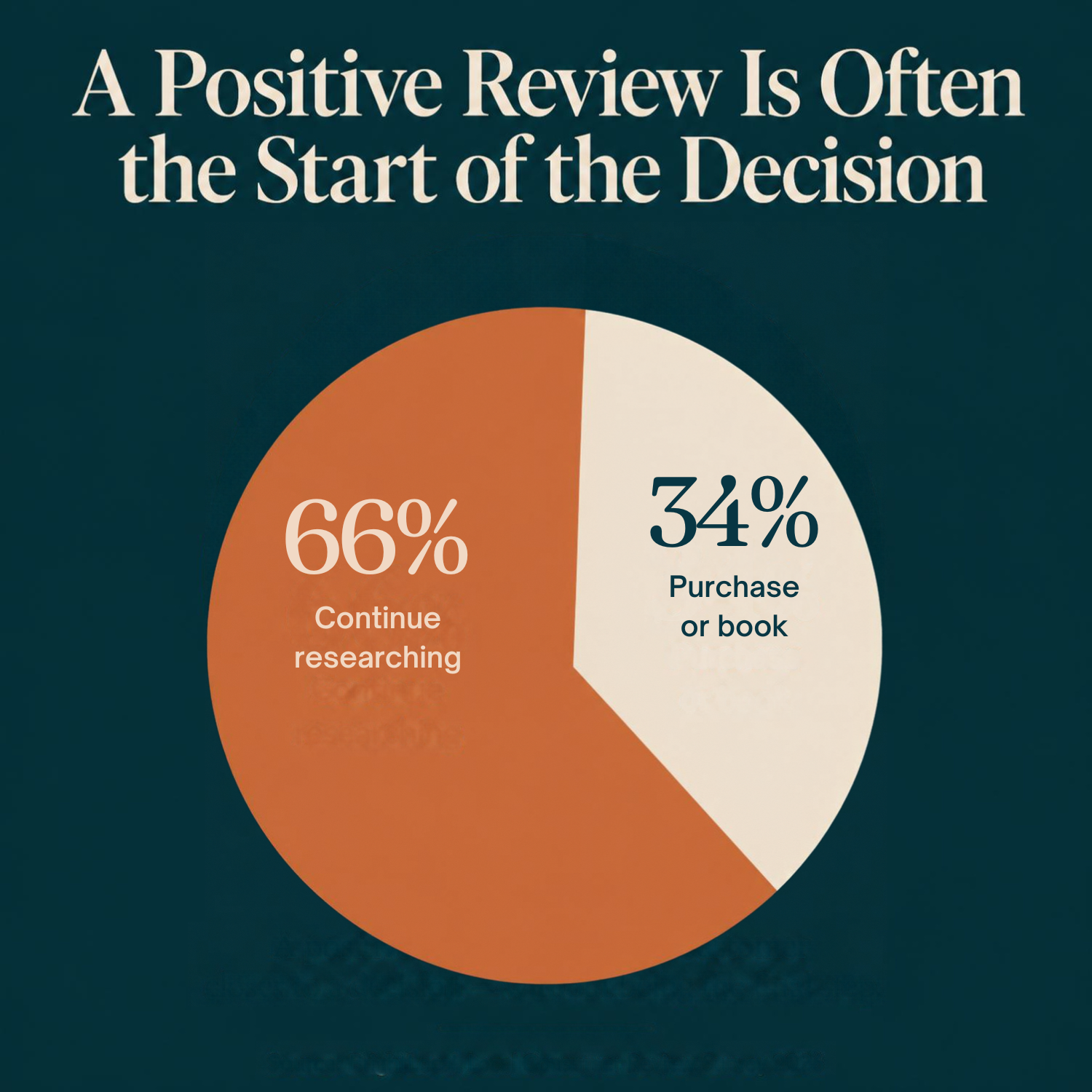
BrightLocal's 2026 research found that after reading positive reviews, 66% of consumers said they would continue researching, while 34% reported being ready to purchase or book. The research also found that 54% would visit the business's website after reading positive reviews.
That tells us something important:
A review doesn't always close the sale.
Sometimes, it simply gets you into the next stage of consideration.
What Customers Look For During Local Research
According to BrightLocal's 2026 consumer research, these were among the factors consumers considered when researching local businesses:
Notice what's happening here.
Search position is only one part of the decision.
A business can appear prominently and still lose the customer if the rest of the profile doesn't give them enough confidence.
That is why local visibility and reputation have to work together.
The Difference Between Being Found and Being Chosen
This is where many businesses get stuck.
They focus on:
“How do I appear on Google?”
But customers are asking:
“Why should I choose you?”
Those are two very different questions.
Being found puts your business in front of the customer.
Your reputation helps give that customer a reason to continue.
Think of it as two stages:
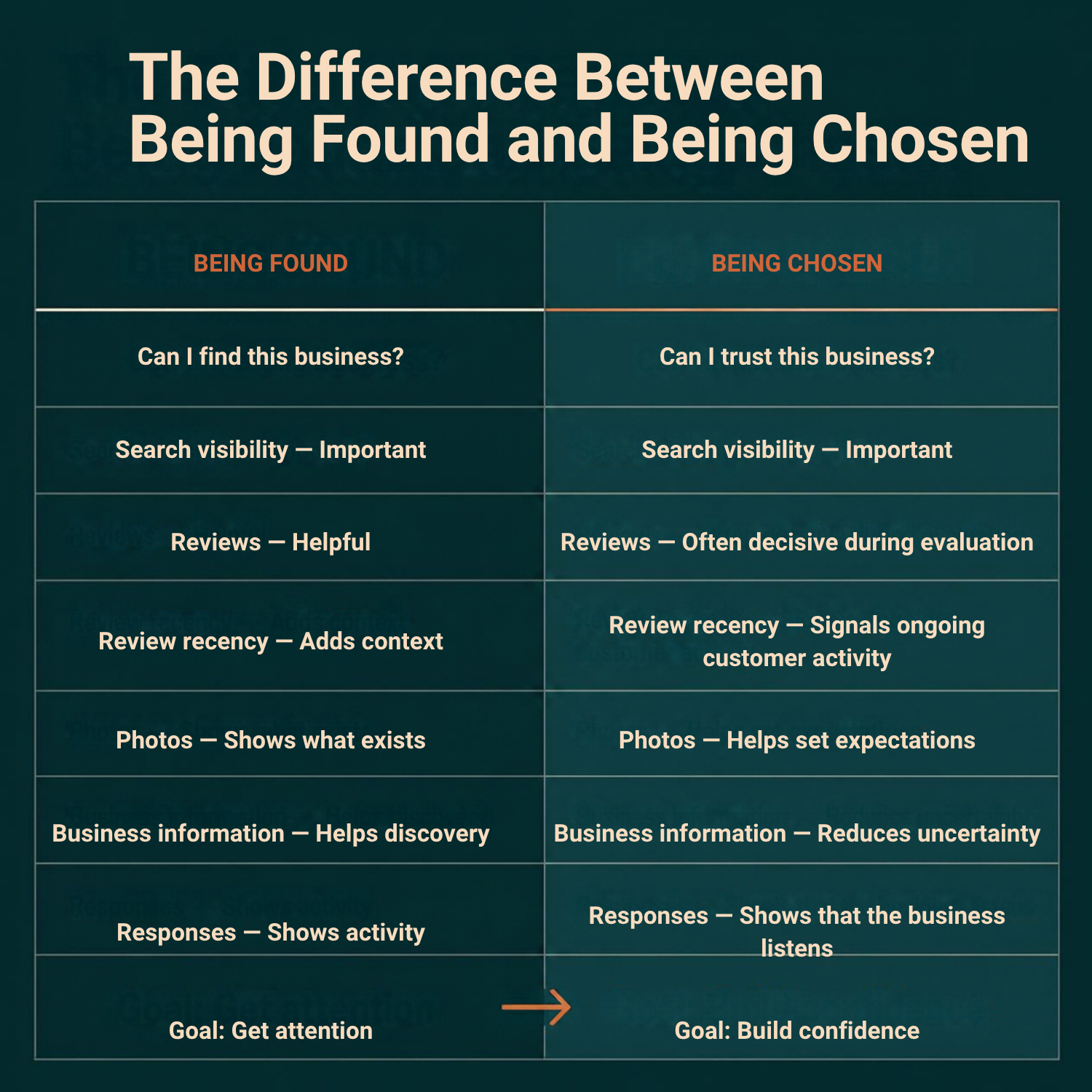
The business that understands all four stages doesn't just try to rank.
The Reputation Gap
Here's where the problem gets interesting.
Imagine two businesses.
Business A
Excellent customer service
Loyal customers
Strong offline reputation
Great products
Old reviews
Infrequent updates
Few recent customer experiences visible online
Business B
Comparable service
Comparable pricing
Consistent review activity
Fresh customer feedback
Updated information
Strong photos
Active online presence
A customer who has never visited either business doesn't know what happens behind the scenes.
They only see the evidence available to them.
And that creates what we can call the Reputation Gap:
The difference between how good your business actually is and how good it appears to someone discovering you for the first time.
The larger that gap becomes, the more your business depends on customers taking a chance on you.
And customers don't always take chances.
Your Happiest Customers Are an Untapped Asset
There is another side to reputation management that businesses often overlook.
Your customers may already be willing to talk about you.
They just don't always remember to do it.
BrightLocal's 2025 Local Consumer Review Survey found that 96% of consumers were open to writing a review, even though not everyone had actually written one recently.
That's a fascinating distinction.
The problem isn't necessarily:
“Customers don't want to review us.”
Sometimes the problem is:
“We never made it easy or timely for them to do it.”
A great customer experience creates the raw material.
A good reputation process turns that experience into visible proof.
From Happy Customer to Visible Reputation
The journey can be surprisingly simple.
01 — Create the experience
Give customers something worth talking about.
02 — Ask at the right moment
Don't wait weeks after the experience has faded.
03 — Make the action easy
The fewer steps involved, the easier it is for a customer to follow through.
04 — Let the experience become visible
A genuine customer review becomes part of the information future customers can discover.
05 — Respond
A review shouldn't feel like the end of the conversation.
It can be another opportunity to show that the business is listening.
Reviews Are Also a Conversation
A review isn't just a number.
It's a public interaction between a customer and a business.
Someone says:
“The service was excellent.”
You respond.
Someone says:
“I had to wait too long.”
You respond.
Someone asks a question.
You respond.
Someone recommends you.
You acknowledge it.
Those responses are visible to people who weren't part of the original interaction.
BrightLocal's 2025 research found that consumers are more likely to use businesses that respond to reviews, with responses to different types of feedback affecting consumer perceptions of the business. The same research also found that consumers consistently value businesses responding to feedback rather than leaving reviews unanswered.
So responding isn't just about thanking the person who wrote the review.
It's also about communicating with the next person reading it.
The Trust Equation Is Changing
There was a time when a five-star rating could do much of the heavy lifting.
Today, customers have more information.
They can read the actual experience.
They can compare businesses.
They can look at photos.
They can check multiple platforms.
They can use social media.
They can even use AI tools to research local businesses.
BrightLocal's 2026 research found that 23% of consumers used AI tools during their most recent local-business search, while 75% used more than one channel during that search.
That means the modern customer journey isn't one straight line.
It's more like this:
Search → Compare → Verify → Explore → Decide
And your reputation needs to survive every step.
Trust in Online Reviews Has Changed
There's another important shift.
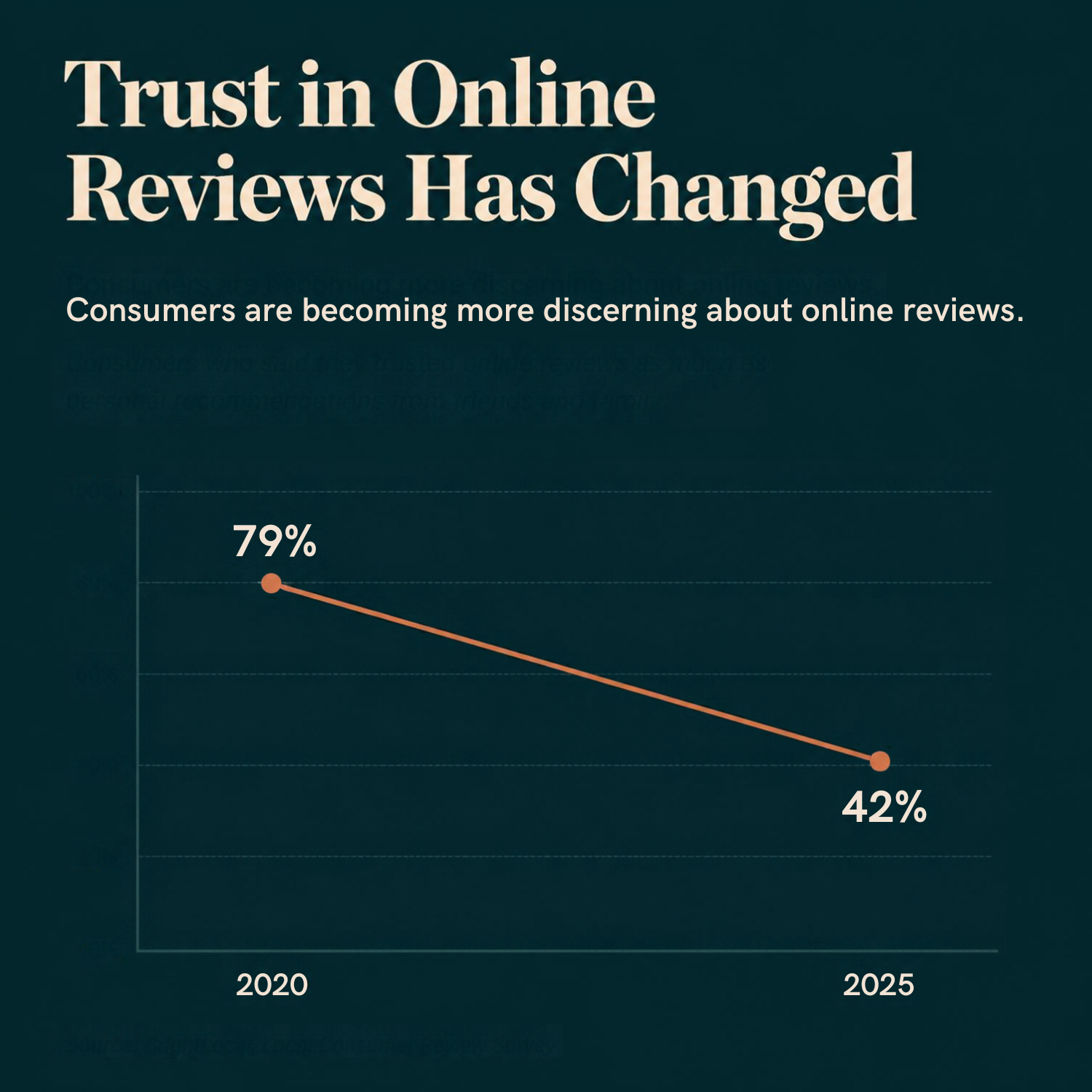
Consumers still use reviews heavily, but they have become more cautious about taking them at face value.
BrightLocal's historical research found that the share of consumers who said they trusted online reviews as much as personal recommendations from friends and family fell from 79% in 2020 to 42% in 2025.
That doesn't mean reviews have stopped mattering.
Quite the opposite.
It means customers are becoming more discerning about them.
They want context.
They want details.
They want genuine experiences.
They want signals that feel real.
The takeaway isn't that businesses should chase a perfect rating.
It's that authenticity and context matter.
A collection of vague five-star ratings doesn't tell the same story as detailed, genuine customer experiences.
What Happens After a Positive Review?
A positive review can create momentum.
But it doesn't always mean an immediate purchase.
BrightLocal's 2026 research found:
66% continue researching after reading positive reviews.
34% move toward purchase or booking.
54% visit the business website.
37% read more reviews.
24% visit the business's social media channels.
That gives us a useful picture of the modern local-business funnel.
A review can therefore be viewed as a bridge, not necessarily the final destination.
It moves the customer from:
“I've found you.”
to:
“I'm seriously considering you.”
The Businesses That Win the Moment of Choice
This isn't about having the most reviews.
It isn't about having a perfect 5.0 rating.
It isn't even about being everywhere.
It's about making sure the information customers find gives them enough confidence to take the next step.
That means paying attention to:
Visibility — Can customers find you?
Accuracy — Is your information complete and current?
Reviews — Are customers sharing genuine experiences?
Recency — Does your profile feel active?
Responses — Are you listening and engaging?
Photos — Does your online presence reflect the real experience?
Consistency — Does your reputation match across channels?
Conversion — Is it easy for a customer to contact, visit, book, or buy?
These aren't isolated marketing activities.
Together, they create a digital first impression.
Reputation Management Shouldn't Be a Monthly Task
The biggest mistake is treating reputation like something you check once in a while.
Open Google.
Look at reviews.
Reply to a few.
Close the tab.
That's not reputation management.
That's reputation maintenance.
Modern reputation management is continuous.
Every new customer creates a potential review.
Every review creates a potential conversation.
Every conversation creates another signal for future customers.
Every search creates another opportunity to be considered.
The process keeps moving.
This Is Where StarOwl Comes In
StarOwl is built around a simple idea:
Your business shouldn't have to manually manage every signal customers see online.
From helping businesses stay active on Google to making customer review collection easier, responding to reviews, and keeping an eye on reputation, StarOwl brings these pieces together.
Instead of asking:
“Did someone leave us a review this week?”
or:
“Did we respond to that negative review?”
or:
“When was the last time we posted something to our Google Business Profile?”
you can build a system around those activities.
Because your online reputation shouldn't depend on someone remembering to check it.
Your Customer Already Knows Why They Love You.
The real challenge is making sure the next customer can see it.
A customer can love your business and still choose someone else.
Not because they don't value what you offer.
But because they haven't experienced it yet.
Until they do, they judge what they can see.
Your search presence.
Your reviews.
Your photos.
Your information.
Your activity.
Your responses.
Your reputation.
Your business may be better than the competition.
But before a customer can experience that difference,
they need a reason to choose you.
And increasingly, that reason begins online.
The StarOwl Perspective
Don't just build a great business.
Build a reputation that makes it easier for people to choose it.