
What Happens Between “I’ll Think About It” and a Lost Customer?
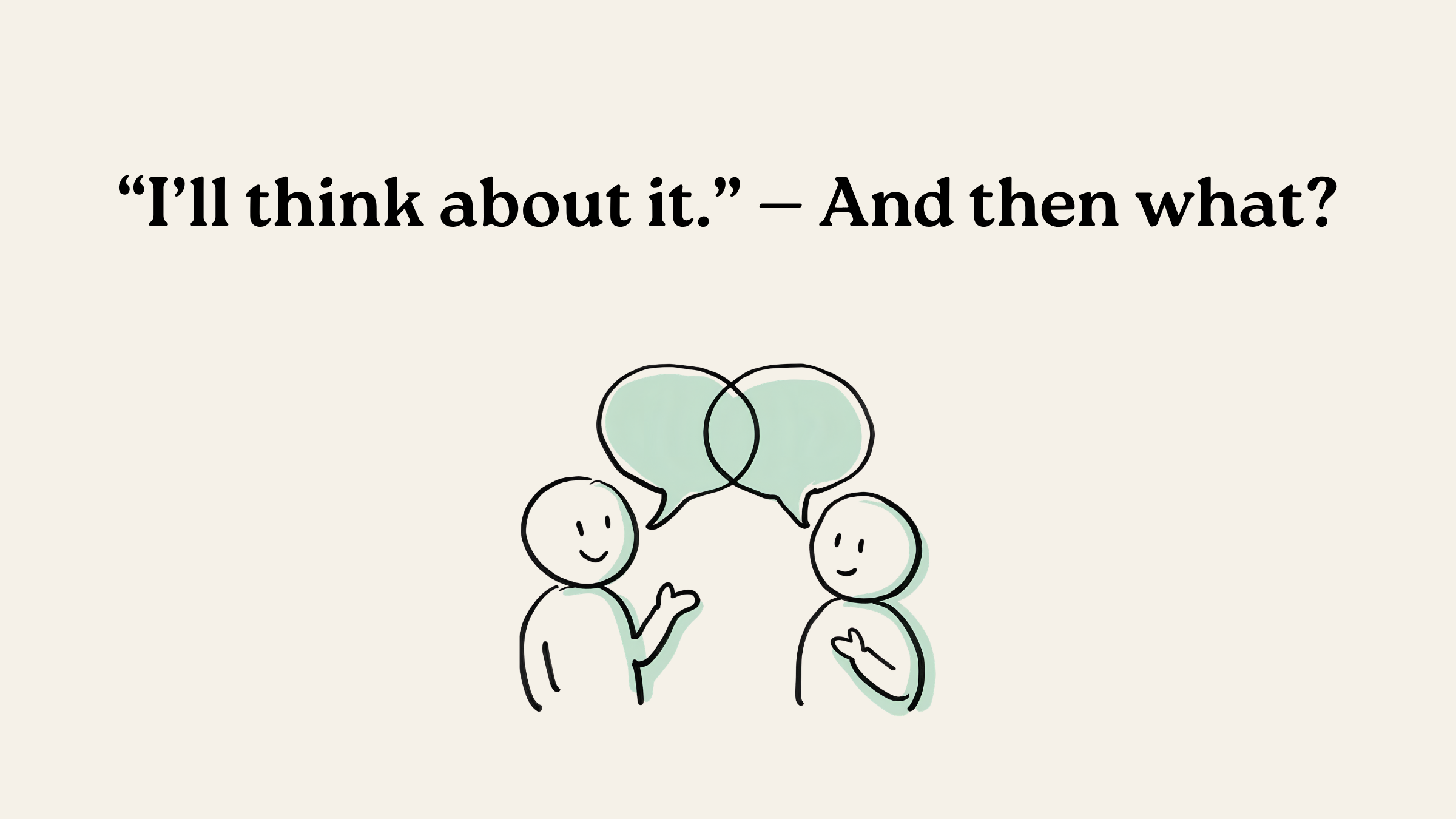
What Happens Between “I’ll Think About It” and a Lost Customer?
A customer asks for the price.
You answer.
They ask a few more questions. You explain the product, share the details, maybe even send a quotation.
Then comes the sentence every salesperson knows:
“I’ll think about it.”
So you wait.
One day passes.
Then three.
Then a week.
The customer gets busy. Your team gets busy. New leads arrive. The old conversation slowly disappears into the inbox.
There was no rejection.
No complaint.
No “not interested.”
Just silence.
And somewhere between “I’ll think about it” and that silence, a potential customer becomes a lost customer.
But here's the interesting part:
The customer didn't always say no.
Sometimes, the conversation simply stopped at the exact moment when it needed to continue.
“I’ll Think About It” Is Not a Rejection
That sentence sounds simple.
The reason behind it isn't.
When a customer says “I'll think about it,” they could actually mean:
“I'm comparing you with another option.”
“The price is higher than I expected.”
“I need to ask someone else before deciding.”
“I have one more question.”
“I'm interested, but I'm not ready yet.”
“I'll come back to this later.”
Or simply, “Something else distracted me.”
From the outside, all of these situations look exactly the same:
The customer stopped replying.
But they aren't the same customer problem.
And that's where many businesses make their first mistake.
They treat silence as a single category.
What Actually Happens After “I’ll Think About It”?

Customer intent rarely disappears in one moment.
It usually fades through a series of small steps.
Interested → Hesitant → Delayed → Distracted → Forgotten → Lost
The customer may never consciously decide:
“I'm not buying from this business.”
Instead, something more ordinary happens.
They get busy.
Another brand follows up.
They see another offer.
Their priority changes.
The original conversation moves further down their inbox.
And eventually, the decision gets made somewhere else.
The Follow-Up Gap Is Where Good Leads Go Quiet
Businesses spend a lot of effort generating leads.
Ads.
Instagram.
IndiaMART.
Website forms.
Referrals.
WhatsApp campaigns.
But generating a conversation is only the beginning.
The real question is:
What happens after the customer shows interest?
Consider this:
A customer sends an enquiry at 4:30 PM.
Your team replies at 4:45 PM.
The customer asks for pricing.
Your salesperson responds.
The customer says:
“Okay, I'll think about it.”
The salesperson plans to follow up tomorrow.
Tomorrow becomes the day after tomorrow.
A new lead comes in.
The salesperson moves on.
The customer moves on too.
No single mistake happened.
That's exactly why this revenue leak is so difficult to see.
Your Business May Be Following Up. But Is It Following Up With Context?
There is a big difference between following up and continuing a conversation.
Traditional automation often thinks in terms of time:
Day 1: Send message.
Day 3: Send reminder.
Day 7: Send another reminder.
But customers don't think in days.
They think in questions, concerns, priorities and decisions.
Imagine two customers.
Customer A
“Does installation come with this?”
You answer:
“Yes, installation is included.”
They say:
“Okay, I'll think about it.”
Their hesitation may simply be about comparing options.
Customer B
“₹30,000 is a little expensive for me.”
You explain the pricing.
They say:
“I'll think about it.”
Their hesitation is probably different.
Maybe they're evaluating value.
Maybe they need a different package.
Maybe they need a payment option.
Yet a traditional system might send both customers:
“Hi! Just checking if you're still interested.”
Same timing.
Same message.
Completely different situations.
That's the problem.

The shift is from “Did we follow up?” to “Did we give the customer a reason to reply?”
Not Every Silent Customer Is the Same
A customer who stopped responding isn't necessarily a dead lead.
They may be one of several different types of customers.
The Researcher
They're comparing you with competitors before making a decision.
The Hesitant Buyer
They want the product but have an unresolved concern.
The Busy Buyer
They were interested but simply got distracted.
The Decision Maker
They need approval from a partner, manager, family member or team.
The Almost-Ready Buyer
They already like what you're offering but aren't ready to act today.
The important thing is this:
All five can look identical inside a CRM.
They can all appear as:
“No response.”
But the conversation contains clues.
The customer's questions.
The objections.
The products they asked about.
The timing.
The last thing they said.
The stage they reached.
That's valuable information.

Illustrative model for explanation purposes; actual customer behaviour varies by business and industry.
The Cost of Silence Grows With Time
The longer a customer stays inactive, the more opportunities there are for their attention to move somewhere else.
That doesn't mean every lead follows the exact same pattern.
But the principle is simple:
Momentum is easier to maintain than to rebuild.
A relevant message shortly after a conversation feels natural.
The same message weeks later can feel completely disconnected.
Customer Conversation Momentum Over Time

Illustrative model — not a measured industry benchmark. Actual customer behaviour varies.
The Answer Isn't “Send More Messages”
This is where businesses often misunderstand automation.
The obvious solution to a silent customer is:
Send more follow-ups.
But more messages don't automatically create more conversions.
If the first message was irrelevant, sending three more irrelevant messages doesn't solve the problem.
A customer doesn't need another:
“Hi, just following up!”
They need a reason to continue.
That reason could be:
An answer to their previous question.
Clarification around pricing.
A comparison they were looking for.
More information about the product.
A reminder that is actually relevant to their situation.
A solution to the concern they mentioned earlier.
Or simply the right message at the right time.
The goal isn't to chase the customer.
The goal is to remove the reason they stopped moving forward.
What Changes When AI Understands the Conversation?
This is where AI Agents become fundamentally different from simple automation.
A basic automation might see:
Customer inactive for 7 days.
An AI Agent can work with much more context:
Customer asked about pricing, compared two options, mentioned a budget concern, and then stopped responding.
The first tells you what happened.
The second gives you a clue about what should happen next.
That distinction matters.
Because the next action shouldn't always be:
Send message.
Sometimes it should be:
Answer.
Sometimes:
Clarify.
Sometimes:
Re-engage.
Sometimes:
Offer an alternative.
And sometimes:
Wait.
That's the difference between automating messages and automating customer conversations.

Don't automate the message.
Automate the next meaningful step.
Same Customer. Two Completely Different Outcomes.
Let's take the same conversation.
WITHOUT CONTEXT
Customer:
“What's the price?”
Business:
“₹30,000.”
Customer:
“Okay, I'll think about it.”
↓
No follow-up.
↓
Customer gets distracted.
↓
Conversation goes cold.
↓
Lost opportunity.
WITH CONTEXT
Customer:
“What's the price?”
Business:
“₹30,000.”
Customer:
“Okay, I'll think about it.”
↓
Conversation context is understood.
↓
A relevant follow-up is sent later.
↓
Customer gets the information they actually needed.
↓
Conversation reopens.
↓
Opportunity continues.
The Revenue You Don't See in Your Lead Dashboard
Most businesses know how many leads they generated.
They know their ad spend.
They know their cost per lead.
They know how many customers converted.
But there is another question worth asking:
How many interested conversations simply stopped?
Imagine 100 qualified conversations.
Some convert immediately.
Some clearly say no.
But a third group can sit somewhere in between:
Interested.
Uncertain.
Inactive.
These aren't necessarily lost customers.
They're unfinished opportunities.
And businesses often keep spending money to acquire new leads while old opportunities are still sitting inside their inbox.
That's why re-engagement isn't just a customer-service activity.
It can be a revenue strategy.
The New Customer Journey Isn't Linear
The old model looked something like:
Lead → Salesperson → Follow-Up → Conversion
But modern customer conversations are rarely that clean.
A more realistic journey looks like:
Lead → Conversation → Questions → Hesitation → Silence → Re-engagement → Decision → Conversion
And every one of those stages can contain useful context.
The businesses that can act on that context have an advantage.
Because they aren't just collecting leads.
They're understanding what happens between the lead and the outcome.
Where Nextel Fits In
Nextel's AI Agents are designed to help businesses manage those moments between conversations.
Instead of treating every inactive customer as simply “no response,” AI can use the conversation history and context to help determine what should happen next.
A lead can be qualified.
A customer can be engaged.
A conversation can be followed up.
An inactive customer can be re-engaged.
A missed opportunity can be recovered.
And the important part is that these actions don't have to exist as disconnected manual tasks.
They can become part of one continuous customer journey.
Because your WhatsApp inbox shouldn't just tell you:
who messaged you.
It should help you understand:
what happens next.
The Customer Didn't Always Say No.
Sometimes they said:
“I'll think about it.”
Sometimes:
“I'll get back to you.”
Sometimes:
“Let me discuss it.”
Sometimes they said nothing at all.
And sometimes, they simply got distracted.
Those aren't always rejections.
They're unfinished conversations.
The businesses that learn to recognize the difference won't necessarily need to generate more and more leads.
They'll get better at doing something equally important:
Making more of the conversations they already have.
Because the gap between:
“I'll think about it”
and
“I bought it somewhere else”
isn't always a rejection.