
Google Reputation Velocity & Local SEO: The Hidden Growth Engine for Multi-Location Brands
For years, businesses treated their Google review count as a scoreboard.
500 reviews looked better than 100.
4.8 stars looked better than 4.5.
And more reviews generally meant more trust.
But for a multi-location business competing in local search, the total number of reviews is only part of the story.
Imagine two businesses:
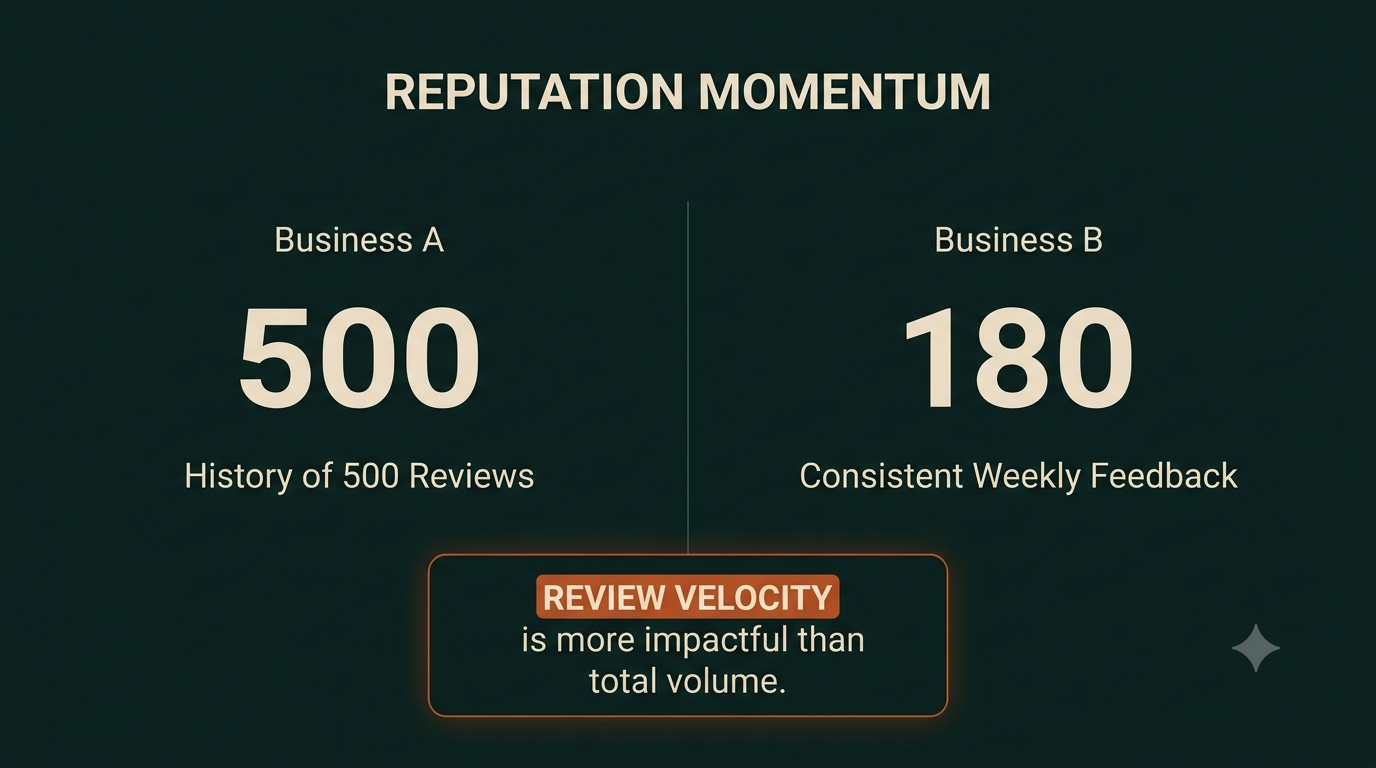
Business A: 500 reviews, but its last review came three months ago.
Business B: 180 reviews, with new customer feedback arriving consistently every week.
Which one looks more active, relevant, and trustworthy to a customer searching today?
That is where a more useful operational metric comes into play:
What Is Reputation Velocity?
Reputation Velocity is the pace and consistency at which a business generates fresh customer feedback and manages its online reputation.
It looks beyond the total number of reviews and considers the ongoing movement of a business's reputation.
Key components include:
Review frequency
Review recency
Rating consistency
Customer feedback volume
Review response activity
Location-level reputation trends
For multi-location brands, this becomes particularly important because reputation isn't built once.
It has to be maintained continuously across every location.
Why Review Volume Alone Isn't Enough
A large review count creates social proof, but it doesn't necessarily tell the complete story about what is happening at a location today.
Consider a restaurant with:
4.8★ | 1,200 reviews
At first glance, that looks impressive.
But if most of those reviews were generated years ago, a customer may still wonder:
"Is this place still providing the same experience?"
Now consider another restaurant:
4.7★ | 450 reviews
with fresh reviews arriving every few days.
The second profile communicates something different:
Customers are still visiting. Customers are still sharing their experiences. The business is still active.
This is why brands should stop thinking about reputation as a static number and start treating it as an ongoing operational process.
Reputation = Volume + Quality + Recency + Consistency
The objective isn't simply to collect more reviews.
The objective is to create a healthy, continuous feedback loop.
1. How Reputation Activity Supports Local Search
Google's local search systems consider multiple signals when determining which businesses appear prominently for local searches.
These can include:
Relevance to the search query
Distance from the searcher
Prominence
Google Business Profile information
Reviews and ratings
Website and local relevance
Links and citations
User interactions and other contextual signals
Reviews should therefore not be treated as an isolated ranking hack.
Instead, they are one component of a broader local-search ecosystem.
Fresh customer feedback can also strengthen the trust layer around a business.
A customer searching:
"best dental clinic near me"
isn't simply evaluating the star rating.
They may also look at:
How many people reviewed the clinic
How recently people reviewed it
What customers are saying
Whether the business responds
Whether recent experiences appear positive
Whether the profile looks active and legitimate
This creates an important distinction:
Review Volume tells you how much reputation you have accumulated.
Reputation Velocity tells you how actively that reputation is being maintained.
2. The Freshness Problem
One of the biggest mistakes businesses make is running occasional review campaigns.
For example:
January: 80 reviews
February: 5 reviews
March: 2 reviews
April: 0 reviews
May: 1 review
The business may have generated a significant number of reviews, but the process isn't sustainable.
A healthier operational pattern could look more like:
January: 20
February: 24
March: 22
April: 27
May: 25
The second pattern creates something far more valuable:
Consistency.
Instead of treating reviews as a quarterly marketing campaign, businesses can make reputation generation part of their everyday customer journey.
3. Why Consistency Matters for Multi-Location Brands
This problem becomes significantly harder when a company has multiple locations.
Imagine a brand with 50 stores.
Each store generates:
Hundreds of customer transactions
Dozens of potential review opportunities
Different customer experiences
Different managers
Different response times
Different review volumes
Now multiply that across 50 locations.
A centralized marketing team cannot realistically depend on every branch employee to remember:
"Ask the customer for a Google review after every successful interaction."
Some employees will remember.
Some won't.
Some will ask verbally.
Some will send a message.
Some branches will generate 30 reviews.
Another branch might generate only 3.
This creates reputation inequality across locations.
And that can become a serious operational challenge for a growing brand.
4. Reputation Velocity Across Locations
For a multi-location business, don't look only at the company's average rating.
Look at reputation performance location by location.
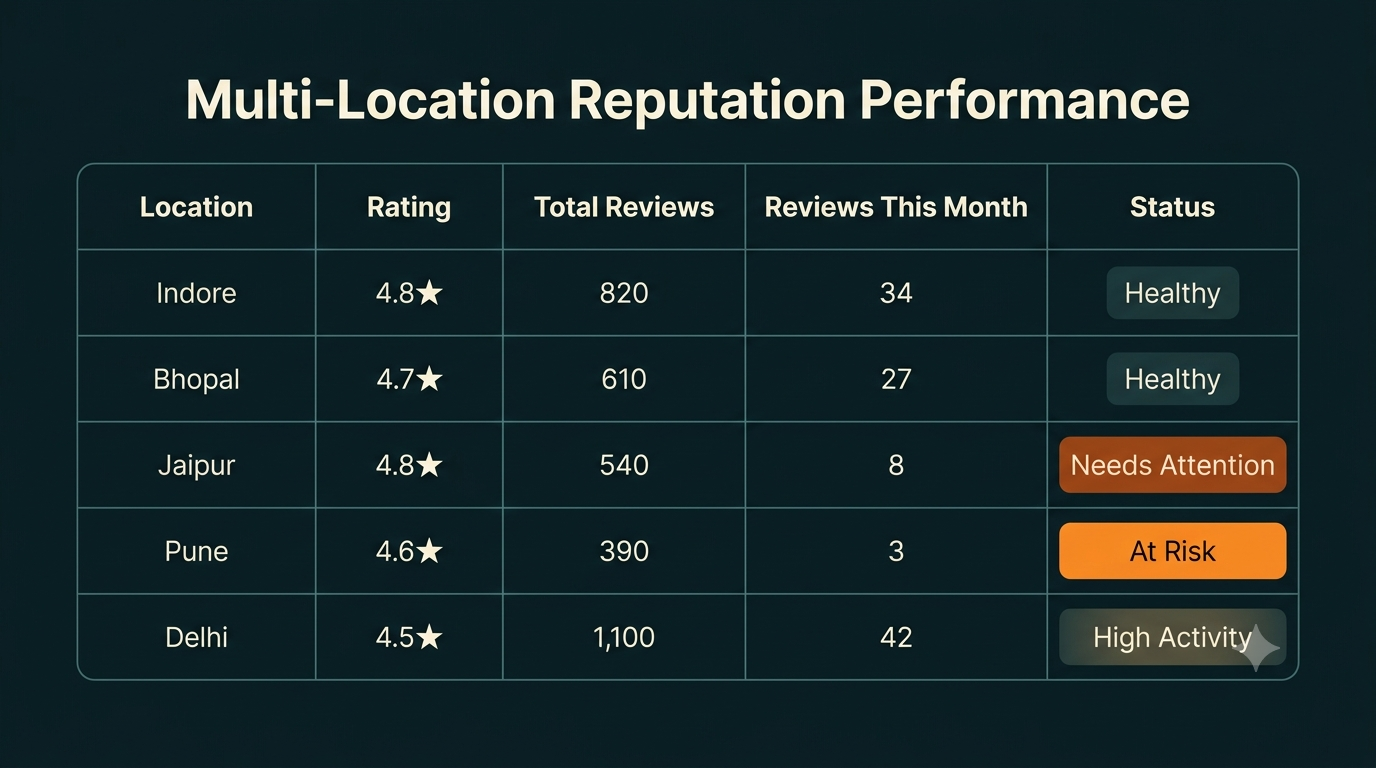
Notice something interesting.
Delhi has a lower rating than Indore, but significantly higher recent activity.
Pune has fewer reviews overall and almost no recent review generation.
If you only monitor total review count, you miss this difference.
If you monitor reputation velocity, you can identify which locations need attention.
5. From Review Collection to Reputation Operations
Traditional review management usually looks like this:
Transaction → Employee remembers → Employee asks → Customer searches Google → Customer reviews
There are too many opportunities for the process to break.
The customer gets busy.
The employee forgets.
The manager doesn't follow up.
The customer doesn't know where to leave the review.
The result?
A perfectly satisfied customer leaves without providing any feedback.
Automation changes the process.
Instead:
Transaction → Automated Trigger → Customer Message → Feedback → Smart Routing → Google Review / Internal Resolution
The review request becomes part of the customer journey rather than an employee responsibility.
[IMAGE 4 — Manual vs. Automated workflow goes here]
6. How StarOwl Turns Transactions Into Reputation Opportunities
This is where StarOwl becomes the operational layer between customer transactions and online reputation.
The workflow can be structured around four stages.
Step 1: Customer Transaction
A customer completes a purchase, appointment, consultation, delivery, or service.
This event becomes the trigger for reputation collection.
Step 2: Automated Feedback Request
Instead of relying on staff to remember the request, the customer receives a personalized message through a supported communication channel.
The timing can be configured around the customer journey so the request reaches them when feedback is most relevant.
Step 3: Feedback Routing
The customer's feedback can be captured before asking them to publicly share their experience.
For example:
Positive experience → Google Review
Issue or dissatisfaction → Internal feedback / support workflow
This gives the business an opportunity to understand unhappy customers and resolve genuine issues.
The goal should not be to manipulate or selectively gate reviews. The goal is to collect authentic feedback and make the feedback process easier for customers.
Step 4: Reputation Response
Once reviews arrive, businesses can monitor and respond consistently.
AI can assist with drafting responses based on:
Customer sentiment
Review content
Location
Service type
Brand tone
The result is a reputation workflow that doesn't stop when the review is submitted.
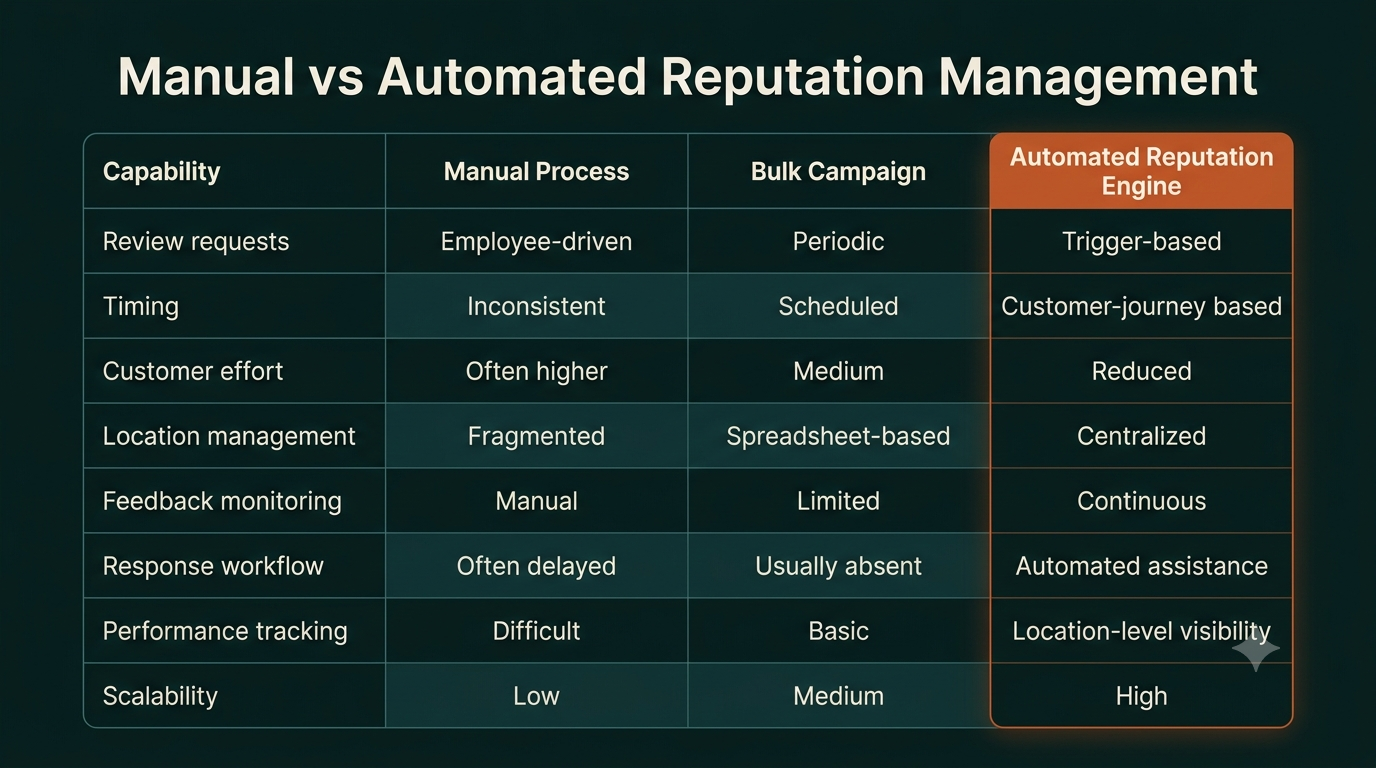
7. The Difference Between Manual and Automated Reputation Management
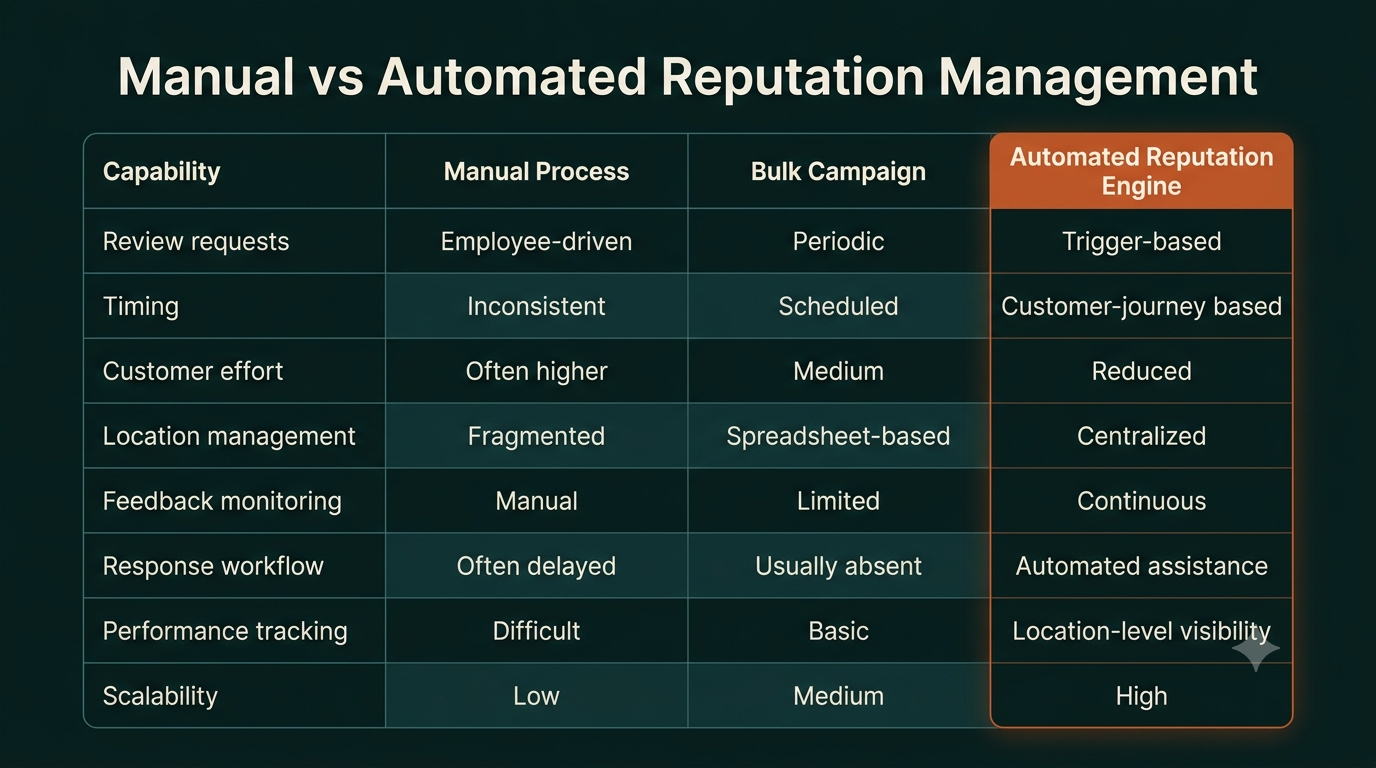
8. Building a Reputation Velocity Dashboard
Once reputation becomes an operational process, businesses can start measuring it.
A useful dashboard should track more than the average Google rating.
Core metrics can include:
Review Velocity
How many new reviews are being generated per location over a defined period?
Review Recency
How recently did each location receive customer feedback?
Rating Distribution
Are reviews concentrated around high ratings, or is a location seeing an increase in lower ratings?
Response Rate
How many reviews have received a response?
Response Time
How quickly does the business respond?
Location Comparison
Which branches are outperforming or underperforming?
Feedback-to-Review Conversion
How many customer feedback interactions ultimately result in public reviews?
These metrics transform reputation from a vague marketing activity into something the operations team can actually manage.
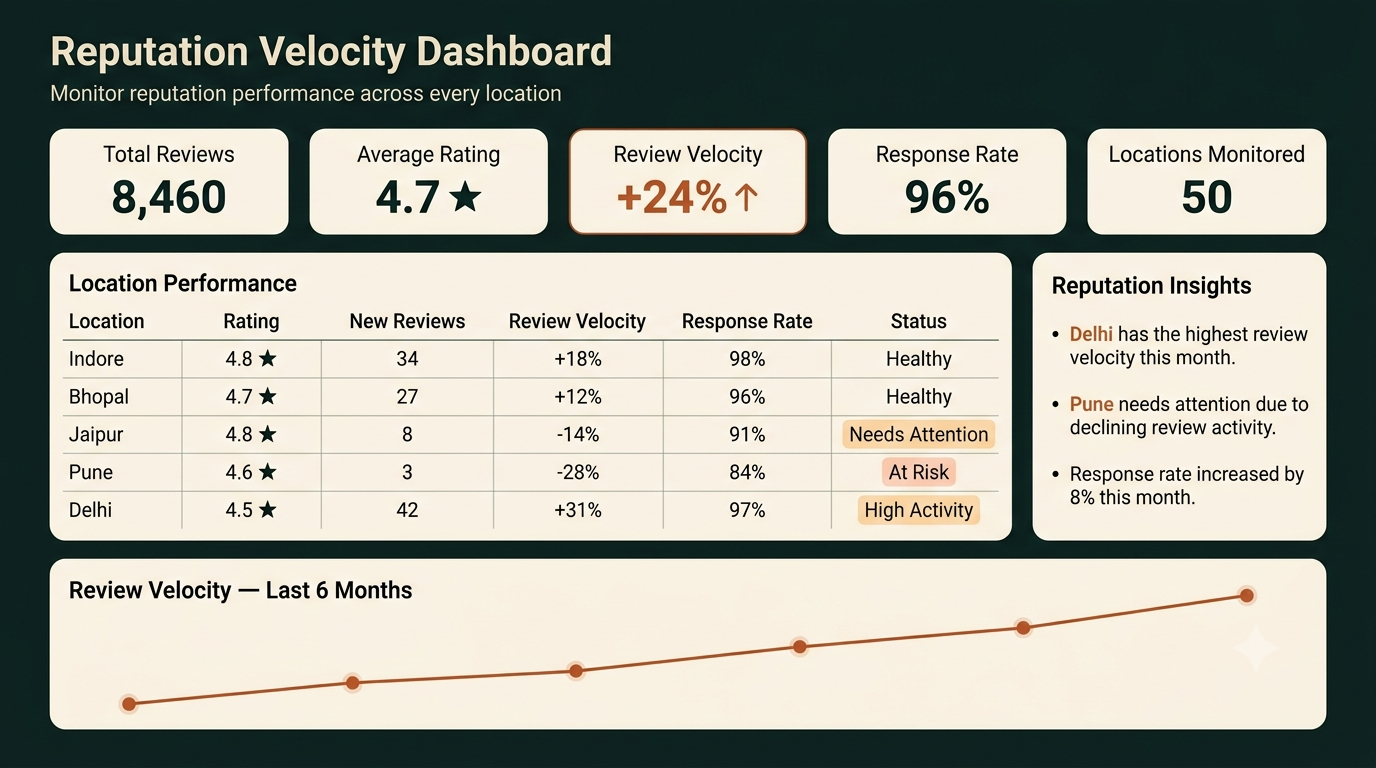
9. Reputation Velocity and the Local SEO Flywheel
The bigger opportunity appears when reputation management is connected with the rest of the local SEO strategy.
Think of the system as a flywheel:
More Transactions
↓
More Feedback Opportunities
↓
More Authentic Customer Reviews
↓
Stronger Social Proof
↓
More Customer Trust
↓
Better Click & Conversion Potential
↓
More Customers
↓
More Transactions
↓
More Feedback Opportunities
The goal isn't to manufacture reviews.
The goal is to make sure genuine customer experiences don't disappear simply because nobody asked.
[IMAGE 3 — Reputation Velocity Flywheel goes here]
10. What Multi-Location Brands Should Do Differently
If you manage 10, 50, or 500 locations, stop asking:
"How many reviews do we have?"
Start asking:
"How consistently is every location generating and managing customer feedback?"
A strong reputation strategy should include:
1. Automate the Trigger
Connect review requests to actual customer events instead of relying on staff memory.
2. Make the Process Frictionless
Give customers a clear, direct path to provide feedback.
3. Monitor Every Location
A company-wide average can hide underperforming branches.
4. Track Recency
A location that hasn't received a review in months deserves attention even if its historical review count is high.
5. Respond Consistently
Every review is another customer touchpoint. Use AI to assist teams in maintaining timely, relevant responses.
6. Close the Feedback Loop
Don't treat negative feedback as merely a rating problem. Use it as operational intelligence.
7. Connect Reputation With Local SEO
Review management should work alongside optimized Google Business Profiles, location pages, local content, citations, and other local-search activities.
The New Reputation Metric: Momentum
The future of reputation management isn't simply about accumulating reviews.
It's about maintaining momentum.
A business with 1,000 historical reviews but little recent customer feedback shouldn't automatically be considered healthier than a business consistently generating genuine feedback every week.
For multi-location brands, this becomes even more important.
Because local search isn't just about having one strong reputation.
It's about maintaining hundreds of individual local reputations simultaneously.
That's difficult to do manually.
But when reputation collection, feedback management, monitoring, and response workflows are connected to the customer journey, reputation becomes scalable.
[IMAGE 7 — Final StarOwl CTA visual goes here]
Turn Every Customer Interaction Into a Reputation Opportunity
Your customers are already generating the experiences that can strengthen your brand's reputation.
The question is:
Are you capturing those experiences consistently?
With StarOwl, businesses can build an automated reputation workflow that helps collect customer feedback, simplify review generation, monitor locations, and manage responses at scale.
Because the competitive advantage isn't just having more reviews.
It's building a reputation engine that keeps moving.
Build Your Reputation Velocity Strategy With StarOwl
Explore how StarOwl can help your business automate review collection and reputation management across multiple locations.
Start your StarOwl journey or book a multi-location strategy demo today.