
WhatsApp Broadcast for Indian Businesses: The Complete Playbook - Segmentation, Templates & Timing
WhatsApp Broadcast for Indian Businesses: The Complete Playbook
WhatsApp broadcasts have a 90%+ open rate in India significantly higher than email, SMS, or any social media channel. Yet most Indian SMBs who try broadcast campaigns get disappointing results and conclude that 'WhatsApp marketing doesn't work for our business.'
The channel works. The execution usually doesn't. This guide covers the five elements of a WhatsApp broadcast campaign that actually converts.
Element 1: Segment Before You Send
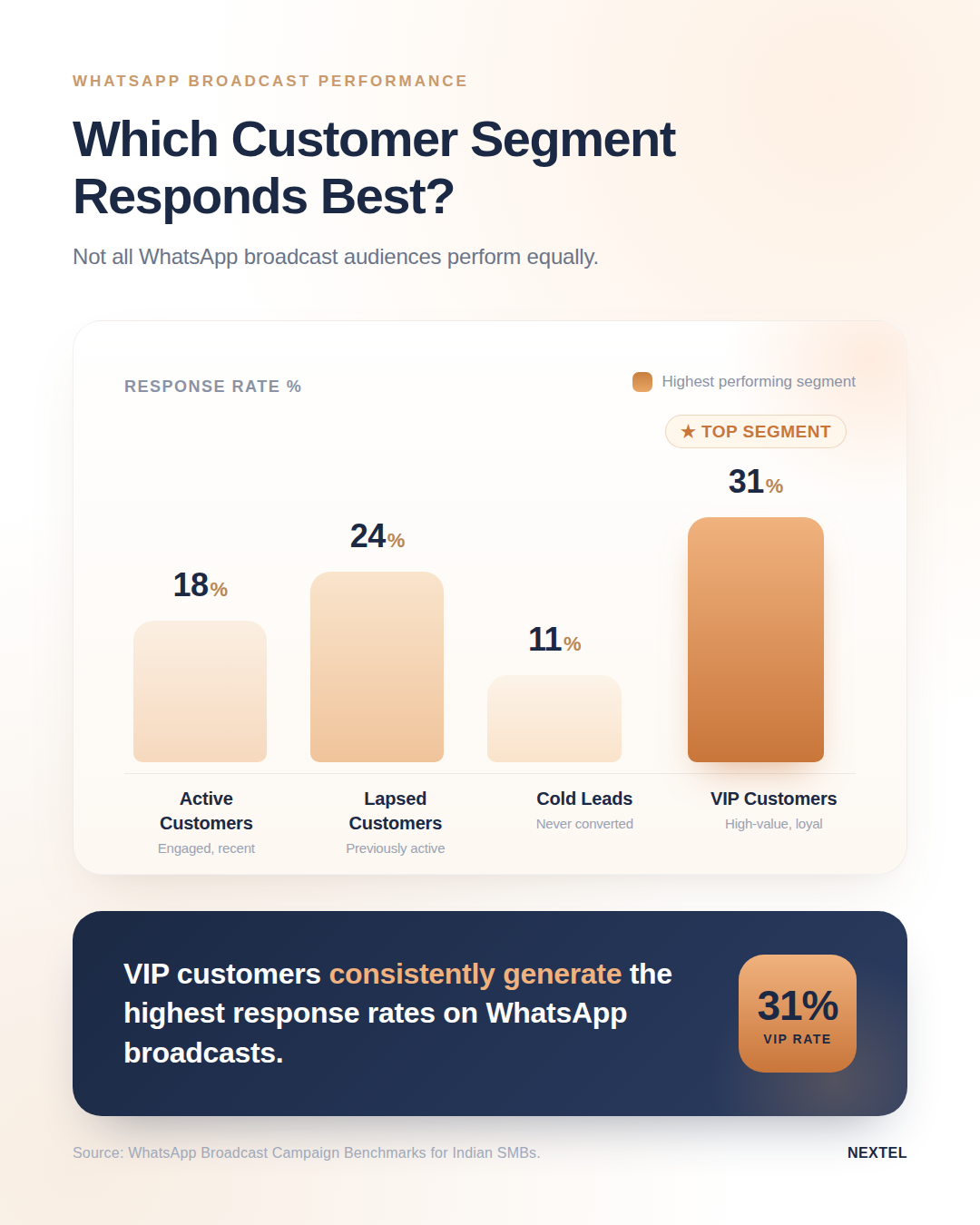
The single most common broadcast mistake is sending the same message to everyone in your list. This guarantees that most recipients find the message irrelevant which means low engagement, low conversion, and gradual erosion of your list's responsiveness.
Every customer list has natural segments:
Active customers (last 60 days)
These people have a recent positive experience with your business. They need minimal convincing. Send them: loyalty acknowledgements, new service announcements, referral incentive offers.
Lapsed customers (60–180 days)
They came once, had a good enough experience to not have explicitly left, and have simply drifted. The highest-ROI re-engagement segment. Send them: 'it's been a while' messages with a soft incentive, seasonal relevance hooks, new reviews since their last visit.
Cold leads (inquired, never converted)
They showed intent at some point. Something stopped them. Send them: social proof updates (new reviews, case studies), updated offer with different framing, a direct 'are you still looking?' check-in.
VIP customers (top 20% by spend or frequency)
Your most valuable segment. Often the most neglected. Send them: first access to new services, exclusive offers, a personal message from the owner. The return rate on VIP re-engagement is consistently the highest of any segment.
Element 2: Message Structure That Converts
WhatsApp messages are read in seconds. Attention is not given, it has to be captured immediately. The structure that consistently performs:
1. Opening: name + relevant context. 'Hi Priya, it's been 6 weeks since your last visit at [Salon Name].'
2. The offer or update: one specific, tangible thing. Not 'check out our new services' but 'We've added keratin treatment, ₹2,499 including the consultation.'
3. Why it's relevant to them: one line connecting the offer to their history. 'You'd mentioned wanting to try something different for your hair.'
4. One clear action: link, reply, or call. Not all three. One.
What consistently kills broadcast performance:
✘ Messages longer than 5-6 lines - most recipients stop reading
✘ Multiple asks in one message - creates decision paralysis
✘ Generic openings - 'Dear Customer' signals mass messaging immediately
✘ No clear action - recipient reads, thinks 'interesting,' and moves on
Element 3: Timing - The Most Underestimated Variable
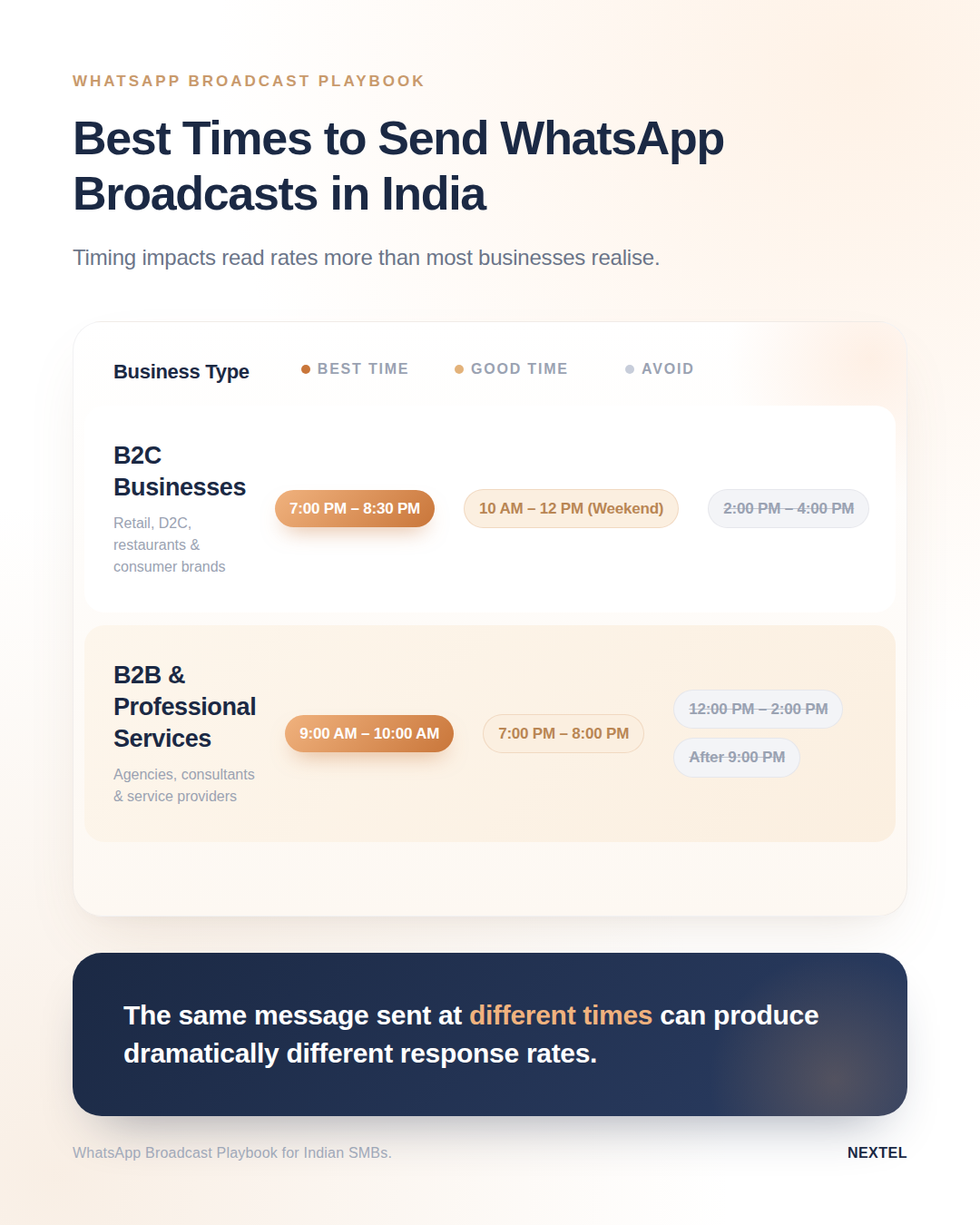
The same message sent at different times can have dramatically different read and response rates. For Indian businesses:
B2C businesses (salons, restaurants, retail, spas):
• Best: 7:00–8:30pm weekdays. Commute home or post-dinner scroll time.
• Good: 10:00am–12:00pm weekends. Relaxed morning browsing time.
• Avoid: 2:00–4:00pm any day. Post-lunch lull, lowest open rates.
B2B and professional services (coaching, real estate, clinics):
• Best: 9:00–10:00am weekdays. First active hour, people are in decision-making mode.
• Good: 7:00–8:00pm weekdays for follow-ups.
• Avoid: lunch hour (12-2pm) and after 9pm.
A note on frequency: more than 3-4 broadcasts per month to the same segment risks fatigue. The quality and relevance of each message matters more than volume.
Element 4: The Follow-Up Sequence
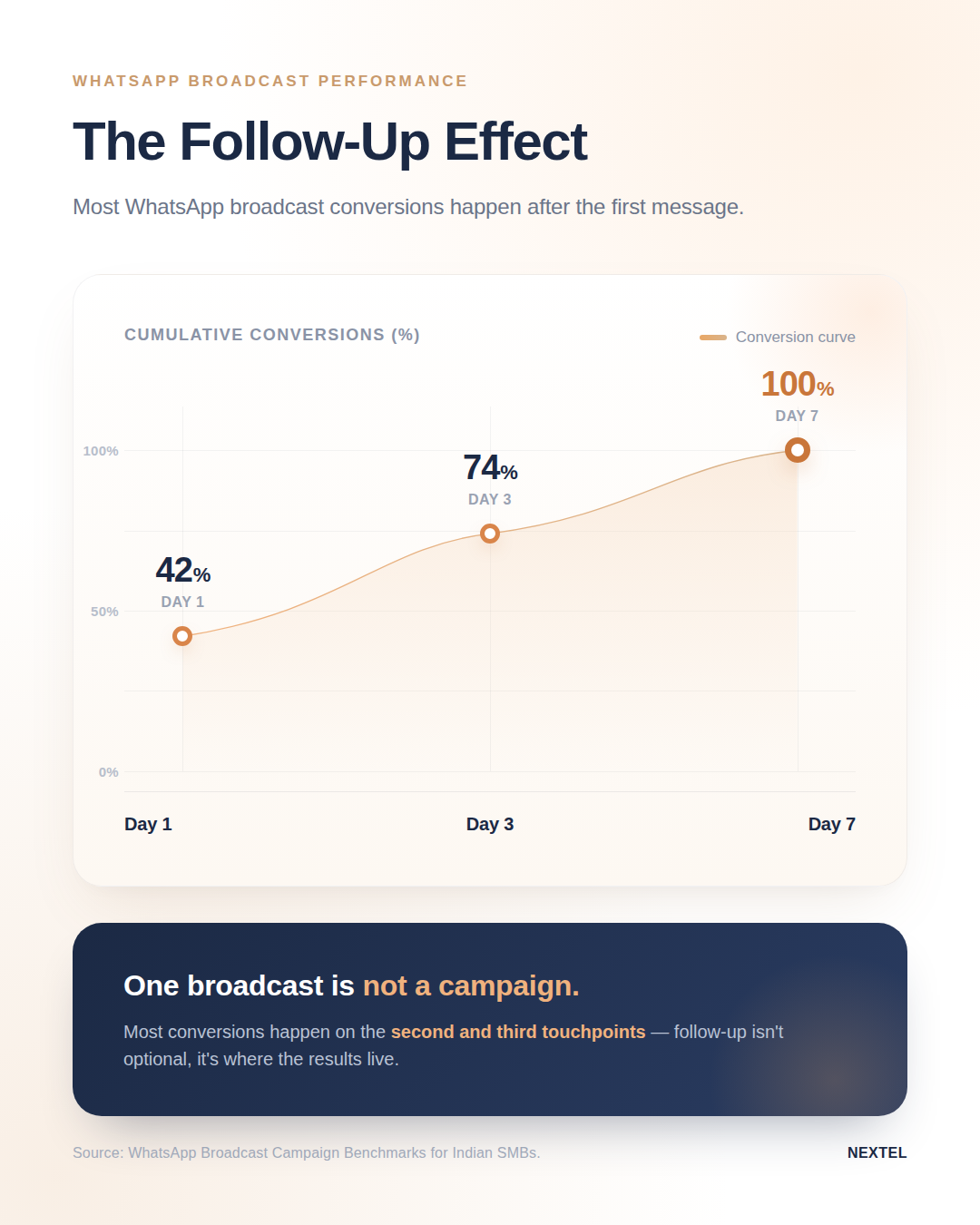
A single broadcast is the start of a campaign, not the campaign itself. Most conversions happen on the second or third touchpoint.
A simple sequence that works:
Day 1: The primary broadcast - offer, update, or re-engagement message
• Day 3 (to non-responders): A follow-up with a different angle. Same offer, different framing. 'Wanted to make sure you saw this' or an added detail about the offer.
• Day 7 (to still non-responders): A close message. 'The offer expires tomorrow' or 'Last few slots available this week.' Creates genuine urgency if it's true.
The rule: change the framing, not the offer. Sending the same message three times is spam. Sending three perspectives on the same offer is a campaign.
Element 5: The Four Metrics That Tell You Everything
Delivery rate
Should be 95%+. Significantly below this indicates stale numbers or numbers that haven't opted into receiving WhatsApp from your business. Clean the list.
Read rate
85-92% is normal for WhatsApp business messages. Below 70% suggests a timing issue or a sender name/number problem (customers not recognising who the message is from).
Click or reply rate
15%+ is a good benchmark. Above 30% indicates strong message-audience fit. Below 10% points to a relevance problem - the message isn't connecting with the segment.
Conversion rate
Clicks or replies that became actual sales or bookings. Track this separately. A high click rate with low conversion usually means the landing page or follow-up process is the bottleneck, not the broadcast.
Nextel's broadcast feature includes list segmentation, Meta-approved message templates, scheduled sending, and delivery analytics. All available on the Growth plan and above.
Start free at nextel.io